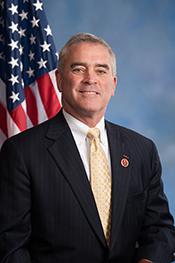
Congressional Voices — 1 of 1 Former Legislators
Fmr. Rep. Brad Wenstrup, DO (R-OH, retired)
Podiatric Surgeon · U.S. House of Representatives 2013–2025 · Now: Executive Director, Americans for Health Excellence (AFHE)
Important Context — Not a Sitting Member of Congress
Brad Wenstrup served 12 years as a Republican congressman from Ohio (OH-2) before retiring in January 2025. He is no longer in office. He now leads Americans for Health Excellence (AFHE), a nonpartisan advocacy coalition he launched in April 2026. He is documented here not as a sitting legislator but as a former Republican physician-congressman who left office and immediately became a named public advocate for the same accountability arguments his former colleagues are making from the floor. That transition — from elected Republican to post-office reformer — is itself significant.
Why He's on This Page
Wenstrup spent 12 years in Congress, 36 years practicing podiatric medicine, and a career in the Army Reserve including a deployment to Iraq — and he has been asking the malpractice accountability question for insurers the entire time. Retiring from office didn't end that argument. It freed him to make it louder, without electoral constraints, through a named coalition with bipartisan welcome from both sides of the aisle.
The fact that a former Republican congressman retired and immediately launched a healthcare accountability organization — and was welcomed by Democrats — is exactly the kind of cross-spectrum convergence this section documents. The diagnosis has escaped the party. It's now in the post-legislative record too.
On This Page
Section I · Primary Source · The Hill · June 1, 2026
"When Insurers Deny Care, Patients Pay the Price"
Published four months after retiring from Congress, Wenstrup's Hill op-ed does something rare: it combines 36 years of clinical experience, 12 years of legislative perspective, and a direct citation of Mark Cuban's accountability question — and arrives at the same conclusion as Dr. Slaughter, Rep. Dunn, and Rep. Murphy, from yet another independent direction.
The Opening — 30 Years
"Mark Cuban recently asked why health insurers aren't liable for malpractice when their denials harm patients. As a physician, I have been asking that question for more than 30 years. The answer is the same now as it was then: No one is holding them accountable. It is time to change that."
— Dr. Brad Wenstrup, The Hill, June 1, 2026
The Clinical Picture
"Every physician knows the frustration. You examine a patient, review the medical history, apply your training to make a clinical judgement, agree on a treatment plan, and then a denial arrives — not from a treating physician or anyone who has seen the patient, but from an administrator following a checklist, who has no accountability for getting it wrong."
— Dr. Brad Wenstrup, The Hill, June 1, 2026
The Data
In the ACA marketplace, insurers denied 19% of in-network claims in 2024 — the highest rate since the exchanges began.
In Medicare Advantage, more than four million prior authorizationPrior AuthorizationA health-insurance process that requires your doctor to get advance approval from your plan before it will cover a specific service, procedure, or drug. requests were denied in 2024 — and more than 80% of appealed denials were overturned. If the denials were medically justified, why were so many reversed?
AMA 2024: physicians and staff spend an average of 13 hours each week on prior authorization paperwork alone. Forty percent of practices now employ staff whose only job is managing it.
The Closing Argument
"Insurers exploit the fact that most patients will never appeal. Doctors do appeal, however, because they know their patients by name."
— Dr. Brad Wenstrup, The Hill, June 1, 2026
Section II · The Accountability Argument in Two Sentences
One Sentence That Changed the Outcome
This is the most important passage in the op-ed. It is not a policy argument. It is a documented clinical outcome — and it is the Clinical Integrity Amendment argument made in two sentences, from a physician who lived it:
The Anecdote
"The insurance company physicians who denied care for my patients were often from unrelated specialties, and they always refused my requests for them to examine the patients themselves. Yet when they were pressed to accept medical responsibility for their decisions, the denials were frequently reversed."
"I once told an insurer that I hoped the call was being monitored for quality assurance. The next day, his company approved the care plan I had prescribed. Nothing had changed medically. The only thing that changed was that someone felt accountable."
— Dr. Brad Wenstrup, The Hill, June 1, 2026
What He Documented
Specialty-mismatched reviewers. Refusal to examine patients. Denials reversed the moment accountability was introduced. This is the exact mechanism Dr. Potter recorded, Dr. Masterson mapped to fraud law, and Clinical Integrity Amendment § 2 and § 5 are written to close.
What It Proves
The denial was not a medical determination. It was a financial default that collapsed the moment a named individual felt personally exposed. That is not a coverage decision. That is the business model Dr. Masterson describes — and the Clinical Integrity Amendment is designed to make that exposure permanent, not incidental.
The Independent Convergence
Wenstrup arrived at this from 36 years of private practice and 12 years in Congress. Dr. Slaughter arrived at it from a phone camera. Rep. Dunn arrived at it from a House hearing. None of them coordinated. All of them described the same mechanism: no accountability, no consequence, reversal the moment accountability appears. That convergence is not anecdote. It is a pattern with a structural cause — and a structural legislative answer.
Section III · The Coalition · Launched April 2026
Americans for Health Excellence — The Post-Congressional Move
Wenstrup retired from Congress in January 2025 and launched Americans for Health Excellence (AFHE) in April 2026 — fifteen months after leaving office. The coalition is nonpartisan and has already received bipartisan public welcome, including from Rep. Greg Landsman (D-OH): "We're facing a health care crisis in the United States, and it's an all-hands-on-deck situation. I love that Brad Wenstrup is jumping in and leading on this."
What AFHE Is Pushing For
Transparency
83% of voters want claim denial rates made public. 84% want insurers to disclose how much of premiums goes to care vs. overhead and profit.
Accountability
The same standard that applies to physicians who make medical decisions should apply to insurers who override them. That argument has gone unanswered for 30 years.
Affordability
Health insurance costs are voters' top healthcare concern — ahead of drug prices and hospital bills. 91% support requiring insurers to pass discounts directly to patients.
Why Post-Congressional Is Different
Sitting members of Congress are constrained by committee assignments, party positioning, re-election calculations, and floor rules. Wenstrup has none of those constraints now. He can name the mechanism, name the legislation, name the problem, and campaign for it publicly — without managing a whip count or a donor call. His Republican credentialing remains. His electoral accountability is gone. What's left is the argument, undiluted.
Section IV · Convergence
The Cuban Connection — Arriving from a Different Direction
Wenstrup opens his Hill op-ed by citing Mark Cuban's question about insurer malpractice liability — and that citation is worth examining carefully. Cuban is not a physician and not a legislator. He is a market actorMarket ActorAny entity operating within a healthcare market context — insurer, employer, provider, or intermediary. who arrived at the accountability argument from a business and consumer angle, and whose cost-plus pharmacy model was already cited by Rep. Murphy on the House floor as the market-correction alternative to vertical integrationVertical IntegrationA corporate structure in which a single entity owns multiple layers of the healthcare delivery chain — insurer, pharmacy benefit manager, pharmacy, and physician group — creating s….
Former Congressman · Physician
"As a physician, I have been asking that question for more than 30 years."
— Dr. Brad Wenstrup, 36-year surgeon, 12-year Republican congressman
Social Media · Physician
"Now that insurance companies are making medical decisions for patients without a license — should they be held accountable?"
— Dr. J Mack Slaughter Jr · 22.5K likes
Market Actor · Entrepreneur
Cuban publicly asked why health insurers aren't liable for malpractice when their denials harm patients — and his cost-plus pharmacy model is already cited by Rep. Murphy as the market-correction alternative.
— Mark Cuban · cited in Wenstrup's Hill op-ed, June 2026
A former Republican congressman, a social media physician, and a market entrepreneur all arrived at the same accountability question from entirely different starting points, with no coordination, in the same news cycle. That is no longer a fringe argument. It is a documented pattern with sources across every sector of American public life.
Why This Page Doesn't Yet Have a Mark Cuban Section
Cuban is documented throughout this site — cited by Rep. Murphy on the House floor, cited by Wenstrup in The Hill, referenced in the DocSchmidt / S.3822 context. He does not fit the physician voices framework and does not fit the sitting-legislator congressional voices framework. He is something else: a market actor who arrived at the accountability argument from a business angle and whose cost-plus pharmacy model is already functioning as proof of concept. When his voice gets its own dedicated treatment on this site, it will be in a different section — not here. For now, the convergence is documented. The full treatment is coming.
Other Members in This Series