The Remedy Room — S.3829+ · The AbilityForge Framework
The AbilityForge Framework
Original legislative architecture drafted by Michael Kissling. These are not bills someone else wrote that AbilityForge is tracking — these are proposals, frameworks, and evidentiary records authored here, designed to close the gaps the existing legislation leaves open.
Framework Sections
- The Clinical Integrity & Patient Safety Amendment
- ↳ The Equal or Better Mandate — Legal Promise vs. Documented Reality
- ↳ Denial Defensibility Score — 2023 vs. 2024 Carrier Comparison
- ↳ Reviewer Roulette — Play § 2 Yourself (Interactive)
- The Authority Already Exists — Here Is How Often It Is Used
- § 6 Buffer Fund Economic Simulator — Interactive Model
- ↳ § 7 The Patient Restitution Trust — The Path to Justice
- Denial on Trial — A Framework for Medical Due Process
- ↳ The Courtroom — Who Actually Sits Where (Interactive)
- ↳ Obstruction of Medical Care — A Separate Offense
- ↳ The Record Rule — The Peer-to-Peer Goes On the Record
- The PSI Briefing — Documented Evidence of Prior Knowledge Omission
The Clinical Integrity & Patient Safety Amendment
Proposed Addition to S.3829 — Drafted by Michael Kissling, AbilityForge.net
⚡ The Critical Bolt
The entire Wrongful Denial Echo Chamber operates because the physician who signs the denial letter faces no personal professional consequence. A corporate reviewer can exclude objective clinical data on procedural pretexts, issue a denial the IRE will overturn in seconds, and walk away with their license intact. The Clinical Integrity Amendment closes this gap by making every IRE overturn a self-executing referral to the State Medical Board. This is not additional bureaucracy — it is the equivalent of bar discipline for an attorney who hides exculpatory evidence. The mechanism only works when the person pulling the trigger can lose their license for doing so.
🔑 The Keystone — Lifting the ERISA Shield
Every mechanism below sits downstream of one federal wall: ERISA preemption. When your health plan comes through an employer, ERISA §514 erases the state-law claims you would otherwise have, and §502(a) caps your entire remedy at the value of the denied benefit itself — nothing for the harm the denial caused. Pilot Life v. Dedeaux (1987) and Aetna v. Davila (2004) foreclosed state bad-faith and negligence suits. The “deemer clause” exempts self-insured plans from state insurance law entirely — so a standard like Pennsylvania Act 146 cannot even reach the largest plans.
Translated: a patient wrongfully denied and permanently harmed can, at most, belatedly recover the cost of the procedure they were owed. Never the amputation. Never the cascade. Never the years lost. And no state official can help — not because they won’t, but because federal law forbids it.
The proof — an escalation ladder, in the states’ own hands
1 · The individual — the state can’t help one patient
The Pennsylvania Office of Attorney General told me, in writing: “We cannot pursue your complaint, because it does not fall within our authority or the scope of our voluntary mediation process.” Its only power is to ask the insurer — and once UnitedHealthcare said no, its advice was to hire my own lawyer.
Mar 2025 — Intake → Apr 2025 — “Consult an attorney” → Jul 2025 — “Outside our authority” →
2 · The state legislature — even PA’s boldest bill hits the wall
Pennsylvania HB2611 would criminalize a wrongful denial as aggravated assault of an insured. But by its own text it reaches only PA-licensed insurers — not the self-insured ERISA plans that administer most large-employer denials. The strongest state bill on the board still cannot clear the federal shield.
3 · The states, together — 39 AGs ask Congress to act
In April 2025, 39 State Attorneys General jointly petitioned Congress for federal legislation on healthcare-corporate consolidation — the states’ own top law-enforcement officers, at scale, telling Washington that state power is not enough. Their letter targeted PBMs; the structural admission is identical: this has to be fixed federally.
This is not AbilityForge’s opinion that the fix must be federal. It is the documented, converging verdict of the states themselves — from one patient’s case file to a 39-state coalition. Only Congress can lift what Congress imposed.
Only federal law can lift what federal law imposed. That is why this framework attaches to a federal vehicle (S.3829) rather than a state bill — and why its keystone is an express ERISA carve-out: a patient’s private right of action for harm caused by an improperly-conducted review, and enforceability of state standards like Act 146’s same-specialty rule against the plan. No prison. No prosecutor. A courtroom door — reopened.
The legal mandate — 42 CFR § 422.100
Medicare Advantage plans must provide coverage equal to or better than Traditional Medicare.
In exchange for this obligation, MA plans receive capitated federal payments averaging ~$1,000/month per enrollee — billions in taxpayer-funded premiums paid on the assumption that this legal standard is being met.
Traditional Medicare — the baseline
Denial defensibility
71.3%
of denials upheld by independent review · FY2022
Appeals overturned
28.7%
of appealed denials reversed · FY2022
DMEPOS / prosthetics
63.9%
overturned in prosthetic/equipment category · FY2022
Medicare Advantage — the reality
Denial defensibility
18.3%
of denials upheld by independent review · KFFKFFKFF (formerly the Kaiser Family Foundation) is an independent, nonpartisan source of health-policy research, polling, and journalism. 2023
Appeals overturned
81.7%
of appealed denials reversed · KFF 2023
PA volume
49.8M
prior auth requests · 2023 · averaging 4+ per enrollee/yr
The compliance gap — required vs. documented
Required floor
≥ 71.3%
defensibility
↔
Documented
18.3%
industry avg · 2023
Medicare Advantage defensibility falls 53 points below the Traditional Medicare baseline the law requires it to meet or exceed. This is not a data anomaly — it is a documented, multi-year, multi-carrier pattern of systematic non-compliance.
If 81.7% of MA prior authorizationPrior AuthorizationA health-insurance process that requires your doctor to get advance approval from your plan before it will cover a specific service, procedure, or drug. denials are overturned by a neutral physician — and the legal standard requires coverage equal to or better than Traditional Medicare, where only 28.7% are overturned — then the majority of Medicare Advantage denials are not coverage disputes. They are compliance failures.
Sources: 42 CFR § 422.100 · KFF Medicare Advantage prior authorization analysis 2023 · CMS Prior Authorization and Pre-Claim Review Program Stats FY2022 · DMEPOS = Durable Medical Equipment, Prosthetics, Orthotics, and Supplies
Full IRE overturn data → Room I
The KFF dataset, carrier-by-carrier overturn rates, and the 8-in-10 documentation are in The Problem Room.
Systemic Denial Practices →§ 1 — Prohibition of Prior Knowledge Omission
K-Level — Medicare functional classification (K0–K4) for prosthetic eligibility. Reference →
When a Medicare Advantage organization or ERISA plan has previously approved a specific functional classification, medical baseline, or K-LevelK-LevelMedicare's prosthetic functional classification (K0–K4) that determines device eligibility under LCD L33787., that classification becomes an Established Medical Fact for a minimum of 12 months.
In plain English: If UHC acknowledges a patient's K3 functional mobility status in March, it may not deny a permanent prosthetic in September by claiming the same mobility threshold is unmet — unless it produces new clinical evidence of decline. A denial issued against a prior-established medical fact without documentation of regression is void ab initio and triggers Buffer Fund penalties.
This provision directly addresses the documented Kissling v. UnitedHealthcareUnited HealthcareThe largest health insurer in the United States by revenue. UnitedHealth Group operates two primary business segments: UnitedHealthcare (health insurance) and Optum (pharmacy care… case: UHC approved K3 status in March 2023, then denied the permanent prosthetic in September 2023 while possessing that prior knowledge — a textbook Prior Knowledge OmissionPrior Knowledge OmissionA denial issued without referencing documented clinical evidence already present in the patient's medical record that establishes medical necessity..
§ 2 — The Clinical Integrity Rule (The "Act 146 Standard")
Any adverse benefit determination based on medical necessity must be reviewed by a physician holding current, valid Board Certification in the same or directly relevant specialty as the treating physician. The reviewing physician must certify under penalty of perjury that they have reviewed all objective clinical data submitted — including PT/OT evaluations, imaging, and standardized assessment scores.
- A pediatrician may not review an adult bariatric claim.
- A general practitioner may not review a specialized prosthetic claim.
- A non-vascular physician may not review a vascular surgical necessity determination.
- An ocular plastic surgeon may not review a lymphedema surgery for a breast cancer patient.
That last example is not hypothetical. See Dr. Elisabeth Potter's documented peer-to-peer call in the Independent Voices section below.
§ 2(c) — The Record Rule
Every peer-to-peer review goes on the record: the reviewer states their name, license, and board certification at the outset, and the full transcript reaches the patient and treating physician within 5 business days. An unrecorded or unproduced peer-to-peer creates a presumption in favor of the treating physician — no record, no denial. The recorded peer-to-peer is bodycam footage for medicine; Dr. Potter had to document her call herself. Under § 2(c), the system documents it for every patient, every time. Full breakdown in Denial on Trial →
Reviewer Roulette (play § 2 yourself)
Pick your claim. Spin for the physician who gets to overrule your doctor. Then flip on the Act 146 Standard and spin again.
The house picks who reviews you. You don't get a say. Neither does your doctor.
YOUR ASSIGNED REVIEWER
—
§ 3 — The Patient Safety Buffer Fund
Upon submission of a medical necessity override by the treating physician, coverage is provisionally granted through the Patient Safety Buffer Fund while the determination is under review. Patients shall not be denied care during the appeals process.
If the denial is upheld:
The treating provider repays the Buffer Fund in full.
If the denial is overturned:
The insurer reimburses the Buffer Fund at 300% of the claim rate. The insurer funds the safety net their denials require.
Under § 3(c), the Fund is not general revenue — it is held in trust, and patients are its named beneficiaries. See § 7, The Patient Restitution Trust →
§ 4 — The Administrative Cure Mandate
A plan may not issue a final denial for administrative reasons without first providing a 48-hour Cure Period to correct any clerical or procedural deficiency. If a plan classifies a denial as "administrative" to circumvent the Clinical Integrity review — when the record contained sufficient clinical data to warrant medical review — the plan faces a civil monetary penalty of $10,000 per violation.
This closes the loophole by which insurers reject claims on paperwork pretexts to avoid the specialty-matching and data-review requirements of § 2. In the 2023 KFF data, "Administrative reason" accounted for 18% of all ACA Marketplace denials — second only to the vague "Other" category.
Denial defensibility score
% of denials held up by independent review
Higher = the denial was medically defensible. Think of it as a test score — graded by a neutral examiner with no financial stake in the outcome.
Medicare
average
Group
The 2024 industry "improvement"
The industry average rose 1 point — carried almost entirely by UHC moving below the average. Centene and CVS/Aetna both got worse. The headline masks the divergence.
DMEPOS — prosthetics category
In Traditional Medicare, prosthetic denials are already among the hardest to defend — 63.9% overturned (FY2022). In Medicare Advantage, that number is substantially higher.
Sources: KFF Medicare Advantage prior authorization analysis 2023 & 2024 · CMS Prior Authorization and Pre-Claim Review Program Stats FY2022
Echo chamber context → Room I
The business model that depends on patients not appealing. The 0.2% appeal rate. The full carrier breakdown and the 8-in-10 documentation.
Systemic Denial Practices →§ 5 — Physician Accountability: The Malpractice Trigger
This is the critical section. The bolt that disassembles the chamber.
Any physician acting as a medical director or reviewer who issues a denial that is subsequently overturned by an IRE — due to a demonstrable failure to adhere to established clinical standards or failure to review submitted evidence — shall be deemed to have engaged in Unprofessional Conduct.
- Mandatory Board Reporting: The IRE shall be statutorily required, upon issuing an overturn, to report the name and license number of the reviewing physician to their respective State Medical Board for investigation into malpractice and negligence.
- Pierce the Corporate Veil: Reviewing physicians shall not be shielded from personal liability for patient harm caused by denials issued in contradiction to established medical consensus — regardless of their employment relationship with the plan.
"A prosecutor who hides exculpatory evidence faces disbarment. A corporate reviewer who ignores qualifying clinical data faces nothing — until now."
— Clinical Integrity & Patient Safety Amendment
The industry average IRE overturn rate is 81.7% (KFF 2023). UnitedHealthcare's rate was 85.2% in 2023, improving to 79.1% in 2024 under sustained public and legal pressure — credit where it is due. Neither number changes the structural argument. These are not medical disagreement rates. They are compliance failure rates — executed by physicians whose licenses have never been at risk. This single provision changes that calculus permanently, regardless of what direction the numbers move next.
§ 5 — the accountability gap
Same act. Two physicians. Two outcomes — until now.
The act: reviewing physician willfully omits qualifying clinical evidence — the IRE overturns the denial — a patient is harmed.
Treating physician
Misses or ignores clinical evidence. Patient harmed.
Consequence
- Malpractice liability
- State Medical Board review
- License suspension or revocation
- Wrongful deathDeaththe act of dying; the end of life; the total and permanent cessation of all the vital functions of an organism. suit
- Criminal exposure
Insurance reviewer — today
Omits qualifying evidence. IRE overturns. Patient harmed.
"Corporate decision."
No personal liability
ERISA shield engaged
License never at risk
No board referral
No exposure
AMA 2024 — documented outcomes
29% of PA cases — serious adverse event
18% — life-threatening or permanent impairment
8% — disabilityDisabilityPermanent or long-term functional impairment resulting from an untreated or inadequately treated medical condition., permanent damage, or death
Clinical Integrity Amendment — § 5
Same act. Same omission. Same outcome for the patient.
Consequence — same standard
- Mandatory board referral on IRE overturn
- License suspension or revocation
- Veil pierced — personal liability
- Malpractice exposure
- ERISA shield lifted — the patient can finally sue for the harm
UHC prior auth IRE overturn rate
2023 (KFF)
85.2%
2024
79.1%
UHC's 2024 rate reflects a genuine improvement — credit where it is due.
When UHC increased approvals under public pressure, shareholders sued them for it. There is no neutral equilibrium in a system without personal accountability.
Industry average overturn rate
2023 (KFF)
81.7%
Even at UHC's improved 2024 rate — nearly 8 in 10 appealed denials are still overturned.
§ 5 is not contingent on whether a carrier is having a good year. The structural accountability gap exists regardless of the number.
"A prosecutor who hides exculpatory evidence faces disbarment. A corporate reviewer who ignores qualifying clinical data faces nothing — until now."
— Clinical Integrity & Patient Safety Amendment, § 5 · AMA patient harm data: 2024 Prior Authorization Physician Survey (n=1,000)
§ 6 — Buffer Fund Sustainability and Long-Term Capitalization
The Patient Safety Buffer Fund is designed to be self-sustaining through the penalty revenue generated by wrongful denials. This creates an honest design paradox: the better the reform works, the less fraud feeds the fund. § 6 addresses this directly — not by hiding the problem, but by building a funding architecture that scales with success rather than depending on ongoing failure.
Phase 1 — Seed Capitalization (Year 0)
A one-time industry assessment of 0.1–0.2% of annual premium revenue across all participating carriers shall provide initial capitalization — estimated at $5–10 billion based on current denial volume and premium data. This is not a tax on patients. It is a one-time accountability deposit from the industry whose practices created the need for the Fund in the first place.
Phase 2 — Endowment Layer (Upon Reaching Critical Mass)
Once the Fund reaches its actuarially-modeled critical mass threshold — as determined by the Department of Recovery based on projected overturn volume and provisional coverage obligations — 20–30% of the Fund shall be carved into a low-risk investment portfolio (U.S. Treasuries and index instruments). The yield from this endowment becomes a perpetual baseline: at 4% annual return on a $2B corpus, the Fund generates approximately $80 million per year indefinitely — sufficient to cover residual provisional coverage when wrongful denials are rare. Success finances itself.
Phase 3 — Dynamic Multiplier Scaling (Triennial Adjustment)
The 300% reimbursement multiplier and 500% clawback penalty shall be subject to automatic triennial review by the Department of Recovery. Multipliers shall adjust downward as national wrongful denial rates fall:
The Department of Recovery's aggregated cross-case pattern data — already mandated by the legislative architecture — provides the exact dashboard needed to calculate and publish these adjustments transparently every three years. The scaling is not discretionary; it is automatic and public.
The Design Principle
Most enforcement funds assume the problem they are designed to solve will persist indefinitely. The Buffer Fund assumes the opposite — that the reform will work, and builds a funding architecture that proves it. When the multipliers scale down, it is not a sign of weakness. It is the actuarial signature of a system that no longer needs to punish its way to solvency. The burden of funding this safety net belongs entirely on the industry whose conduct made it necessary — not on the patients it was built to protect. The Department of Recovery publishes the data. Congress reads it. The public sees it. That transparency is the accountability mechanism that makes the whole architecture trustworthy.
§ 6 Buffer Fund Economic Simulator
Slide the denial rate to watch the Dynamic Multiplier Scaling engage in real time. This is the math behind § 6 — the architecture that funds itself.
Slide left to simulate the market correcting its behavior over time. The multipliers hold until a threshold is crossed — that is the design.
The market has already moved once. Medicare Advantage overturn rates ran 81.7% in 2023 (reported to CMS) and 67% in 2025 (self-posted by insurers under a new CMS transparency rule). That is the mechanism this model assumes — rules change behavior, and the penalties scale down as they do. It is also still more than three times the Phase 2 threshold, which is the distance this framework is built to close. How these two figures are sourced →
Default: the denied iliac vein stenting — $55,000.
Buffer Fund Reimbursement
$165,000
300% Multiplier
Clawback Penalty
$275,000
500% Multiplier
Total Insurer Liability
$440,000
Upon IRE overturn — capital flowing into the Fund
Multiplier thresholds per § 6 Dynamic Scaling schedule: >20% / 5–20% / <5%
§ 7 The Patient Restitution Trust — The Path to Justice
Under current law, a patient who wins their appeal receives only the care they were owed from the start. The wrongful denial itself — the delay, the harm, the months of unpaid advocacy — carries no remedy short of years of litigation. This section creates the remedy.
The Buffer Fund does not merely hold money — it is held in trust, and patients are its named beneficiaries. That single word does real legal work: a trustee owes fiduciary duties of loyalty, prudence, and full public accounting, and any beneficiary has standing to sue the trustee for maladministration. The Department of Recovery administers the fund — but it answers, by law, to the patients it exists for.
Automatic Restitution
Upon IRE overturn, the patient receives 100% of claim value within 30 days. No further action required — the independent third-party appeal has already served as the adjudication. The overturn is the verdict; the check follows automatically.
Out-of-Pocket Make-Whole
Documented losses the denial caused — cash-paid care, travel, interest and financing costs, credit harm — reimbursed in full by the Trust.
Disability, Dismemberment & Death Benefit
Where a wrongful denial constitutes a clear and unmistakable error of negligence leading to severe harm — disability, dismemberment, or death — a defined benefit of not less than $1,000,000 to the patient or their survivors, per a schedule published by the Department of Recovery.
Appeal Representation
Court-appointed counsel for healthcare: the Trust funds the patient's advocate in the Denial on Trial proceeding — defending the accused in a room where the insurer operates as both the judge and the prosecution, and its peer-to-peer review sits as the jury. No patient stands alone in that room, and the offender pays for the defense.
Non-waiver, and paid by the offender. Accepting Trust benefits waives nothing — every payment is cumulative with civil recovery, and ERISA shall not bar the beneficiary's claims. Every § 7 payment is assessed against the offending insurer separately from, and in addition to, the § 3 reimbursement and the S.3829 clawbacks. The path to justice is paid for by the party that made it necessary.
§ 8 — Obstruction of Medical Care: A Separate Offense
Corrupting the appeal proceeding — concealed reviewer conflicts, algorithmic denials without qualified clinical review, Prior Knowledge Omission, suppressed evidence, manipulated timelines, or a vanished peer-to-peer record — is charged independently of whether the underlying denial is ever reversed. The same logic by which obstruction of justice is prosecuted separately from the underlying crime: the integrity of the proceeding is a protected thing in its own right.
The appeals process has become a proceeding in which the insurer operates as both the judge and the prosecution against the patient. § 8 makes rigging that proceeding a crime of its own. Full argument in Denial on Trial →
Denial on Trial — A Framework for Medical Due Process
Proposed by Michael Kissling, AbilityForge.net | In support of S.3829 and the Clinical Integrity & Patient Safety Amendment
The Core Problem: A Rigged Proceeding
The current insurance appeals system asks patients to prove they deserve care — while the insurer who denied them controls the evidence, employs the reviewing physician, and faces no consequence if they are wrong. This is not a medical judgment system. It is a financial extraction system dressed in clinical language.
The Denial on Trial framework applies the logic of Gideon v. WainwrightGideon v. Wainwright1963 U.S. Supreme Court ruling establishing that the Sixth Amendment guarantees the right to appointed counsel for defendants who cannot afford an attorney. to healthcare: you cannot have a fair proceeding when one side has no counsel. The current IRE system asks a single body to be both judge and patient advocatePatient AdvocateA person who uses lived experience navigating the healthcare system to advocate for structural change. simultaneously — structurally identical to the injustice that created the public defender system.
The Courtroom — Who Actually Sits Where
Every denied patient walks into a room. Toggle between the room that exists today and the room the Amendment builds. Click anyone in the scene — and in today's room, try banging the gavel.
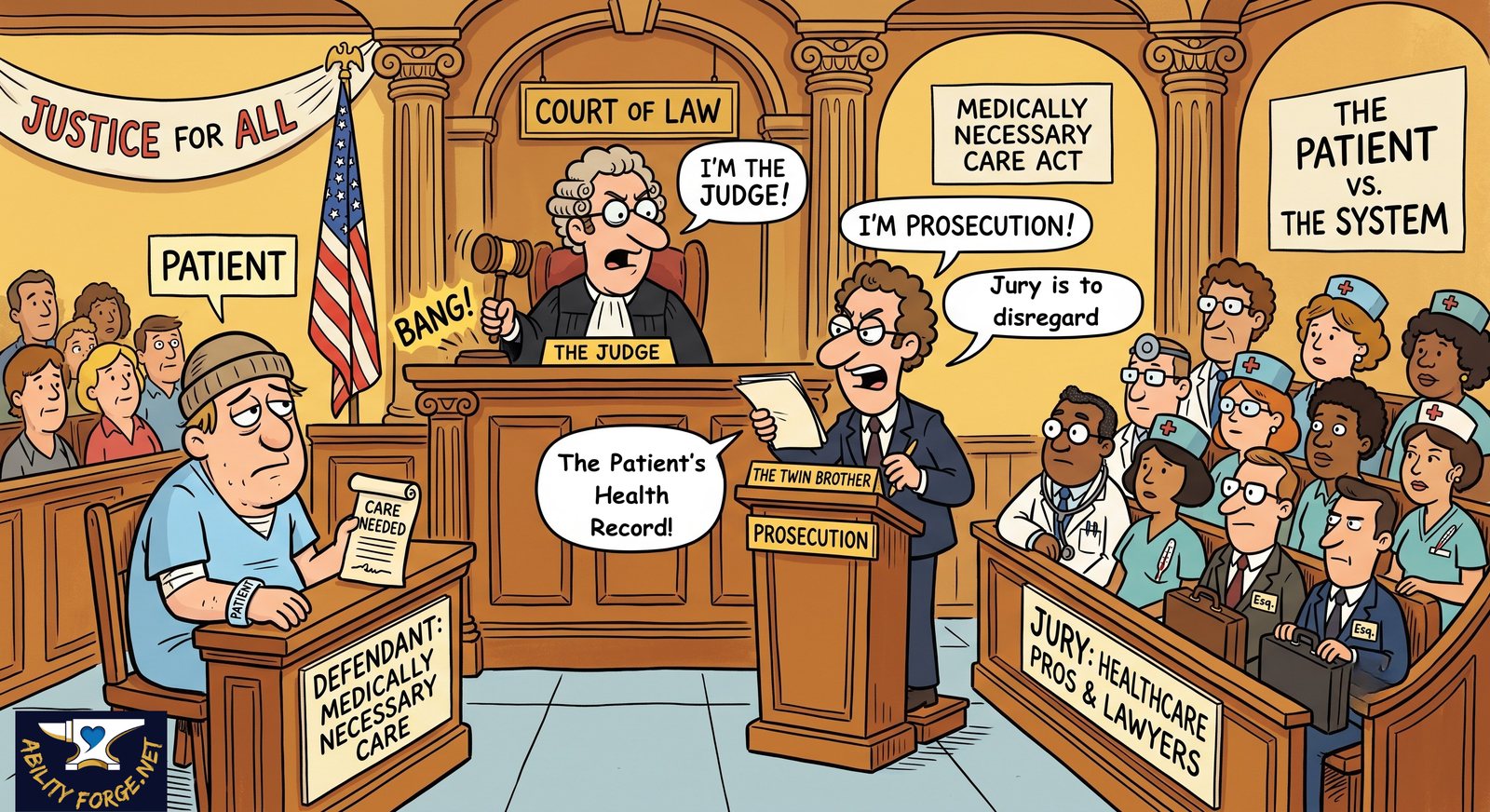
Obstruction of Medical Care — A Separate Offense (codified as § 8 of the Amendment)
The law already recognizes this logic. Obstruction of justice is prosecuted separately from the underlying offense — because corrupting the mechanism designed to deliver accountability is itself a harm to the public. You can be acquitted of the crime and still convicted of obstructing its investigation, because the integrity of the proceeding is a protected thing in its own right.
What the insurer does inside the appeals process is structurally identical: they suppress evidence, employ the reviewer, control the timeline, and face no penalty for corrupting the proceeding. The appeals process has become a rigged prosecution's court against patients — and the rigging itself goes unnamed and unpunished.
| Element | Obstruction of Justice | Obstruction of Medical Care |
|---|---|---|
| The protected mechanism | The court — society's process for delivering accountability | The appeal — the only process the patient has |
| How it is corrupted | Witness tampering, evidence suppression, delay | Conflicted reviewers, algorithmic denials, Prior Knowledge OmissionPrior Knowledge OmissionA denial issued without referencing documented clinical evidence already present in the patient's medical record that establishes medical necessity., controlled timelines, unrecorded peer-to-peer reviews |
| Why it is separate | Corrupting the accountability mechanism harms the public itself | Corrupting the appeal harms every patient who must rely on it |
| Criminal exposure | Yes — charged independently of the underlying offense | Currently none under existing law. § 8 of the Amendment closes this gap. |
When an insurer manipulates the appeals process — through conflicted reviewers, algorithmic denials, or Prior Knowledge Omission — they are not just wrongfully denying a claim. They are obstructing the only process the patient has. That is a separate offense, and it demands separate criminal exposure — independent of whether the underlying denial is ever reversed.
The Record Rule (§ 2(c) of the Amendment) — The Peer-to-Peer Goes On the Record
The peer-to-peer call is where the wrongdoing happens live — the specialty mismatch introduces itself, the reviewer reveals they haven't read the chart, the scripted denial gets recited to a treating physician who knows better. It is the most probative moment in the entire proceeding, and under current practice it is the only one that leaves no evidence. Only 16% of physicians participating in peer-to-peer reviews report that the health plan's "peer" often or always has appropriate qualifications. (Source: 2025 AMA Prior Authorization Physician Survey (archived copy))
The Record Rule requires every peer-to-peer to be recorded in full, with the reviewer stating their name, license number, and board certification on the record at the outset. The complete transcript goes to the patient and treating physician within 5 business days — admissible in the Denial on Trial proceeding, the § 5 board referral, and any § 8 prosecution.
The recorded peer-to-peer is bodycam footage for medicine. A medical license, like a badge, is authority held in public trust. When an officer abuses the badge, the footage is what turns the victim's word into evidence — and when an insurance doctor abuses the license against the patients it exists to protect, the recording does the same: abuse becomes evidence, and evidence becomes removal under § 5.
The spoliation principle supplies the teeth: an unrecorded or unproduced peer-to-peer creates a presumption in favor of the treating physician's determination. The party that controls the record and fails to preserve it shall not benefit from its absence. No record — no denial.
Current System vs. Denial on Trial Model
| Role | Current System | Denial on Trial Model |
|---|---|---|
| IRE Role | Neutral arbitrator | Patient advocate (Public Defender) |
| Burden of Proof | Patient must prove need | Insurer must prove denial is justified |
| Medical Evidence | Reviewer may exclude data outside their note | All submitted clinical data reviewed under penalty of perjury |
| Ruling Authority | IRE acts as judge and advocate simultaneously | Administrative Law Judge rules independently |
| Physician Accountability | No consequence for wrongful denial | Mandatory State Medical Board referral on IRE overturn |
| Fraud Mechanism | Prior Knowledge Omission goes unpunished | Suppression of known qualifying evidence = malpractice trigger |
The Three Roles
- Prosecution (The Insurer): Files the denial — and bears the burden of proving it is justified against the established medical record.
- Public Defender (The IRE): Advocates for the patient's complete clinical record against that denial — as a Public Defender, not a neutral arbitrator.
- Adjudicator (Administrative Law Judge): Rules independently — with authority to trigger financial penalties and mandatory board reporting.
The Capacity Problem: Why We Need a Department of Recovery
The Amendment's higher stakes — 300–500% Buffer Fund multipliers, mandatory board reporting, malpractice triggers, and a patient's private right of action ERISA can no longer bar — will cause insurers to fight every case harder. The current IRE infrastructure, already under strain, will be overwhelmed.
Private IREs rule case by case. They do not aggregate patterns. They do not notice that a single reviewing pediatrician is adjudicating hundreds of adult bariatric claims monthly. A federally-staffed Recovery Coordination Office would:
- Absorb IRE overflow volume created by the new penalty structure
- Maintain cross-case pattern data that converts individual fraud into prosecutable systemic fraud
- Administer the Patient Safety Buffer Fund with federal accountability
- Feed the mandatory board reporting pipeline the Clinical Integrity Amendment requires
"Long after the sensationalism of a verdict fades, the legislative reform that finally dismantles the Wrongful Denial Echo Chamber is what will endure."
— Michael Kissling, AbilityForge.net
The PSI Briefing — Documented Evidence of Prior Knowledge Omission
Submitted to the Senate Permanent Subcommittee on Investigations | March 2026 | Michael Joseph Kissling, Medicare Advantage Beneficiary & Healthcare Advocate
85.2%
UHC prior auth overturns
(KFF 2023)
81.7%
Industry average
overturn rate
~29%
Traditional Medicare
overturn rate
$1.1M+
Taxpayer cost
— this case alone
This is not a dispute over medical judgment. It is a documented mechanism of deceptive business practice — executed with paper trail proof of intent.
The Fraud Mechanism: Prior Knowledge Omission
UHC medical directors deny legitimate claims by deliberately ignoring qualifying medical information already in their possession. This is not administrative error. It is documented, repeatable policy.
- The insurer acknowledges a patient's qualifying status through an approval decision
- The insurer then denies a directly related claim while possessing that prior knowledge
- The reviewing physician excludes objective clinical data on procedural pretexts
- The patient is forced through an appeals process that functions as a delay weapon
- The insurer offloads the financial cost of resulting harm onto taxpayers
The Documented Case: Kissling v. UnitedHealthcare — The Paper Trail
UHC approves learner prosthetic — officially acknowledging K3 functional mobility status (AMPnoPRO score: 35). This classification is mandatory knowledge in UHC's possession.
Six days after K3 establishment: UHC changes beneficiary's plan, making all existing physicians and physical therapists out-of-network. Care continuity disrupted.
UHC denies transition to permanent tertiary prosthetic — claiming beneficiary does not demonstrate sufficient functional ability. Denial issued while UHC possesses K3 approval AND updated K4 PT evaluation (AMPnoPRO: 44/47).
Updated PT evaluation confirms advancement to K4 status (AMPnoPRO: 44/47). UHC reviewer explicitly refuses to acknowledge this data because it was not written in his specific office note.
UHC final denial letter states: "Medicare Guidance says that the requested computerized knee advanced feet exceed your needs" — a statement made with documented prior knowledge that patient was K3-K4, in direct violation of Medicare Policy Article A52496.
Maximus Federal Services (IRE) immediately overturns UHC denial. Finding: medically necessary. This overturn is equivalent to summary judgment — UHC's position was indefensible.
Medicare lowers microprocessor knee standard from K3 to K2 — meaning the patient would have qualified under even the future relaxed standard. UHC's denial had no medical or regulatory basis at any point in time.
The Smoking Gun: Dr. Stockhausen's Documentation
The attending physician, Dr. Sean T. Stockhausen, documented in writing that the UHC peer-to-peer reviewer confirmed he remembered the K4 argument — and then stated he could not use objective PT data, including walking speed and AMPnoPRO score, unless it was written directly in his own office note. He subsequently amended his office note specifically to include the AMPnoPRO score.
This is the echo chamber mechanism documented by the treating physician himself: standardized, Medicare-approved assessment scores excluded on a procedural pretext manufactured by the corporate reviewer. Under the Clinical Integrity Amendment § 2, this action would be void and trigger mandatory board reporting.
The Cascading Taxpayer Cost
The Wrongful Denial Echo Chamber does not save money. It shifts costs from the insurer onto the public:
- A denied $55,000 iliac vein stenting surgery (85–90% five-year patency rate) triggered cascading wound care failures
- A 17-month delay in FDA-standard ApligrafApligrafAn FDA-approved living cell therapy and bioengineered skin substitute used in chronic wound care, including diabetic foot ulcers and venous leg ulcers. wound treatment (PMA P950032S016, established 2000) allowed infection to progress until bone pathology showed demineralization described as "cuttable with a scalpel"
- When Apligraf was finally approved, it closed the wounds in two weeks — vindicating the standard UHC suppressed for 17 months
- The denied permanent prosthetic resulted in statistically preventable falls and the loss of physical capacity to protect an autistic child from danger
- Total taxpayer-funded cost: $1.1 million and climbing — on a case that began with a $55,000 denial