Everywhere
There is no pristine corner. PFAS has been found in the blood of penguins in remote Patagonia, in whales with no place to hide, in half of California's waterways, in biosolids spread on US food crops, in 97% of children's blood samples tested. This is not a local problem that started at a military base. It is a planetary contamination event.
97%
of children tested positive for PFAS
~50%
of California waterways contaminated
700+
US military bases with known contamination
Global
Arctic, Patagonia, open ocean — no safe zone
In the Water
PFAS Found in America's Lakes and Streams
Environment America · Oct 2026A national review of state surface-water monitoring found PFAS at least once at 1,329 of 1,602 monitored locations from 2022 to 2024 — about 83% — with 114 of 174 tested compounds detected. PFAS turned up at every monitored location on the Mississippi River in Minnesota and Wisconsin and across Lake Ontario. The highest reading, about 1,040,000 ng/L of PFOS, came from a stormwater pond in Brunswick, Maine, after a 2024 firefighting foam release. The authors note many waterways are never tested at all.
Read the Report from Environment America →About Half of California Waterways Contaminated with PFAS
The GuardianA pesticide and PFAS analysis of California's waterways finds contamination in roughly half the state's surface water — including waterways that feed agricultural irrigation systems and drinking water supplies. The finding complicates the assumption that PFAS contamination is primarily a military or industrial site issue.
Read the Article from The Guardian →Are PFAS Forever Chemicals in Your Water? See the Latest Data.
Interactive MapAn interactive database and reporting tool allowing residents to check PFAS contamination levels in their local water systems — using EPAEPA — Environmental Protection AgencyThe U.S. Environmental Protection Agency (EPA) is the federal agency responsible for protecting human health and the environment by regulating pollutants — including the drinking-w… monitoring data. The map makes the scale of drinking water contamination visible at the ZIP code level.
Check Your Water →Researchers Uncover the Source of Widespread PFAS Contamination in North Carolina
Regional SourceNorth Carolina researchers identify the contamination sources behind PFAS found in rivers, groundwater, and drinking supplies across the region — tracing pathways from industrial discharge points to downstream exposure communities.
Read the Article →City Gives Free Water Filters to West Plains Homes with Contaminated Wells
KXLYLocal government response to private well contamination — a community-level intervention that illustrates both the scale of the problem and the gap between contamination discovery and remediation. Residents received filters; the source contamination remains.
Read the Article from KXLY →In the Food Supply
Bombshell Study Reveals Concerning Substances Being Added to US Crops
BiosolidsResearch finds PFAS-contaminated sewage sludge (biosolids) being applied to agricultural land as fertilizer — creating a direct pathway from industrial and military PFAS discharge through wastewater treatment into food crops. "A risk of contamination of our food."
Read the Article →EPA Should Intervene on Behalf of Towns for PFAS in Biosolids, Filings Argue
Waste DiveLegal filings argue the EPA has both the authority and the obligation to protect communities from PFAS contamination via biosolids — particularly where state regulation has not filled the gap left by federal inaction. The biosolids pathway is one of the least-regulated PFAS vectors in current law.
Read the Article from Waste Dive →Worries Over PFAS in Biosolids Spill Into 2026 Legislative Sessions
Waste DiveState legislatures across the country are taking up biosolids PFAS regulation in 2026 as federal action remains uncertain — states are moving to fill the gap themselves.
Read the Article from Waste Dive →Trump EPA Approves Its First 'Forever Chemical' Pesticide
Regulatory RollbackThe EPA under the current administration approves a PFAS-based pesticide — the first such approval while simultaneously rolling back drinking water protections. The decision expands the intentional agricultural application of forever chemicals at the moment when biosolids contamination of crops is becoming a documented crisis.
Read the Article →In Wildlife — No Place Left to Hide
Penguin Toxicologists Find PFAS Chemicals in Remote Patagonia
UC DavisResearchers studying Magellanic penguins in one of the most remote ecosystems on earth find PFAS in the birds' blood and tissues. The finding — from a population that has virtually no direct human contact — demonstrates that PFAS has traveled through global atmospheric and oceanic transport pathways to reach locations far from any industrial source. There is no clean control group left on the planet.
Read the UC Davis Report →Dolphins and Whales Have 'No Place to Hide' from Forever Chemicals
EuronewsA new study examining PFAS in marine mammals — dolphins and whales — finds contamination at concerning levels across multiple ocean basins. The phrase "no place to hide" echoes the finding from Patagonia: these are animals that live as far from human industry as possible, and they are still being found with PFAS in their tissues.
Read the Article from Euronews →Scientists Make Concerning Discoveries Near US Military Bases: 'Detected in All'
Military ProximityScientific findings near US military installations — PFAS detected in all samples tested, across multiple site types and proximity levels. The military base contamination pattern is not isolated to a handful of high-profile sites. It is consistent across the installation network wherever AFFF was used.
Read the Article →In Children's Blood
SciTechDaily — University Research
Forever Chemicals Found in 97% of Children — Concerning New Study Reveals
A study examining PFAS blood levels in children finds detectable concentrations in 97% of those tested. This figure — which has now appeared consistently across multiple research populations — means that virtual universal childhood PFAS exposure is the documented baseline, not the exception. The question is no longer whether children are exposed. It is what the cumulative burden means for their health trajectories.
The finding has direct implications for how the neurodevelopmental, hormonal, and immune system research on PFAS should be interpreted: the control group no longer exists. Every study comparing "exposed" to "unexposed" children is, to a significant degree, comparing high-exposure to moderate-exposure populations. As ATSDR puts it: "Most people in the U.S. have been exposed to PFAS and have it in their blood" (ATSDR) — national biomonitoring finds it in roughly 99% of Americans tested.
Read the Report from SciTechDaily →High Levels of Short-Chain PFAS Found in Blood of Residents Near Chemical Facility
Blood BurdenResearch on residents living near a chemical manufacturing facility reveals elevated concentrations of short-chain PFAS — the compounds the industry shifted to after PFOS and PFOA were phased out — demonstrating that the replacement chemicals carry their own significant contamination burden. The "safer alternative" argument does not hold under scrutiny.
Read the Article →In the Womb — What Drinking Water Does to the Next Generation
PNAS · Peer-Reviewed · 2025
106,091 Birth Records New Hampshire · 2010–2019"PFAS-Contaminated Drinking Water Harms Infants" — Baluja, Guo, Howden, Langer & Lemoine
Published in the Proceedings of the National Academy of Sciences, this study analyzed every birth record in New Hampshire from 2010 to 2019 — 106,091 births — and linked PFAS contamination in public drinking water to three distinct infant outcomes: increased infant mortality, extremely preterm births, and extremely low birthweight.
The methodology is rigorous. Researchers used groundwater flow direction — whether a public water well sits downgradient (receiving contaminated flow) or upgradient (above the contamination) from a known PFAS source — as an instrumental variable isolating actual exposure. They ran 1,000 falsification tests using randomly placed "pretend" contaminated sites. The effects held. The methodology rules out the common challenge that exposed communities differ socioeconomically — in fact, the instrumental variable approach is specifically designed to address this confound. Exposure is determined by hydrology, not demographics. The three infant outcomes linked to PFAS-contaminated drinking water: 1. Increased infant mortality. 2. Extremely preterm birth (less than 28 weeks gestation). 3. Extremely low birthweight (less than 1,000 grams). These are not marginal effects. They are outcomes that determine whether a child survives the first year of life.
Read the PNAS Study → · archived copyA Closing Poem
Where Water Goes, PFAS Flows



Read the poem as text
I do not break
I do not leave
I go where the water goes.
And for decades, no one knows.
In the lakes to eagle’s nests.
Slow and silent hides from tests.
A nation’s bird, inside it rests.
I do not break
I do not leave
I go where the water goes.
Through the marshlands and the reeds
Into the mallard, out when it bleeds.
Wolf or man, I climb the chain.
From old to young I spread my pain.
I do not break
I do not leave
I go where the water goes.
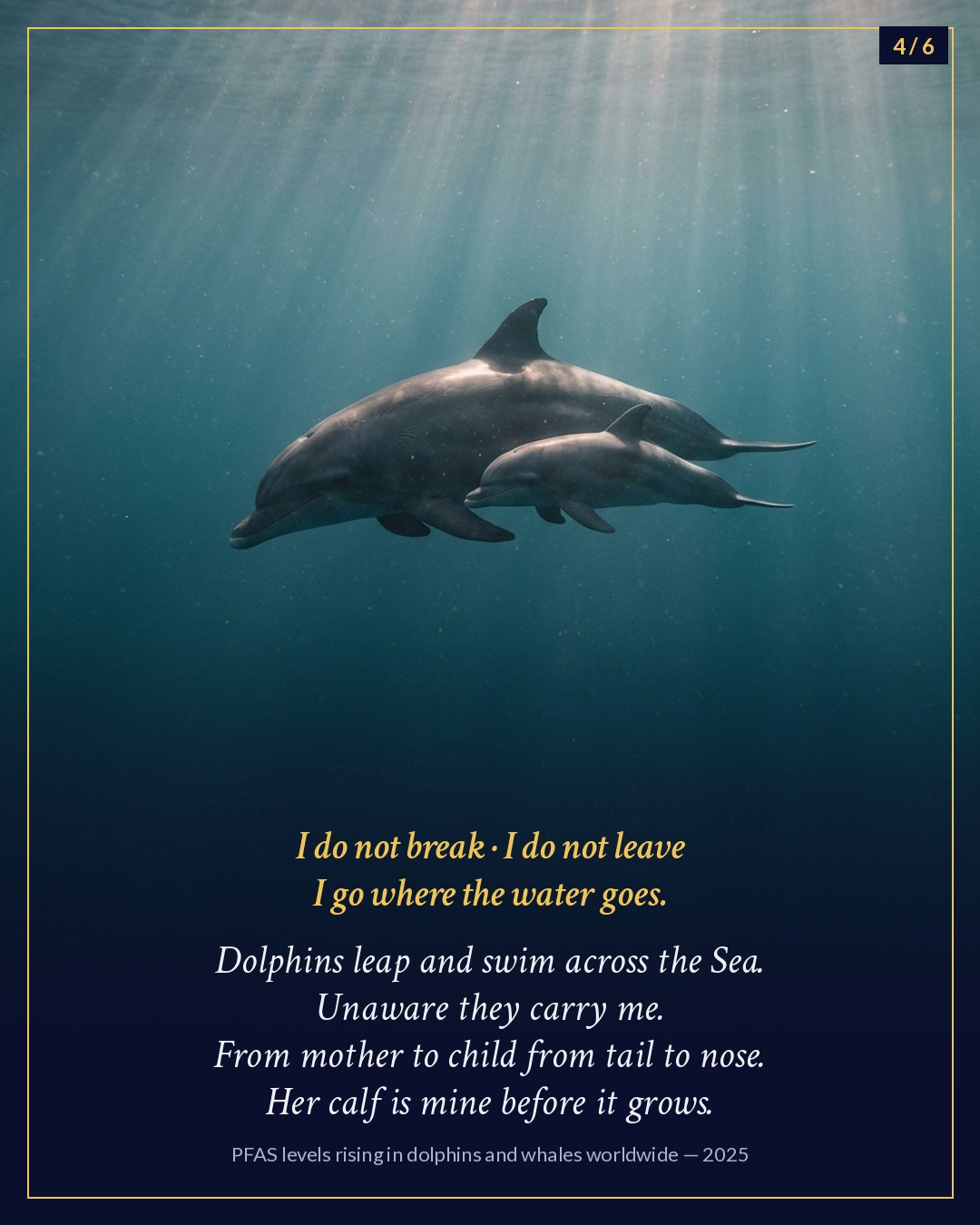
Dolphins leap and swim across the Sea.
Unaware they carry me.
From mother to child from tail to nose.
Her calf is mine before it grows.
I do not break
I do not leave
I go where the water goes.
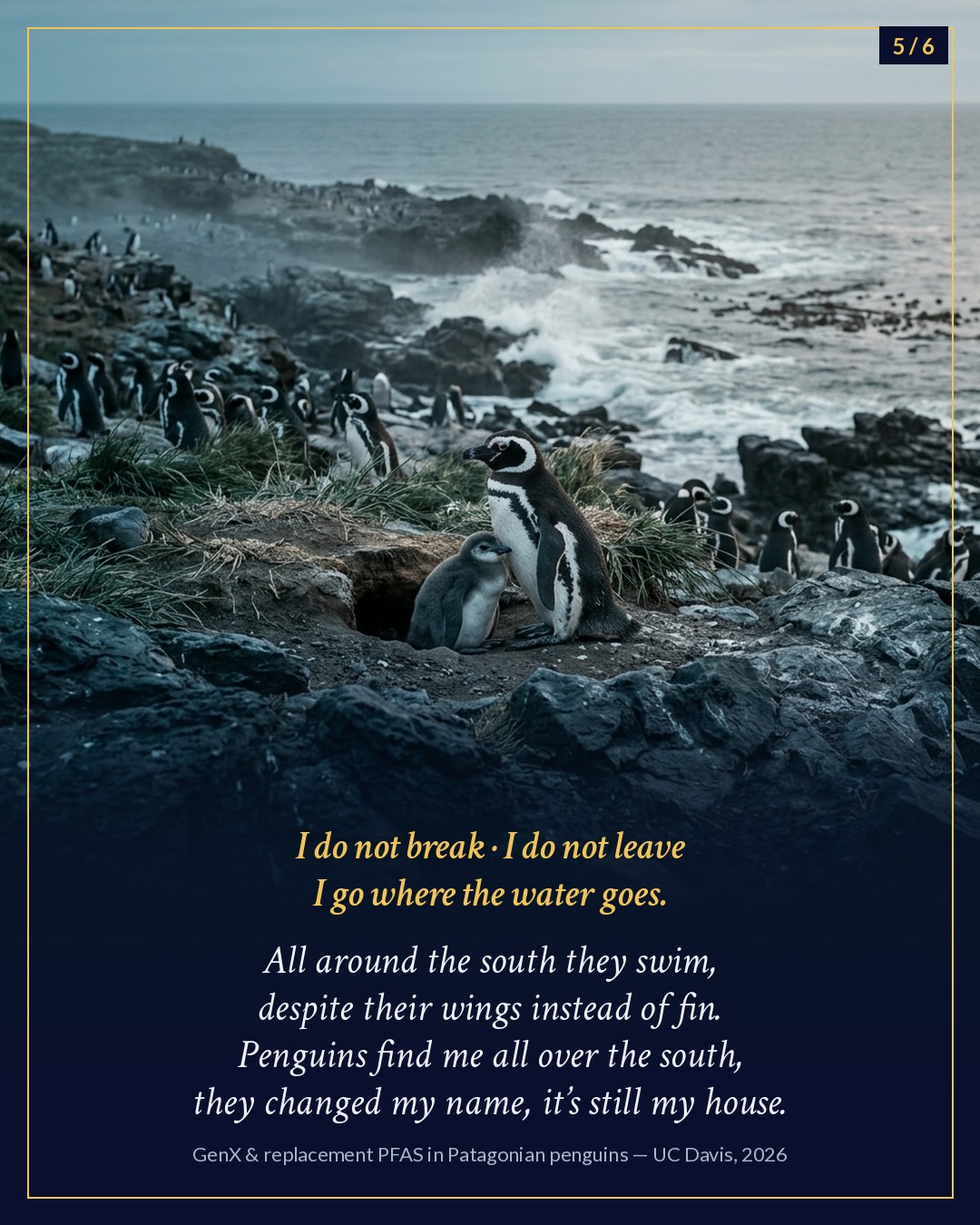
All around the south they swim,
despite their wings instead of fin.
Penguins find me all over the south,
they changed my name, it’s still my house.
Where water goes
PFAS flows
— Michael Joseph Kissling