The Affected
Every data point is a person. The science has finally caught up to what families downstream of Willow Grove have lived for decades. Here is the documented pathway — from contaminated water to the bodies of children not yet born when the foam first hit the ground.
Table of Contents
- The Family Legacy
- Maternal Transfer: The Breastmilk Pathway
- The Biological Chain of Custody
- Step 1: The Placental Breach — preeclampsia, gestational diabetes, placental damage
- Step 2: Transplacental Transfer
- Step 3: Toxic Inheritance via Breast Milk
- Step 4: The Metabolic Cascade — type 2 diabetes risk
- Step 5: Neurodevelopmental Disruption
- Step 6: Carcinogenesis
- The Data and the Decision
- The Research Archive
The Family Legacy
My father-in-law served at Willow Grove Naval Air Station. He battled service-linked colorectal cancer and is now fighting for the service connection to his Stage IVa prostate cancer. His children visited him on base. His daughter — who tests positive for the same PFHxS he carries — suffered severe preeclampsia during her pregnancy. Our daughter, born of that high-risk pregnancy, navigates autism every day.
This is not a cluster of bad luck. This is a documented biological chain of custody. The contamination traveled from the base through the groundwater, into the family's water supply, through the placenta, and into the next generation. The science below describes exactly how.
Maternal Transfer: The Breastmilk Pathway
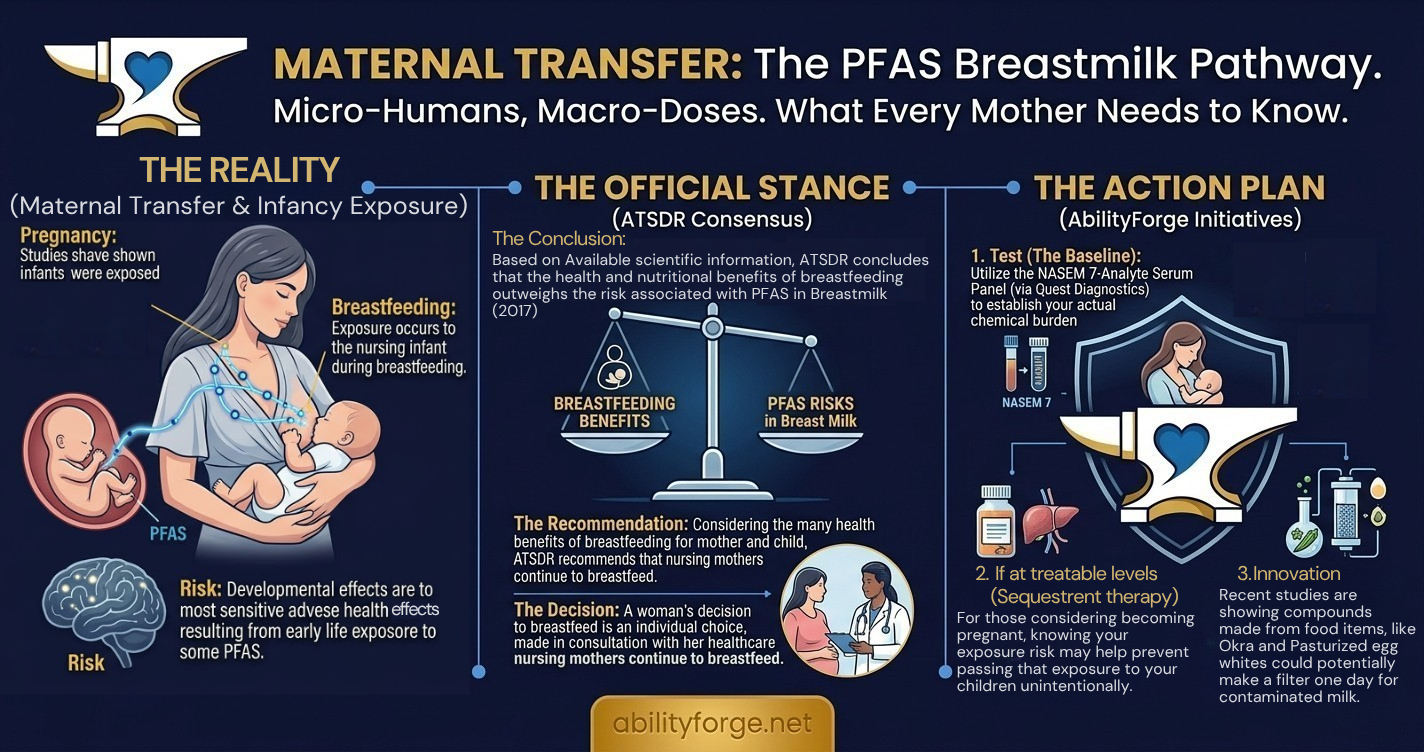
On the ATSDR recommendation: The official 2019 ATSDR guidance concludes that breastfeeding benefits outweigh PFAS risks and recommends nursing mothers continue to breastfeed. That guidance predates multi-study confirmed associations between early-life PFAS exposure and ASD/ADHD markers, and documented elevated infant mortality rates in communities downstream of confirmed contamination sites. The recommendation is not to stop breastfeeding — it is to reduce PFAS exposure at the source. The mother is not the variable. The contaminated water is.
The Biological Chain of Custody
1. The Placental Breach
We were told the placenta protects the unborn child. Research published in Environment International (2025) (Khan et al.) demonstrates that PFAS exposure causes "maternal vascular malperfusion" — structural damage to the placenta itself.
- Syncytial Knots: PFAS causes premature aging of the placenta, reducing oxygen exchange to the fetus.
- Reduced Intervillous Space: The chemical literally chokes off the supply line to the developing child.
- Documented Outcome: This damage is directly linked to preeclampsia and Small for Gestational Age (SGA) births.
"PFHxPA quantification was associated with an increase in the percentages of villi with syncytial knots... suggesting impaired fetal maternal exchange."
— Environment International, 2025
PFAS measured directly in placental tissue
A 2023 study in Ecotoxicology and Environmental Safety (Groisman et al., Israel Ministry of Health / Ben-Gurion University) measured 13 PFAS compounds in placental tissue samples directly. Five — PFOS, PFOA, PFHxS, PFNA, PFDA — were measurable. Elevated PFOA in placental tissue was associated with pregnancy complications (preterm birth, preeclampsia, gestational diabetes, SGA) at an odds ratio of 1.82 (90% CI: 1.06–3.13) per quintile increase.
Groisman L, Berman T, Quinn A, et al. "Levels of PFAS concentrations in the placenta and pregnancy complications." Ecotoxicology and Environmental Safety, 262 (2023) 115165.
Preeclampsia: Measured at Week 10 of Pregnancy
The Swedish SELMA pregnancy cohort (Wikström et al., 2019, Scientific Reports — Örebro University / Karlstad University / Lund University / Mount Sinai) measured PFAS in serum at a median of 10 gestational weeks in 1,773 women. Women with PFOS levels in the highest quartile faced an odds ratio of 2.68 (95% CI: 1.17–6.12) for developing preeclampsia — equal to the risk associated with being a first-time mother. Per doubling of serum PFOS, adjusted OR was 1.53 (95% CI: 1.07–2.20). PFNA also showed significant association (adjusted OR 1.38, 95% CI: 1.01–1.89).
The contamination was already in the bloodstream at 10 weeks — before most women even knew what their first trimester would bring.
Wikström S, Lindh CH, Shu H, Bornehag CG. "Early pregnancy serum levels of perfluoroalkyl substances and risk of preeclampsia in Swedish women." Scientific Reports 9, 9179 (2019). DOI: 10.1038/s41598-019-45483-7.
Gestational Diabetes: The Largest Analysis Ever Conducted
A January 2026 systematic review and meta-analysis published in The Lancet eClinicalMedicine (India-Aldana, Yu, Valvi et al. — Icahn School of Medicine at Mount Sinai, NIH-funded) is the most comprehensive evaluation ever conducted on PFAS and diabetes risk across the lifespan. The finding on pregnancy was unambiguous: higher PFAS exposure was consistently associated with increased likelihood of gestational diabetes mellitus, and with measurable disruption of insulin resistance and secretion markers. Per doubling of serum PFOS: OR 1.13. Per doubling of PFBS: OR 1.14. Per doubling of 6:2 Cl-PFESA: OR 1.30.
The researchers identified "pregnancy as a particularly sensitive window during which PFAS exposure may increase risk for gestational diabetes" — and noted that gestational diabetes itself increases long-term risk of type 2 diabetes for both mother and child. The exposure during pregnancy sets a metabolic trajectory that extends for decades.
India-Aldana S, Yu X, Valvi D et al. "Associations of perfluoroalkyl and polyfluoroalkyl substances with markers of glycaemic control, insulin secretion and sensitivity, and diabetes risk: a systematic review and meta-analyses." EClinicalMedicine 2026. DOI: 10.1016/j.eclinm.2025.103747.
2. Transplacental Transfer
PFAS cross the placental barrier directly. Studies on transplacental transfer efficiency confirm that multiple PFAS compounds pass from maternal blood into fetal cord blood — delivering the contamination to the developing child before birth.
Transfer efficiency varies by compound but is documented across PFOS, PFOA, PFHxS, and other variants. The fetus cannot eliminate these compounds any more than the mother can.
3. The Toxic Inheritance: Breast Milk
A systematic review by ATSDR scientists in Toxicological Sciences (Hoadley et al., 2023) confirms a devastating finding: lactation is a cleaning mechanism for the mother, but a dosing mechanism for the child.
Mothers effectively offload their accumulated body burden of PFAS into their infants through breast milk. Studies show that longer breastfeeding duration is associated with significantly higher PFAS levels in infant serum. The very act of nurturing was hijacked to transfer the toxin to the next generation.
Macrodoses. Micro Bodies.
This is not merely a transfer pathway — it is a concentration event. The chemical load accumulated in an adult body over years of exposure is offloaded into an organism that may weigh seven pounds. The infant has no mature liver metabolism to process it, an immature blood-brain barrier, and no choice in the matter.
Pediatric medicine is built on the fact that infants are not small adults. Doses are calculated by body weight, because an amount an adult tolerates can overwhelm a body a fraction of the size. Infant botulism shows the other half of the problem: the same spores an adult's mature gut handles without incident can be fatal to a newborn whose gut flora hasn't developed yet. Both apply to PFAS — a larger dose per pound, delivered to systems that aren't finished developing.
A peer-reviewed study published in PNAS (2025) documented increased infant mortality within the first year of life in communities with PFAS-contaminated drinking water — based on 106,091 birth records in New Hampshire. The exposure pathway is confirmed. The harm is confirmed. Whether the concentration-to-body-weight differential is the mechanism driving that mortality window is a research gap — but it is a gap with documented endpoints on both sides.
This finding does not recommend against breastfeeding — the nutritional and immunological benefits are documented and significant. It indicts the contamination, not the mother.
4. The Metabolic Cascade
Gestational diabetes doesn't end at delivery. It sets a metabolic trajectory — for the mother and for the child. PFAS exposure during pregnancy disrupts insulin signaling at a cellular level, and the consequences compound over time.
2×+
Increased T2DM risk in highest PFAS tertile (SWAN study)
1,237
Midlife women tracked for 17 years in the SWAN cohort
4 PFAS
Compounds independently associated: PFOA, PFHxS, PFOS, MeFOSAA
Midlife Women: 17-Year Follow-Up Study
The Study of Women's Health Across the Nation (SWAN) — a multi-site, multi-ethnic U.S. prospective cohort — followed 1,237 diabetes-free midlife women (aged 45–56 at baseline, 1999–2000) through 2017. Women in the highest tertile of PFAS exposure faced more than a 2-fold increase in risk of developing type 2 diabetes compared to the lowest tertile. Individual PFAS with significant associations: n-PFOA, PFHxS, Sm-PFOS, and MeFOSAA. The mixture effect — when measured as the combined body burden — was greater than any individual compound alone.
The researchers concluded: "Reduced exposure to these 'forever and everywhere chemicals' may be an important preventative approach to lowering population-wide diabetes risk."
Cardenas A et al. "Per- and polyfluoroalkyl substances and incident diabetes in midlife women: the Study of Women's Health Across the Nation (SWAN)." Diabetologia 65, 1053–1065 (2022). DOI: 10.1007/s00125-022-05695-5.
The pathway from PFAS to diabetes is mechanistic: PFAS disrupt the PPAR-γ receptor pathway that regulates adipogenesis and insulin sensitivity, alter pancreatic β-cell function, and promote systemic inflammation — each of which independently increases diabetes risk. The SWAN study documents the endpoint. The Lancet 2026 meta-analysis documents pregnancy as the window where that trajectory often begins.
5. Neurodevelopmental Disruption
The Thyroid Mechanism
PFAS disrupt thyroid hormone function — specifically T4, which is critical for fetal brain architecture during development. Reviews in Current Environmental Health Reports link early-life PFAS exposure to:
- ADHD and Autism Spectrum Disorder
- Motor development delays
- Language development deficits
- Reduced cognitive performance scores
The Timing Problem
Fetal brain development is time-sensitive. Thyroid hormone disruption during critical windows can have effects that are hard to make up for later — which is why prevention before and during pregnancy matters most.
What Two Major Literature Reviews Now Document
Ames et al., 2025 — Current Environmental Health Reports
Kaiser Permanente / Drexel University Autism Institute. Review of 61 studies on early-life PFAS exposure and child neurodevelopment.
Findings: PFAS associated with reduced cognitive, motor, and language development; elevated ADHD and ASD risk. Key finding on mechanism: PFAS disrupts dopamine and glutamate signaling and calcium homeostasis — foundational neurochemical systems for brain architecture.
Currie et al., 2024 — Environments (MDPI / EPA-funded)
University of Georgia. Review concluded PFAS is "strongly associated with neurodevelopmental disorders, such as ADHD and ASD."
PFOA's association with ASD risk: odds ratio 1.99 per ng/mL increase (95% CI: 1.20–3.29). That is a documented near-doubling of ASD odds associated with PFOA concentration in the peer-reviewed literature.
These are literature reviews of peer-reviewed studies, not advocacy documents. One was partially funded by the EPAEPA — Environmental Protection AgencyThe U.S. Environmental Protection Agency (EPA) is the federal agency responsible for protecting human health and the environment by regulating pollutants — including the drinking-w…. The other was co-authored by researchers at Drexel's Autism Institute — an institution whose stated mission is to understand autism's causes.
The Dopamine Pathway: BH4 Shunting
Ames et al. (2025) document that PFAS disrupts dopamine signaling specifically. The mechanism under research: tetrahydrobiopterin (BH4) is the essential cofactor for tyrosine hydroxylase — the rate-limiting enzyme in dopamine biosynthesis. PFAS-induced neuroinflammation creates oxidative stress, which depletes BH4. Depleted BH4 impairs the synthesis of dopamine, serotonin, and norepinephrine simultaneously.
The chain: PFAS exposure → neuroinflammation → oxidative stress → BH4 depletion → impaired neurotransmitter synthesis → neurodevelopmental disruption.
This is the same BH4 shunting pathway now being explored in the context of glyphosate exposure. Two of the most widely deployed chemical classes in the United States — PFAS and glyphosate — may be converging on the same neurochemical disruption mechanism. That is not a settled finding. It is a research question that requires funding and follow-through.
The BH4 mechanism remains active research, not established consensus. The epidemiological association between PFAS and ASD is the documented finding. The mechanism is where the science is going next — if it is permitted to go there.
The Full Pathway
PFAS arriving at macrodose concentrations relative to infant body weight — delivered through placenta and breast milk — reaches an immature blood-brain barrier that does not yet have the full protective capacity of an adult system. Neuroinflammation during critical developmental windows is linked to ASD and ADHD markers in the research literature.
The proposed chain (the mechanism is still under research): contaminated water → maternal body burden → macrodose transfer to infant → immature blood-brain barrier → neuroinflammation → BH4 depletion → impaired neurotransmitter synthesis → documented neurodevelopmental outcomes.
6. Carcinogenesis & Metabolic Disease
The PSA Test Your Doctor Doesn't Know Is Compromised
The prostate-specific antigen (PSA) test is the primary screening tool for prostate cancer in American men. Specifically, the free-to-total PSA ratio (f/tPSA) — when it drops below 25%, it signals elevated cancer risk. Urologists use this number to determine whether to biopsy.
A 2024 study in Science of the Total Environment (Wang et al., Anhui Medical University and Southeast University) applied machine learning to PFAS serum levels and PSA metrics and found: a linear, positive, dose-dependent association between PFOS exposure and the f/tPSA ratio. As PFOS body burden increases, the ratio shifts — in a direction that can mask prostate pathology or create false signals that drive unnecessary procedures.
The study also found non-linear dose-response relationships between PFOA, PFDeA, PFHxS, and PFNA and the f/tPSA ratio. This is not a single compound effect — it is a class effect across multiple PFAS variants simultaneously present in the bodies of people living near contaminated water sources.
Wang T, Yang J, Han Y, Wāng Y. "Unveiling the intricate connection between per- and polyfluoroalkyl substances and prostate hyperplasia." Science of the Total Environment, Vol. 932, July 2024. DOI: 10.1016/j.scitotenv.2024.173085
What this means for men near Willow Grove: A veteran or resident with documented PFAS exposure in their blood is receiving PSA screenings their urologist does not know to interpret through the lens of PFAS body burden. The exposure doesn't just risk causing prostate disease — it may be distorting the measurement used to detect it.
Benign Prostatic Hyperplasia (BPH): A Population-Level Signal
The same 2024 Wang et al. study found a positive association between the mixture of PFAS and prostate hyperplasia — the non-cancerous prostate enlargement that affects roughly 50% of men in their 50s and 90% of men in their 80s. BPH is frequently dismissed as age-related. The data suggests PFAS body burden may be an accelerating variable.
Among individual PFAS compounds, PFNA had the highest impact on BPH, followed by PFOS. Elevated serum levels of PFDeA, PFOA, PFOS, and PFNA were all linked to prostate hyperplasia. This is not one compound — it is the class, working through endocrine disruption mechanisms.
Prostate Cancer: The High-Fat Diet Compounding Effect
A study published in Nutrients (Imir et al., University of Illinois — including the UIC Departments of Urology, Pathology, and Physiology) found that PFAS exposure combined with a high-fat diet supports prostate cancer progression.
Epidemiological studies show a link between elevated blood PFAS levels and prostate cancer incidence. The mechanism is under active investigation, but the compounding interaction with dietary fat — common in the American diet — is documented.
Colorectal Cancer: The HMGCS2 Mechanism
A 2024 study in Chemosphere (University of Kentucky Markey Cancer Center) found that PFOS exposure downregulates HMGCS2 — an enzyme critical to gut microbiome health — and simultaneously upregulates markers of intestinal carcinogenesis in mouse intestinal tissue.
Loss of HMGCS2 is associated with increased cellular proliferation and lipid accumulation in colon cells. HMGCS2 downregulation is also observed in human colorectal cancer and associated with lower survival rates.
The Population-Level Evidence: SEER Cancer Surveillance Data
A 2025 study in the Journal of Exposure Science & Environmental Epidemiology (Li et al., USC — published open access) cross-referenced county-level cancer incidence from the National Cancer Institute's SEER Program (2016–2021) against PFAS contamination in public drinking water systems. The findings:
- ▸PFAS in drinking water was associated with increased cancer incidence in digestive, endocrine, oral cavity/pharynx, and respiratory systems.
- ▸Among males specifically: PFAS associated with urinary tract, brain, leukemia, and soft tissue cancers.
- ▸Incidence rate ratios ranged from 1.02 to 1.33 across cancer types.
- ▸PFAS in drinking water is estimated to contribute to 4,626 to 6,864 additional incident cancer cases per year in the United States.
Li S, Oliva P, Zhang L, et al. "Associations between PFAS and county-level cancer incidence between 2016 and 2021..." Journal of Exposure Science & Environmental Epidemiology, 2025. (Open access, Nature/Springer)
Endometrial Cancer
A review in Cancers (NC A&T State University) documents PFAS as endocrine disruptors with a suspected association with endometrial cancer, with sociodemographic disparities in exposure amplifying risk in lower-income communities.
Diabetes & Metabolic Disease
Two population-based Swedish cohort studies (Dunder et al., Journal of Exposure Science & Environmental Epidemiology) document associations between PFAS exposure and type 2 diabetes, consistent with the endocrine disruption mechanism affecting insulin signaling and metabolic regulation.
Female Reproductive Outcomes
A 2022 review in Toxicology (Rickard, Rizvi & Fenton — lead author from the Division of the National Toxicology Program, NIEHS/NIH) documents PFAS disrupting hormone secretion, menstrual cyclicity, and fertility through endocrine-mediated mechanisms affecting the breast, thyroid, and hypothalamic-pituitary-gonadal axis. A review in Cancers (NC A&T) additionally documents PFAS-endometrial cancer association.
The preeclampsia documented in my family's case is consistent with this body of research — including the Groisman 2023 direct measurement of PFOA in placental tissue at OR 1.82 for pregnancy complications.
The contamination does not produce a single disease. It shifts the endocrine and metabolic environment in ways that widen multiple disease pathways simultaneously — and, in the case of PSA interference, it may be corrupting the clinical measurement used to catch the cancer it helps cause.
A Matter of Public Record
The Data and the Decision
Here is what the record shows, side by side. If we’ve gotten something wrong, we want to know. Read it and decide for yourself.
What Peer-Reviewed Research Documents
- ▸PFOA exposure is associated with an odds ratio of 1.99 for ASD — documented in a 2024 peer-reviewed literature review at the University of Georgia, partially EPA-funded.
- ▸PFAS disrupts dopamine and glutamate signaling — the neurochemical systems most implicated in autism and ADHD — per a 61-study review by researchers at Kaiser Permanente and Drexel University’s Autism Institute (2025).
- ▸PFAS cross the placental barrier and are present in breastmilk, documented by the federal Agency for Toxic Substances and Disease Registry (ATSDR) in a 2023 systematic review — the government’s own research arm.
- ▸In April 2024, the EPA established maximum contaminant levels for PFAS in drinking water — the first enforceable federal limits in American history, citing neurodevelopmental risk among the documented harms.
What Policy Decisions Followed
- ▸In 2025, the EPA’s PFAS maximum contaminant levels became targets for rollback, delay, or revision — removing or weakening the first enforceable federal protections against the documented exposure pathway.
- ▸In the same period, the administration’s stated public health initiative — “Make America Healthy Again” — identified the causes of rising chronic disease and neurodevelopmental disorder rates as a central mission.
- ▸The stated goal of identifying the cause of rising autism prevalence was announced publicly, with a target of September 2025.
- ▸On September 22, 2025, the administration pointed to prenatal acetaminophen (Tylenol). The largest study of that question — 2.48 million Swedish children, JAMA 2024 — found no link once siblings were compared. The EPA’s PFAS protections remained under revision. The peer-reviewed literature associating PFAS with ASD remained in the public record, unfunded for mechanism research.
Families living downstream of contaminated military installations, drinking water flagged in federal studies, raising children with neurodevelopmental diagnoses, are not asking for advocacy. They are asking for the research that already exists to be followed where it leads — and for the protections that respond to that research to remain in place while the science continues. That is not a partisan position. It is a sequencing question: what do you do with documented evidence while you look for more?
The documents cited throughout this section are primary sources — federal agency reports, peer-reviewed journals, EPA rulemaking records. Links are provided in the Research Archive below.
The Argument
The Cheapest Pro-Life Policy in America
Being pro-life can’t stop at birth. It has to cover the whole route — pregnancy, delivery, the first year, and the childhood that follows.
A peer-reviewed study of 106,091 births found a 191% increase in first-year infant mortality where drinking water was PFAS-contaminated — infants already born, already lost. Protecting them doesn’t take a constitutional battle. It takes clean water.
It overturns nothing and takes nothing from anyone. Clean water may be the cheapest pro-life policy in America — and it’s sitting there unclaimed. We even have a $300 blood test to see who needs a $40 prescription to reduce their body burden of these chemicals by 60%. We have food-safe filtration methods for water, such as ovalbumin. We need to develop a disposable, scalable packet for breast milk to interrupt one of the main vectors of this pathogen-like disease agent: forever chemicals.
Clean water is proven to protect newborns. Endocrinology researchers link PFAS to insulin resistance and diabetes risk, and suggest that reducing exposure may lower it. Whether lowering the body burden can also prevent cancer and diabetes is the study that needs funding now — so the next generation isn’t fighting harm that was already allowed to happen — because 3M and DuPont hid this since the 1970s. When 3M’s own chemist confirmed their forever chemicals were in nearly everyone’s blood in 1997, the company told her to stop, withheld its own 1970s animal-toxicity research from the EPA, and later called the finding a “complete surprise.” It was not a surprise — they had buried it for two decades. America has been paying for that concealment with worse mortality rates, higher obesity rates, and higher medical spending per capita — because we aren’t fighting this yet. Other countries already know, and are already fighting it. That is the worst part: America is ignoring what the world has already said about this chemical. PFAS behave like a manufactured pathogen. They spread, bioaccumulate, pass from mother to child, and leave disease in their wake — and what is already out there keeps spreading for decades. The only difference is where they replicate: not in the body, but in the factory. That means we know exactly where to stop it. It should be limited and eliminated — not dumped on a population’s food and water supply en masse so businesses can profit off the sale of the poison.
Infant-mortality figure: Baluja R, Guo B, Howden W, Langer A, Lemoine D. “PFAS-contaminated drinking water harms infants.” PNAS, Dec 16, 2025;122(50):e2509801122 (191% higher first-year infant mortality, 95% CI 83–298%; New Hampshire births 2010–2019). 3M’s concealment of PFOS in human blood: Sharon Lerner, “Toxic Gaslighting,” ProPublica, 2024 — documented further on The Poison: 3M Knew.
The Research Archive
The findings above are drawn from peer-reviewed studies compiled in the AbilityForge PFAS Research Archive — including studies on neurodevelopment, placental health, cancer mechanisms, and contamination patterns.
Access the Full PFAS Research Archive →