Pylon
Also called the shank
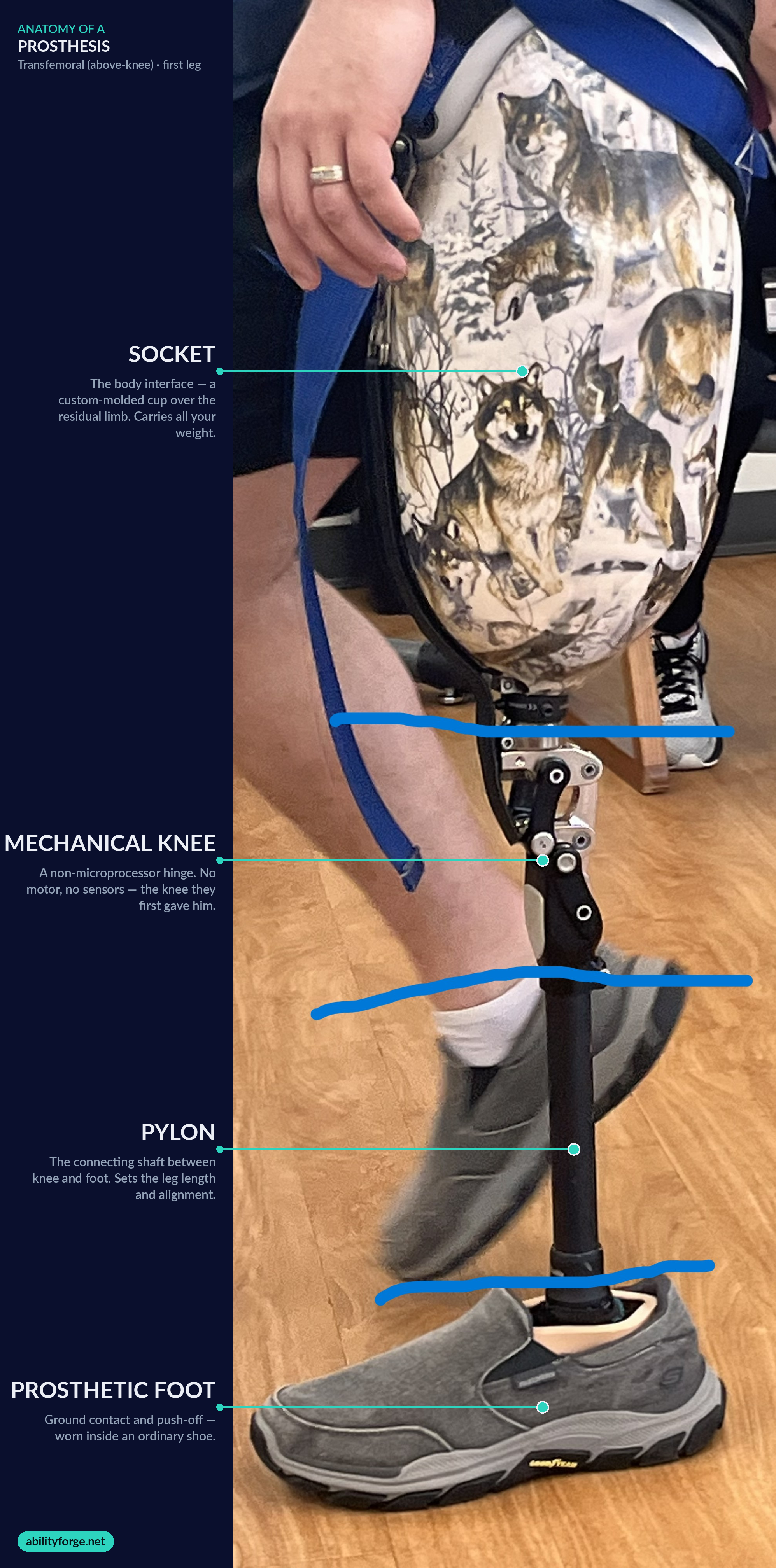
The straight structural tube that connects the knee — or, in a below-knee prosthesis, the socket — to the foot. It's the "shin" of an artificial leg: it carries your weight down to the foot and sets the leg's length and alignment.
In Plain Terms
It's a fancy name for a strong, light tube. Usually aluminum, titanium, or carbon fiber, it does one job well: hold the leg at the right length and pass your weight from the knee down to the foot.
In a modern endoskeletal leg it's an internal tube, often hidden under a shaped foam cover; in an older exoskeletal leg, the hard outer shell is the structure itself.
Mostly a Tube — With Two Exceptions
For most people, the pylon really is just a tube — a precision-made structural tube with an adapter at each end. That's the standard part, and that's what most amputees wear.
Shock absorption usually lives lower down, in the foot — dynamic-response carbon feet and running blades store and return energy with each step. But two specialty pylon versions do exist: a vertical shock-absorbing pylon that telescopes slightly to cushion impact, and a torsion adapter that lets the leg rotate a few degrees so you can pivot without twisting the socket against your skin.
Each even has its own Medicare code — the rotation unit is HCPCS L5986 ("multi-axial rotation unit"), the vertical shock-reducing pylon L5988 — but both are uncommon enough that many amputees never see one, which also makes them exactly the kind of "optional" upgrade a plan can decline.
Sources
Shank function & torsion: "A Prosthetic Shank With Adaptable Torsion Stiffness and Foot Alignment" (NLM/PMC).
Shock-absorbing pylon & gait: "The effect of a shock-absorbing pylon on the gait of persons with unilateral transtibial amputation," VA Journal of Rehabilitation R&D.
On AbilityForge
Of the four parts of the leg, the pylon is the least fought-over — it's the plain connector, hard for anyone to call a luxury. But the pattern still shows up at the edges: the upgraded pylons that cushion impact or let the leg rotate — the very ones that reduce the downstream joint and limb wear this site keeps documenting — are optional add-ons. And "optional" is exactly where denials live.