Mechanical Knee
Also called a non-microprocessor knee (NMPK)
A prosthetic knee that controls standing and stepping through purely mechanical means — friction, springs, locks, and load-triggered latches — with no sensors and no microprocessor. Its behavior is fixed and pre-set: it does the same thing every step, and it cannot sense the difference between a normal step and a stumble. It is the counterpart to the microprocessor knee (MPK).
In Plain Terms — How It Works
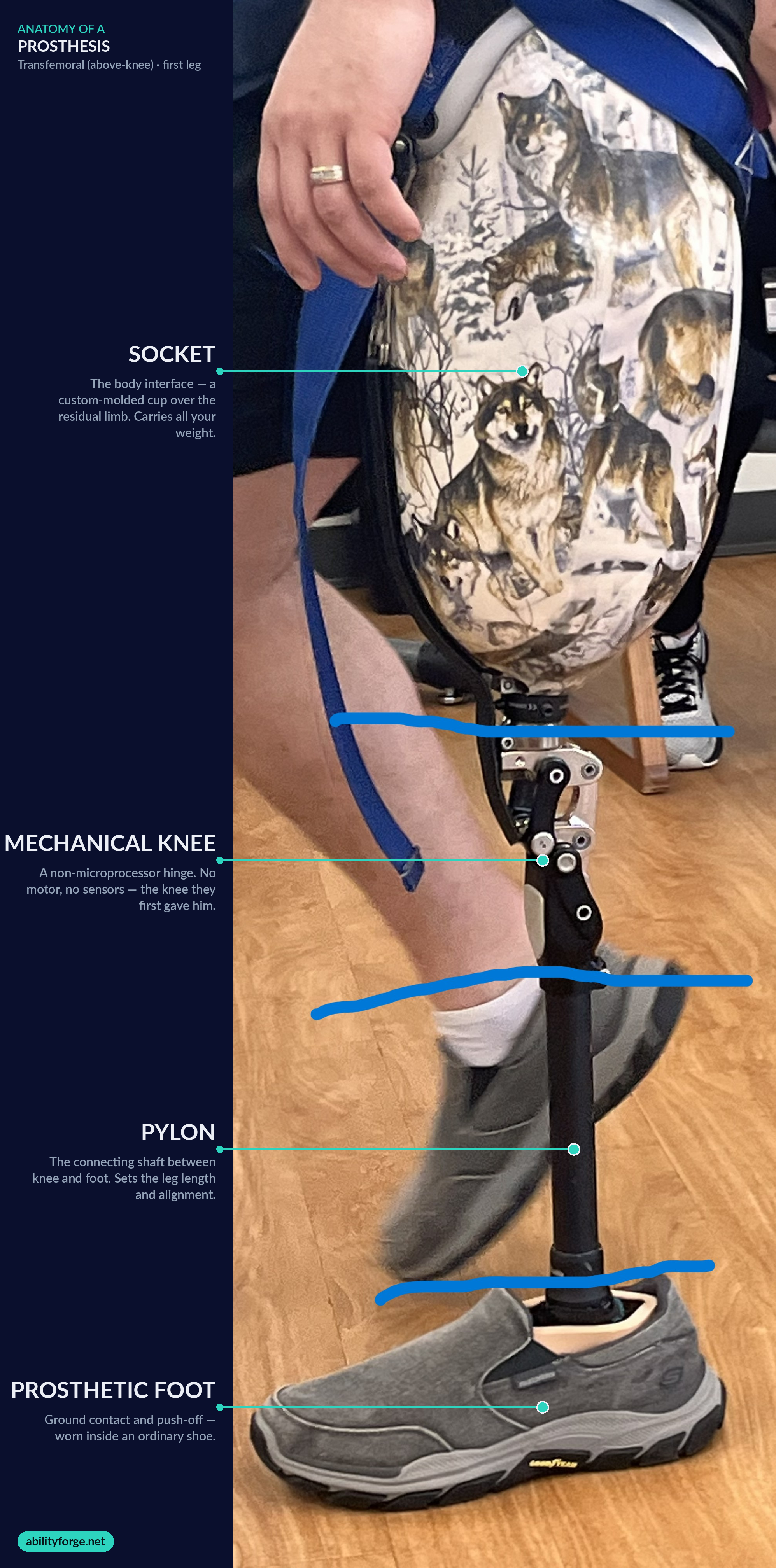
Inside a mechanical stance-control knee, a metal catch grips a plate to hold the knee straight while your weight is on it — that's what stops the leg from folding when you stand on it. To take a step, loading the toe (shifting your weight forward at the end of a stride) trips the catch and releases the knee so it can swing through. No electronics — just a latch and a trigger.
Reliable when it's new, and genuinely useful — this is often the very first knee an amputee is fitted with. But it can't think. It can't tell walking from falling, and it offers no rescue if the timing goes wrong.
How It Fails — the Worn Latch
That catch is a wear part. Under high, repetitive stress — every step, every day, all your weight — the mechanism grinds down. Eventually it stops holding cleanly: it begins to release at the slightest provocation, like a door whose latch has worn until it won't stay shut. The knee then unlocks when it absolutely shouldn't — a small bump, a light touch, a moment of load in the wrong place — and buckles, and you go down.
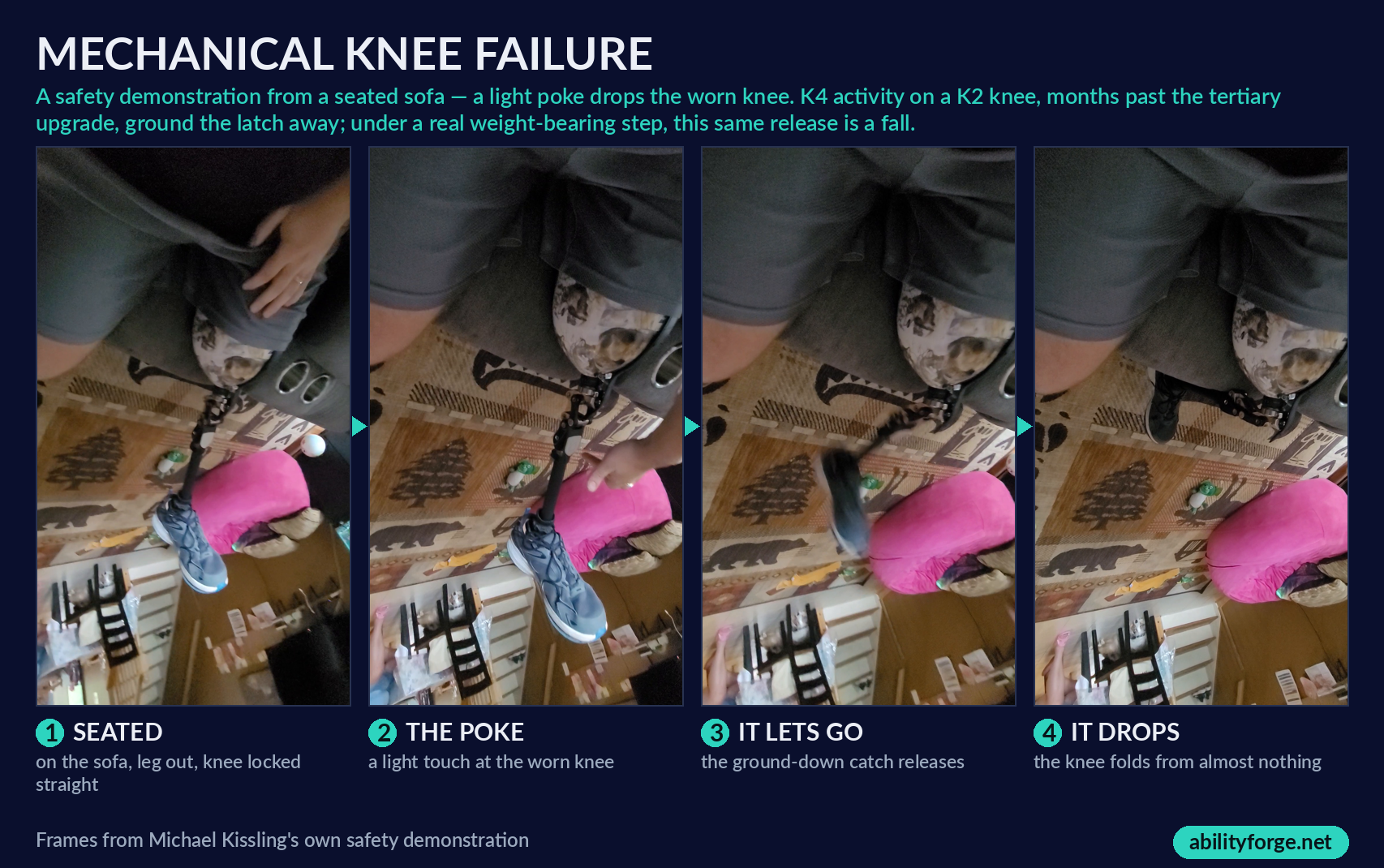
In Michael Kissling's case, the internal catch was ground away until a mere poke would unlatch it. He documented it the only safe way — seated, tapping the knee so it could drop without dropping him — and it gave way from almost nothing. A mechanical knee has no way to notice this is happening and nothing to stop it: on a real weight-bearing step, that same release is a fall.
And the wear wasn't bad luck — it was built in. Michael is a K4 ambulator: the highest activity level. He was kept on a K2-rated mechanical knee — a device built for a "limited community" walker — for months past the point he should have moved to his tertiary (definitive) prosthetic. Put a K4's daily load on a K2's latch and it doesn't just wear; it wears fast. The sequence below is what that mismatch produces.
The Main Types
- Weight-activated stance-control — locks while weight is on the leg and releases as the load shifts. Often the first knee prescribed, and common for older or less active users. (Michael's first leg.)
- Manual locking — locked through the entire gait cycle for maximum stability; the user unlocks it by hand to sit. The most stable, the least natural.
- Constant-friction — a set resistance to swing, tuned to one walking speed.
- Polycentric — a multi-axis linkage whose pivot shifts through the step to add some stance stability and toe clearance.
The Safety Gap
A mechanical knee has no stumble recovery. When the latch releases at the wrong moment — through wear, mistiming, or a trip — nothing intervenes; the buckle just finishes into a fall. That single missing reflex is the entire safety difference between this knee and a microprocessor knee, and it's why the fall data separates the two so sharply.
Sources
Mechanisms and knee types: "Mechanisms and component design of prosthetic knees: a review from a biomechanical function perspective" (NLM/PMC).
MPK vs. NMPK function & falls: "Impacts of Microprocessor-Controlled versus Non-microprocessor-Controlled Prosthetic Knee Joints… on Functional Outcomes" (NLM/PMC). The mechanism description above reflects Michael Kissling's own account of his knee and its failure.
On AbilityForge
This is the knee Michael Kissling was first given. It's the one that couldn't manage stairs — and the one that, when its latch wore out, unlatched at a touch and dropped him. It's the "cheaper" option whose failure mode is falling.
Set that beside what the evidence — and Medicare's own 2024 policy shift — say about the microprocessor knee: fewer falls, higher function, cost-effective. The mechanical knee isn't villainous; it's a real tool with a real place. The wrong is in being held to it, and to its failure mode, when the safer device is proven and available.
And notice the trap built into the rule itself. To qualify for the microprocessor knee, you're often required to demonstrate higher function first — to prove you're a K3. But you're asked to prove it on the very knee whose failure mode is dropping you. You have to "prove and earn" the tool for recovery by performing on the tool that prevents it. It's the same inverted logic this site keeps finding — the stent that required the wounds it would have prevented; the drug you're allowed only after a cheaper one fails you. Prove the catastrophe to earn the prevention.