Prosthetic Socket
The body–device interface — the foundation the whole leg is built on
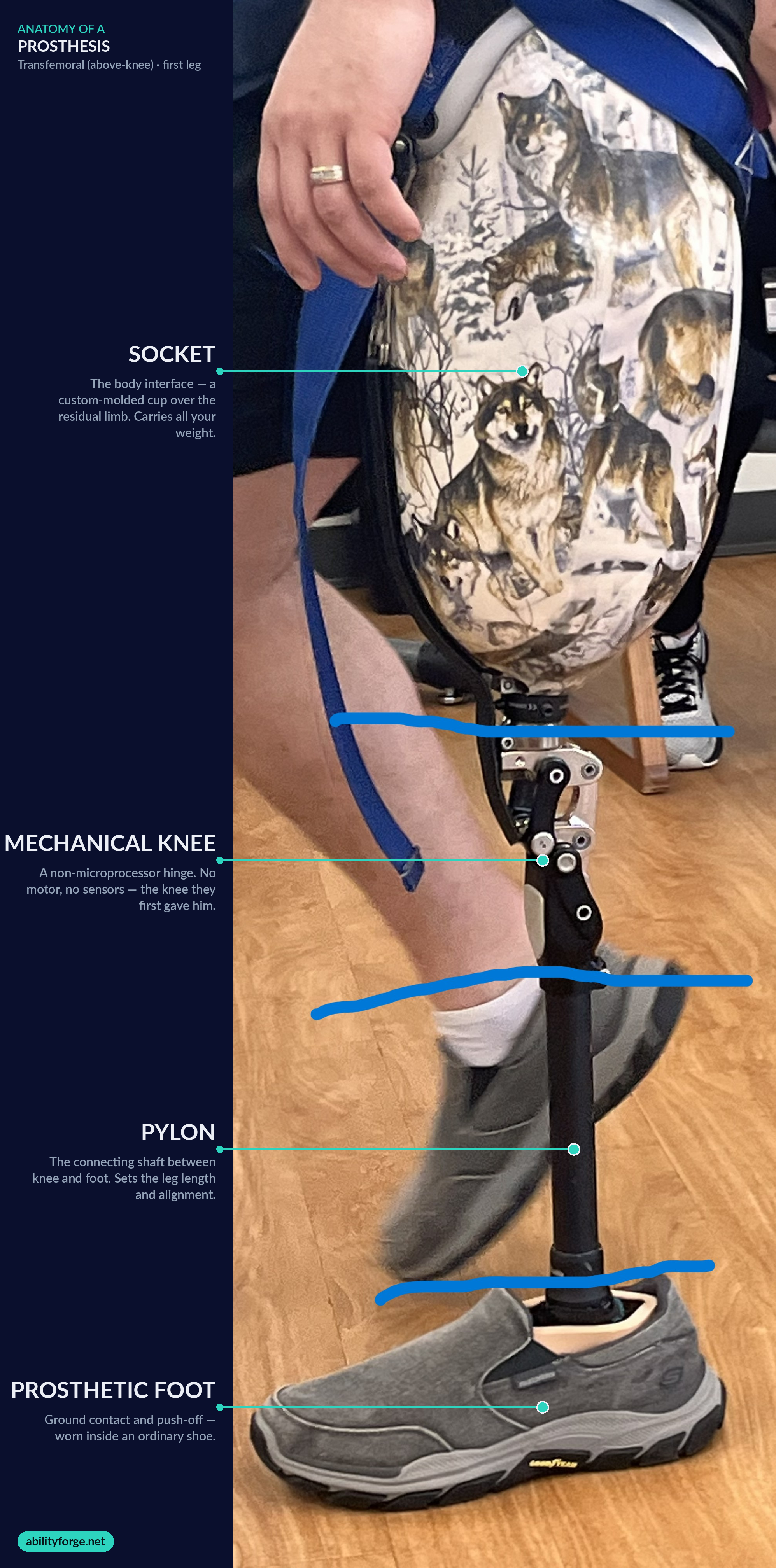
The custom-molded cup at the top of a prosthetic leg — the part that fits over the residual limb and connects it to everything below it (the pylon, the knee, the foot). It is the only component that actually touches the body, and every bit of the body's weight and every force of walking passes through it. Because of that, socket fit is widely considered the single most important factor in whether a prosthesis works at all.
In Plain Terms
The socket is the handshake between your body and the machine. It's the one part that touches you, and it carries your whole weight with every step. Get the fit right and the leg disappears into your gait. Get it wrong and it becomes a source of constant injury — because there's nowhere else to set your weight down.
And here's what the spec sheets miss: if you can't wear the socket, it doesn't matter how advanced the knee or foot below it is. A leg you can't put on isn't a mobility device — it's an expensive prop.
Why Fit Is a Moving Target — the Hermit-Crab Problem
A residual limb isn't a fixed shape. It shrinks as it matures, and it changes with weight. When it outgrows its fit, you don't tweak the same socket forever — like a hermit crab, you leave the old shell behind and get a new one: a fresh socket, cut to the limb's new shape and attached directly to the leg.
How much can it change? Michael Kissling's residual limb shrank so much between sockets that his new, smaller socket could physically be dropped inside the old one — not by design, just a striking measure of how much volume the limb had lost.
And it cuts both ways: gain weight and then lose it, and the limb doesn't return to its old shape — the volume redistributes, so even the old smaller socket won't fit again. Either way, the answer is a new socket. A socket isn't a one-time purchase; it's a consumable that must be re-cut every time the body under it changes — the reality insurers wave away with "you already have a leg."
Sources
Fit and skin-care detail from the Merck Manual (Professional Edition), "Skin Care of the Residual Limb."
Complication rates and secondary-injury findings from "Adjustable Prosthetic Sockets… Skin Breakdown" (NLM/PMC) and "Perceived Effect of Socket Fit on Major Lower Limb Prosthetic Rehabilitation" (NLM/PMC).
Key Points
- The socket is widely regarded as the most important part of the prosthesis — fit determines comfort, control, and whether the leg can be tolerated for daily use.
- A poor fit drives skin breakdown and pressure sores — a frequent complication, reported in roughly 36–41% of lower-limb prosthesis users with rigid sockets — and can progress to pain, ulceration, or infection.
- The residual limb changes volume — day to day, and especially during maturation — so the socket needs ongoing adjustment and, eventually, replacement.
- A bad fit forces the body to compensate, overloading the sound-side leg and the spine — driving overuse injuries and osteoarthritis in the intact limb and back, not just the residual limb.
- When the skin breaks down, patients are told to stop wearing the prosthesis until it heals — which erases mobility and independence entirely.
On AbilityForge
Coverage fights are loud about the parts you can see — the microprocessor knee, the advanced foot. The socket is quieter and more fundamental: it's the part that decides whether any of that can be worn at all. You can win the fanciest knee on the market and still be grounded, because the interface between your body and the machine failed.
And the cost of a bad fit doesn't stay at the limb. Every day the leg can't be worn, the load it should carry goes into the sound leg and the spine instead — wearing down joints that were never meant to do the work of two. A socket denied or under-built isn't a small line item. It's the foundation, and the rest of the body pays for its failure.
See Also