Microprocessor Knee (MPK)
Also called a microprocessor-controlled knee; e.g., the C-Leg, Kenevo, Rheo
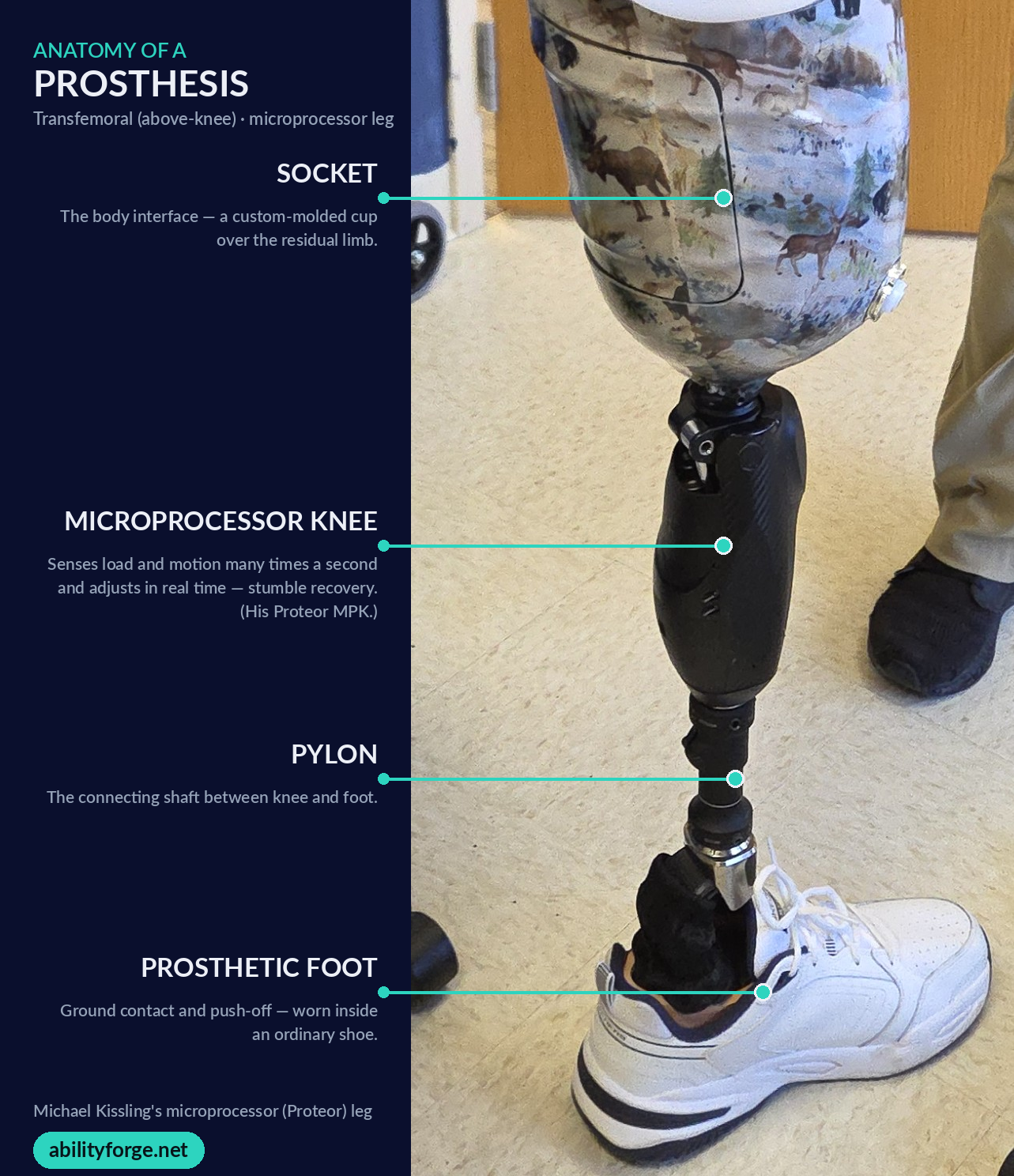
A prosthetic knee with onboard sensors and a microprocessor that reads the leg's load, position, and motion many times per second and adjusts its hydraulic or pneumatic resistance in real time. In effect, the knee knows whether you're standing, walking, descending stairs, or beginning to fall — and responds instantly. A mechanical knee, by contrast, has fixed behavior: it can't tell the difference.
In Plain Terms
The knee thinks. Sensors sample your movement dozens of times a second, and the processor decides — right then — how much to resist bending. Going downstairs, it lets you descend step-over-step instead of shuffling. On a ramp, it holds you back so you don't run away from yourself. Standing still, it locks up so your leg doesn't fold under you.
And the headline feature is the one that saves you: stumble recovery. Swing the leg imperfectly and start to trip, and the knee can snap to high resistance in a fraction of a second — go rigid — and catch you before you go down.
Stumble Recovery — the Feature That Changes the Numbers
This is the standout. The processor watches force and knee-pivot velocity together: if it senses weight going through the leg (a stance-phase load) at the same moment the knee is buckling fast, that pattern reads as a stumble — and the knee instantly imposes high resistance to keep it from collapsing, giving you the split second you need to catch yourself.
A mechanical knee cannot do this. It has no way to know a stumble is happening, so it offers no rescue — the buckle just continues, and the fall follows. That single difference — a knee that can react to a mistake versus one that can't — is exactly why the measured safety metrics come out so decisively in the MPK's favor.
The Evidence — Safety & Function
~64%
reduction in falls reported with a microprocessor knee vs. a mechanical one
18.5%
fewer injured fallers when K2 users were provided MPKs (Medicare cohort)
100%
of simulated scenarios in which the MPK was the more effective option
Beyond falls, microprocessor knees let users handle ramps, stairs, and uneven ground that a mechanical knee forces them to avoid — producing a more stable, more natural, less exhausting gait. In head-to-head modeling, the MPK was the more effective device in every single simulated scenario.
The K2 Breakthrough & the 2024 Medicare Change
For years, Medicare reserved microprocessor knees for K3 and K4 ambulators, and denied them to K2 ("limited community") walkers — on the theory that K2 users couldn't benefit. The clinical evidence dismantled that theory. When K2 amputees were actually fitted with MPKs, they didn't stay put: many began functioning at a K3 level, more active than they had been — and over 12 months they held their quality of life, while matched users kept on mechanical knees significantly declined.
That body of work — including the ASCENT K2 randomized controlled trial and a manufacturer-supported evidence base spanning multiple studies and a meta-analysis of 704 patients — is what forced the policy to move. On July 18, 2024, Medicare released a final Local Coverage Determination expanding microprocessor-knee coverage to K2 beneficiaries for the first time.
The lesson underneath it is the one this whole site keeps finding: the "you won't benefit" denial was never a fact about the patient. It was an assumption — and when someone finally paid to test it, the patients proved it wrong by climbing a whole functional level.
The Economics — Why It's Also the Cheaper Choice
≈99%
the modeled probability that the microprocessor knee is the cost-effective choice at a standard willingness-to-pay threshold — a near-certain "good investment" verdict, echoed across independent cost-effectiveness studies (e.g., 97–99% at €40,000/QALY for the C-Leg and Kenevo).
The objection to MPKs is always the sticker price. But the fuller accounting keeps landing the other way: fewer falls means fewer fractures, ER visits, and hospitalizations, and those avoided costs add up fast.
- For the K1–K2 population, the MPK's cost per quality-adjusted life-year came to $13,568/QALY — well inside the range health systems treat as good value.
- Providing MPKs to Medicare K2 users produced roughly $1,351 per-member-per-month in medical savings, amortizing the ~$25,075 price difference in about 19 months.
- Scaled to the population, that modeled to an estimated $410.3 million in Medicare savings over 10 years.
And this isn't a US-only or manufacturer verdict. Independent analyses across the United States, Sweden, and Germany — different health systems, different price structures, different willingness-to-pay thresholds — keep landing in the same place: the microprocessor knee is the sound investment. When payers who share none of the same incentives all reach the same answer, that's not marketing. That's a finding.
Sources
2024 coverage change: "Medicare Expands Coverage for Microprocessor Knees for K2 Beneficiaries," The O&P EDGE; AOPA, "Final Lower Limb Prosthesis Policy Released."
K2 clinical evidence: ASCENT K2 randomized controlled trial (Disability & Rehabilitation).
Economics: "Economic benefits of microprocessor controlled prosthetic knees: a modeling study," J. NeuroEngineering & Rehabilitation (NLM/PMC); retrospective cohort of Medicare K2 economic value (NLM/PMC).
Cost-effectiveness probability (99% at €40,000/QALY): "The Kenevo microprocessor-controlled prosthetic knee… a cost-effectiveness and budget-impact analysis," Prosthetics & Orthotics International (NLM/PMC) — corroborated at 97–99% by the C-Leg analysis, European Journal of Health Economics.
On AbilityForge
This is the knee at the center of Michael Kissling's componentry fight — and the contrast that defines it. He was first given a mechanical knee: the one that couldn't manage stairs, the one with no way to catch a stumble. The microprocessor knee is the device the evidence says cuts falls, keeps people at a higher function, and pays for itself — and it was the piece the insurer resisted.
Hold that against the 2024 policy change. Medicare looked at the same evidence and widened access toward K2 patients — while individual denials were still treating a proven, cost-saving safety device as a luxury. The technology's value isn't in dispute in the literature. The only thing in dispute is whether a given person will be allowed to have it.
See Also