Prosthetic Foot
Where the leg meets the ground
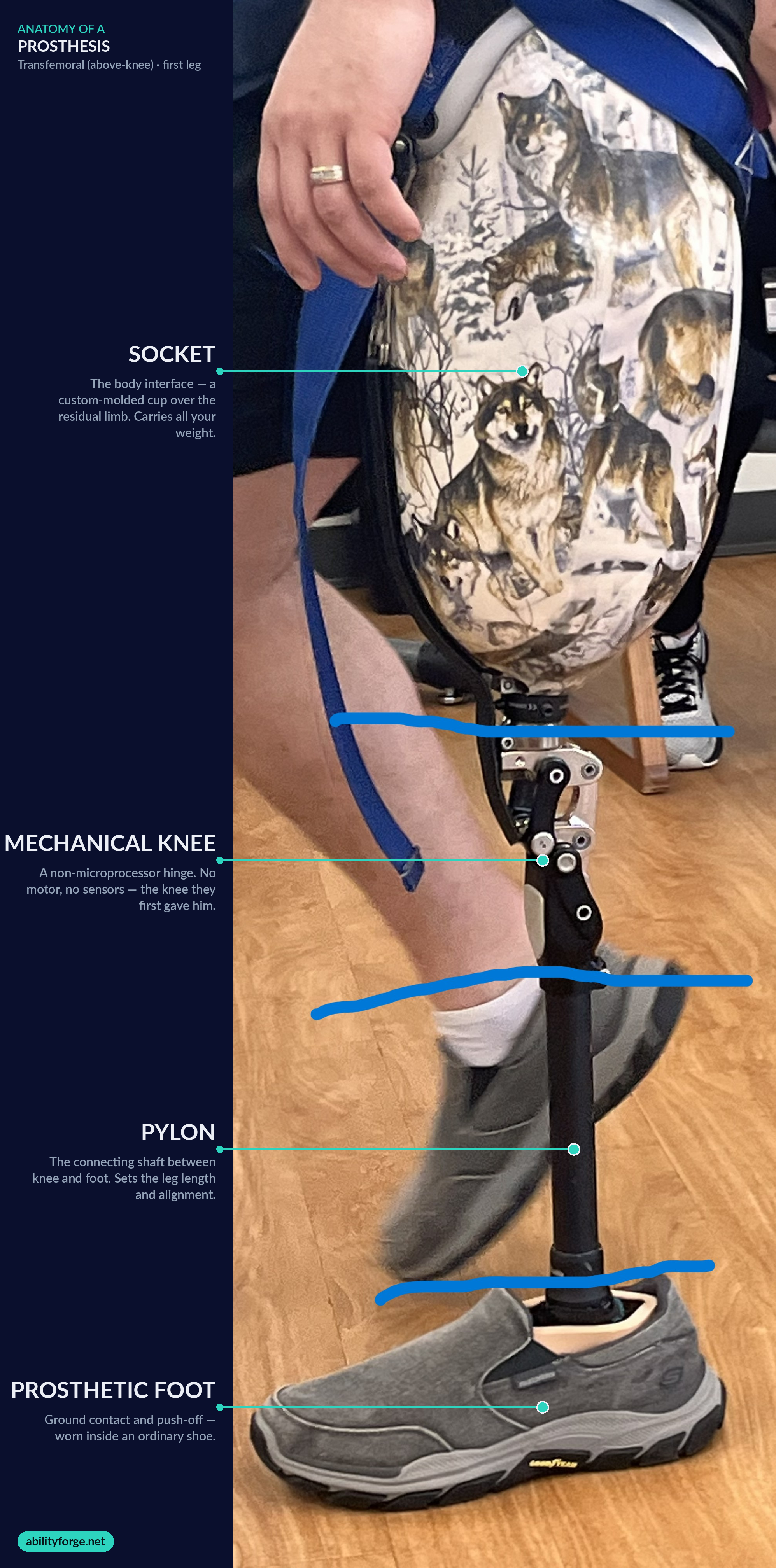
The component at the bottom of the leg that makes contact with the ground. It provides the base of support, cushions the impact at heel-strike, and — in better designs — returns energy at push-off, restoring the roles the foot and ankle used to play. This is the part of the prosthesis with the widest range: from a simple cushioned block to a powered, sensing ankle.
In Plain Terms
A real foot does three things in a single step: it cushions the landing at the heel, stays stable in the middle, and pushes you off into the next step at the toe. Every prosthetic foot tries to imitate those three jobs.
How well it does the third one — the push-off — is what mostly separates a basic foot from an advanced one. A block of rubber can cushion and stay stable. Giving energy back takes real engineering.
The Range — Basic to Advanced
SACH — Solid Ankle, Cushion Heel
The simplest foot: a rigid inner keel with a soft heel wedge that squashes under load to fake a little ankle motion. No moving parts. For limited walkers.
Single-Axis
A hinged ankle that gets the foot flat quickly for stability — helpful for above-knee users with less knee control.
Multi-Axis
Moves in several planes — not just up-and-down but side-to-side — so it adapts to uneven ground and rough terrain.
Energy-Storing / Dynamic-Response (ESAR)
Carbon-fiber leaf springs that store energy as you load the step and spring it back at push-off — the same trick your Achilles tendon does. This is where "energy return" lives. For active walkers.
Microprocessor & Powered Ankles
Sensors adjust the ankle angle for stairs and slopes (e.g., Össur Proprio), or a motor adds real powered push-off (e.g., Ottobock Empower). The highest function — and the priciest.
Running Blades — specialized ESAR
A pure carbon spring with no heel, built to store and return energy for sprinting (e.g., the Flex-Foot Cheetah). Not a walking foot — a piece of athletic equipment for a body.
Sources
Foot types & function: "Prosthetic Feet," Amputee Coalition.
Coverage denials of activity/running prostheses: KFF Health News; PBS NewsHour.
On AbilityForge
The foot is where the coverage fight gets its sharpest. The advanced feet — dynamic-response, microprocessor, powered — are gated by K-level, the same way the microprocessor knee is. And the running and activity blades sit at the very edge of the argument: insurers routinely deny them as "not medically necessary" or "recreational" — as though the ability to run, or exercise, or keep up with your own kid, weren't health itself.
About half of states have passed "insurance fairness" laws requiring prosthetic coverage on par with other benefits, and some specifically cover devices for physical activity. But those laws only reach state-regulated plans — and more than half of privately insured people are in self-funded plans that state law doesn't touch. So whether you're allowed to move often comes down to an accident of which plan you happen to have.