Market Actor for Reform — Allied Voice

Claimable
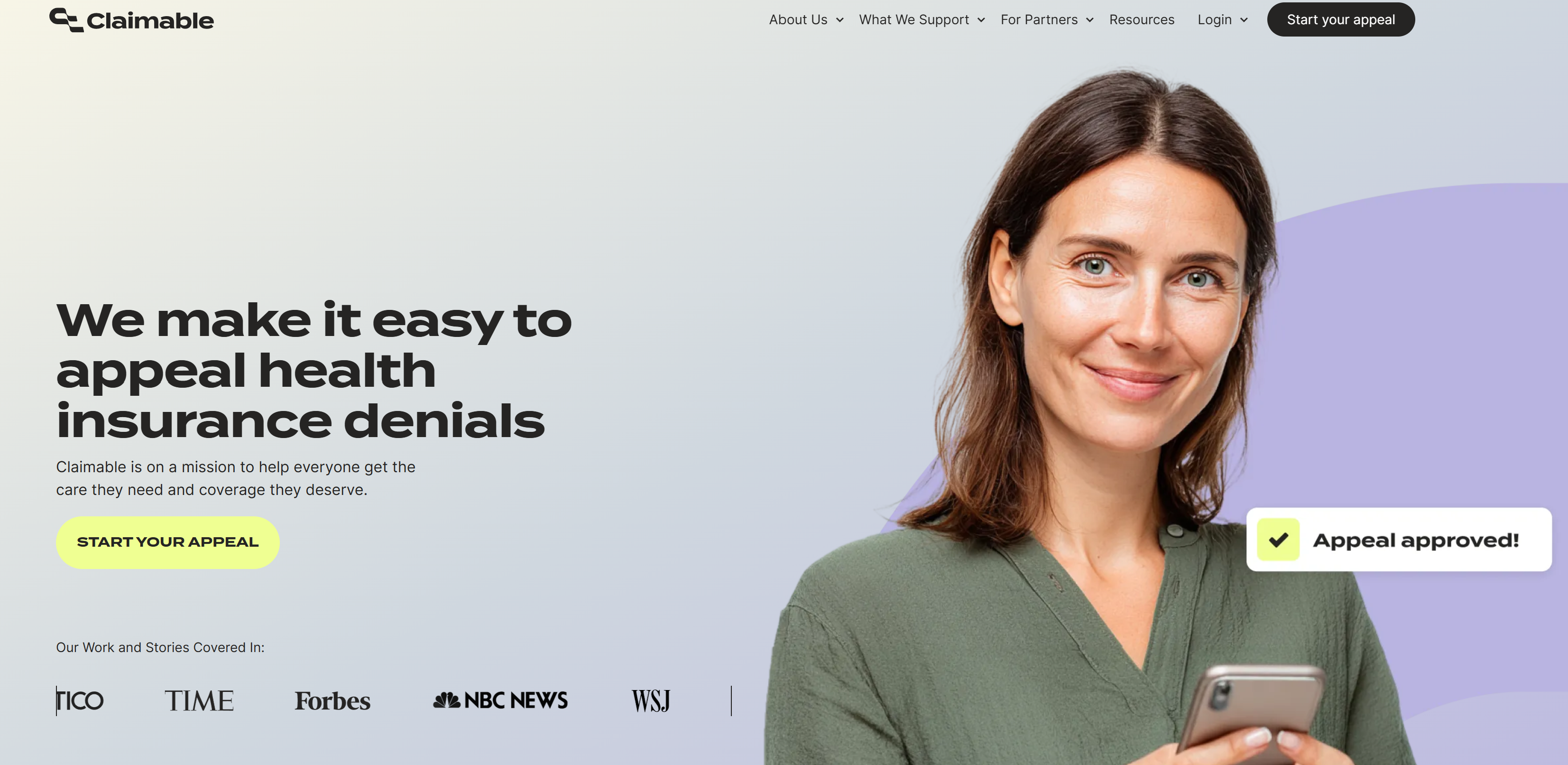
We make it easy to appeal health insurance denials
Physician-led · AI-assisted · Covered in WSJ, TIME, Forbes, NBC News
Why They're Here — Featured with Permission
Warris Bokhari, MD — CEO and Co-Founder of Claimable — gave AbilityForge permission to feature this work. That matters. Claimable is physician-led from its founding premise: the system generates 850 million denied U.S. health claims every year, and nearly all of them are never challenged. Not because the denials are correct. Because the appeals process is designed to be hard enough that most people give up.
AbilityForge features Claimable because the evidence meets the standard: 80% of Claimable appeals succeed. The system's bet — that patients won't fight — is a bad bet when patients have the right infrastructure. Claimable is that infrastructure.
Section I
Why Appeal?
With the right evidence and a well-crafted appeal, you can overturn unjust denials, prevent care delays, and protect yourself from unnecessary medical expenses.
1 in 5
Denied
20% of insured adults face a denied health claim, but you don't need to go it alone — Claimable can help.
<1%
Appeal
Most people don't pursue an appeal, yet everyone has the right to demand a fair resolution — Claimable makes it easy.
80%+
Succeed
80% of Claimable appeals succeed, with most resolved in 10 days or less — delivering industry-leading results.
The Structural Argument
The gap between how many claims are denied (20%) and how many are ever appealed (under 1%) is not ignorance — it is friction. Insurers know most patients won't fight. The appeal process requires time, medical language, documentation, and persistence that most people in the middle of a health crisis don't have. Claimable removes every one of those friction points. The math is simple: if 80% of appeals succeed and almost nobody appeals, a massive amount of denied care is being accepted without challenge. That is not a patient problem. That is an infrastructure gap.
Section II
The Platform
AI-assisted appeal letters, built for patients — not billing departments
Claimable uses AI to draft appeals that are medically grounded, legally formatted, and rooted in the specific denial your insurer issued. You describe your situation. Claimable builds the case. The result is a professional appeal letter that speaks the language an insurer is required to respond to.
How It Works
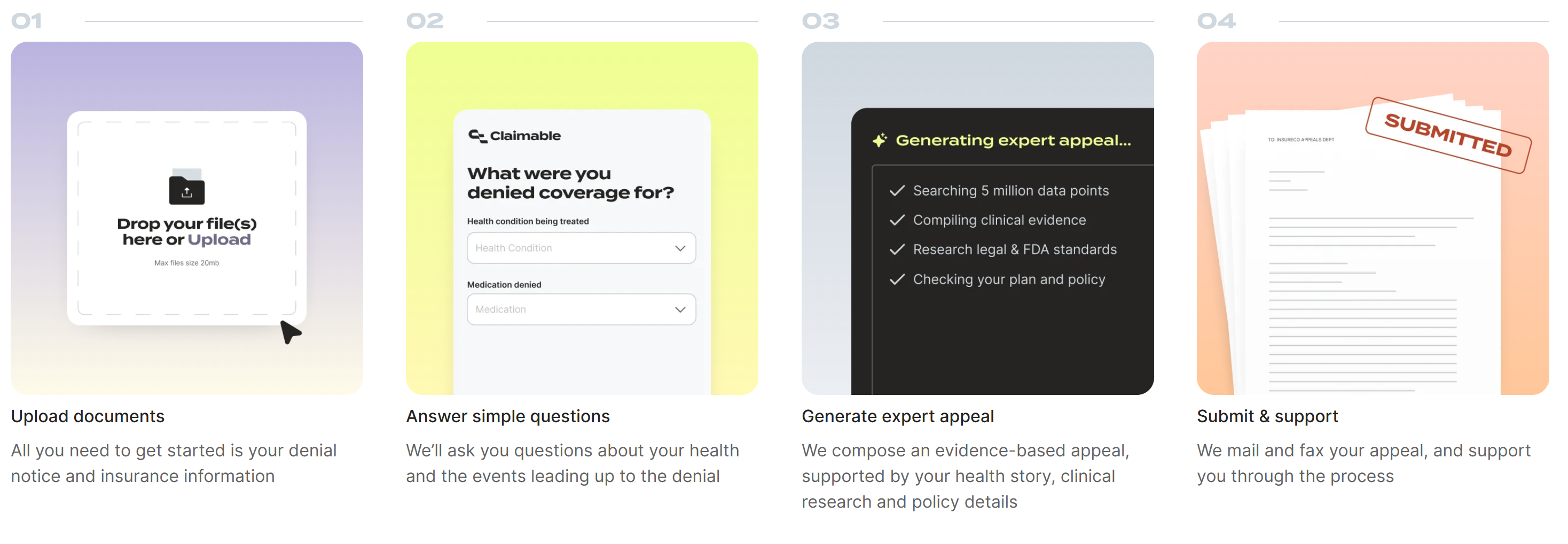
The process is designed around the reality that the person using it is probably dealing with a health crisis, not a billing department. The output is a letter formatted to the standard an insurer must acknowledge.
What Claimable Builds for You
Section III
About the Team
Physician-led · Healthcare insider · AI-native
Claimable's physician-led team of healthcare and insurance insiders, data scientists, and technologists is committed to challenging the 850 million denied U.S. health claims each year — overturning unjust denials and reducing barriers to care, financial strain, and medical debt.
Warris Bokhari, MD
CEO & Co-Founder
Warris has led healthcare strategy and innovation for over 15 years at companies like GE, Apple Health, Anthem, and Amazon. A former NHS physician and startup founder, Warris drives Claimable's mission to transform healthcare through technology.
Alicia Graham
COO & Co-Founder
Alicia has led growth, product, and design for over 15 years. She worked with companies like Kaiser, CareFirst, Amgen, Disney, and Airbnb as a leader at Accenture and frog design, and later joined Truepill to shape pharmacy experiences for digital health pioneers.
Zach Veigulis
CAIO & Co-Founder
Zach is the former Chief Data Scientist at the VA's National Center for Collaborative Healthcare Innovation, with over 10 years of experience in healthcare data science. A peer-reviewed researcher, his work has earned 150+ citations and powers Claimable's AI platform.
On the AI. Zach's time at the VA gave him unique insight into the power of clean, longitudinal healthcare datasets that AI can learn from. Claimable uses AI not only to automate appeals, but to ensure the story behind the care is heard. Their results: 80%+ success rate, decisions returned in under 10 days on average. — DSM Partnership
Section IV
Press Coverage
WSJ · TIME · Forbes · NBC News · DSM Partnership
Wall Street Journal · Health
Five Steps to Take if Your Health-Insurance Claim Is Denied
Read the WSJ article ↗State assistance programs and nonprofits including the Patient Advocate Foundation and the Medicare Rights Center can help craft appeals. A startup called Claimable is trying to use technology to smooth the process.
Claimable: Turning Denied Claims into Human Stories
Read the DSM Partnership profile ↗Zach's time at the VA gave him unique insight into the power of data — particularly clean, longitudinal datasets that AI can learn from. Claimable uses AI not only to automate appeals, but to ensure the story behind the care is heard. Their results speak volumes: an 80%+ success rate in appeals, with decisions returned in under 10 days on average.
Also covered in TIME, Forbes, and NBC News.
Section V
The Call Is Coming From Inside the House
Optum pitched Claimable on denial-reduction software. Optum’s parent company is UnitedHealth Group.
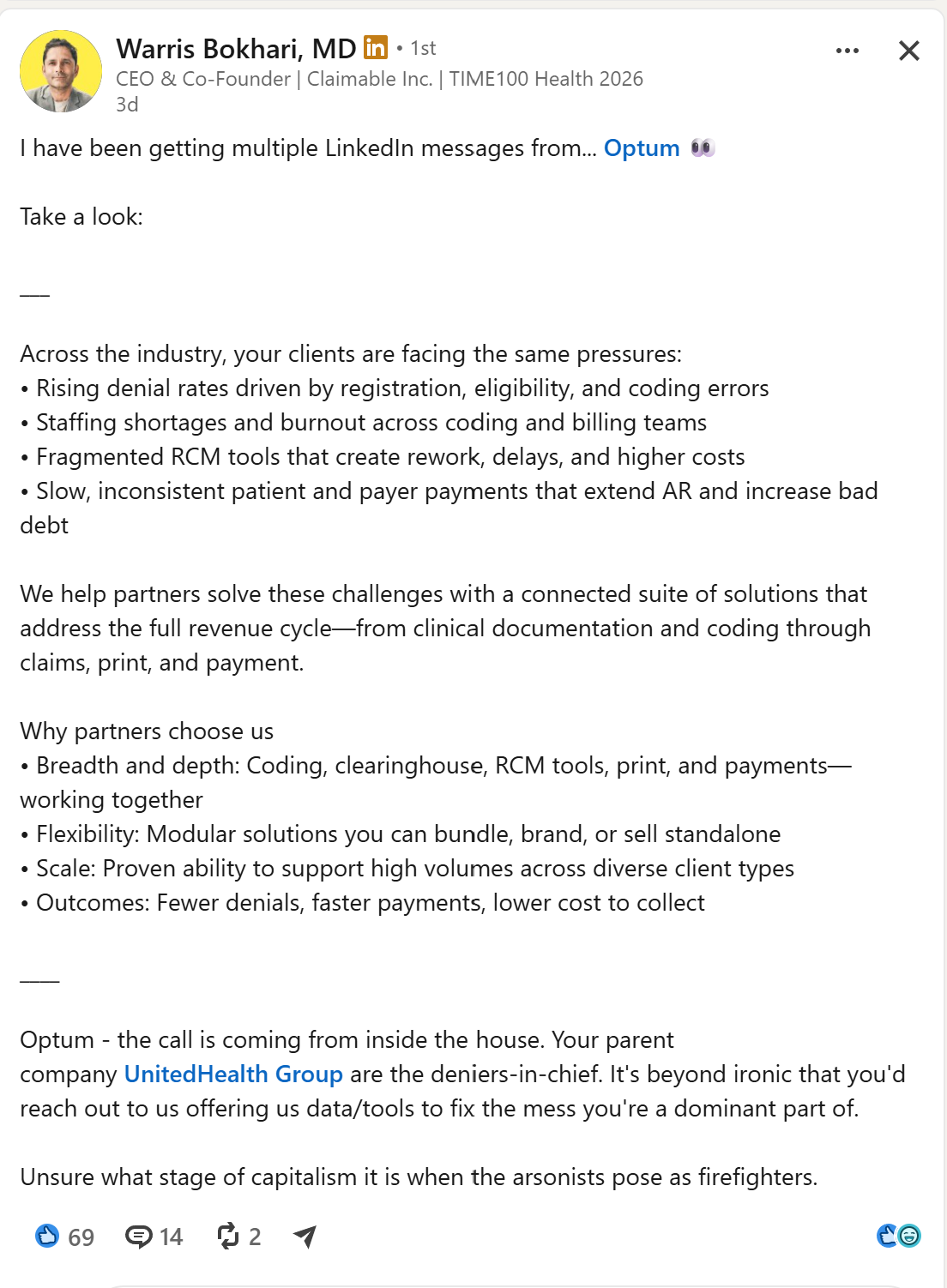
In September 2026, Warris Bokhari, MD posted that he had been receiving repeated sales outreach on LinkedIn from Optum — the health-services arm of UnitedHealth Group, the same corporate parent as UnitedHealthcare. Rather than ignore it, he published the pitch.
What the Pitch Sells
“Across the industry, your clients are facing the same pressures: rising denial rates driven by registration, eligibility, and coding errors…”
“Why partners choose us — Outcomes: Fewer denials, faster payments, lower cost to collect.”
— Outreach message from Optum, as published by Warris Bokhari, MD
His Answer
“Optum — the call is coming from inside the house. Your parent company UnitedHealth Group are the deniers-in-chief. It’s beyond ironic that you’d reach out to us offering us data/tools to fix the mess you’re a dominant part of.”
“Unsure what stage of capitalism it is when the arsonists pose as firefighters.”
— Warris Bokhari, MD, CEO & Co-Founder, Claimable
Why This Is on AbilityForge
One corporate parent stands on both sides of this. UnitedHealthcare issues the denials. Optum sells the tooling to reduce them. Both are UnitedHealth Group. That is what vertical integrationVertical IntegrationA corporate structure in which a single entity owns multiple layers of the healthcare delivery chain — insurer, pharmacy benefit manager, pharmacy, and physician group — creating s… looks like from the inside: the denial is not only a cost the company controls, it is a condition that supports a second product line.
Notice what the sales copy concedes on its own. It names “rising denial rates” as an industry-wide pressure and offers “fewer denials” as a purchasable outcome. A UnitedHealth Group subsidiary is marketing, in writing, the premise that denial rates are too high and that they can be brought down. AbilityForge argues denial rates are a choice rather than an accident. Optum’s own pitch deck treats them as a lever.
And most likely no one aimed this at Claimable. It reads like generic outbound sales — a list, a template, a send. Which is the more damning version: the machine that pitched denial reduction to the company built to fight denials is the same kind of machine that mails a coverage denial to a newborn. Nobody chose it. Nobody was positioned to notice.
The Obvious Objection, Stated Plainly
Revenue-cycle products like this one address administrative denials — registration, eligibility and coding errors on the provider’s side. That is a different category from the medical-necessity and prior-authorization denials documented in the Reason Room. Anyone defending the pitch will say so, and they are right about the distinction.
It does not rescue the structure. The distinction explains which denials the product touches; it does not explain why the largest issuer of denials in the country owns the company selling relief from them. The conflict is not in the product category. It is in the org chart.
Sourcing
This is Dr. Bokhari’s own public account of messages he received, published under his name on LinkedIn. AbilityForge has not independently verified the outreach and has no way to do so — the record here is what he published. AbilityForge is not aware of any public response from Optum, which is not the same as there being none. His words are quoted as his; the pitch text is quoted as what he says he received.
Read the original LinkedIn post ↗Start Your Appeal
Don't accept a denial you haven't fought
Less than 1% of denied claims are ever appealed. 80% of those appeals succeed. You have the right to demand a fair resolution. Claimable makes it possible to do that without a lawyer, a billing specialist, or medical-insurance expertise.