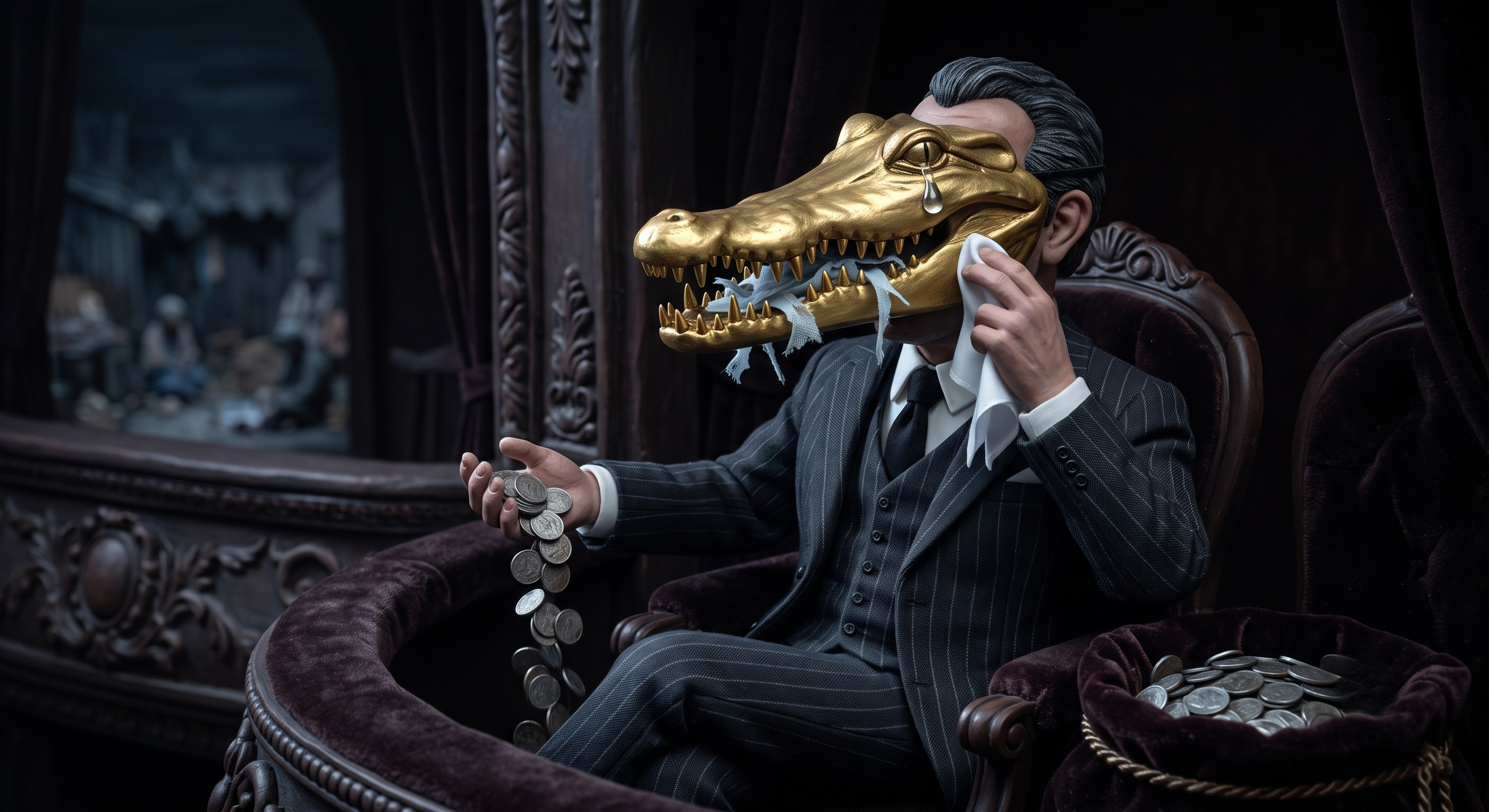
Step Right Up
The Pitch
Told by a roguish bard to his fireside, the tale runs like this: a carnival barker presents the architecture of insurance denial to a room of beast-masked shareholders — framed as innovation, sold as inevitability — until a mother who was never supposed to be in the room reaches the one man the machine can't fully insulate: a senator whose mask still comes off.
Aesthetic Direction
The Cast
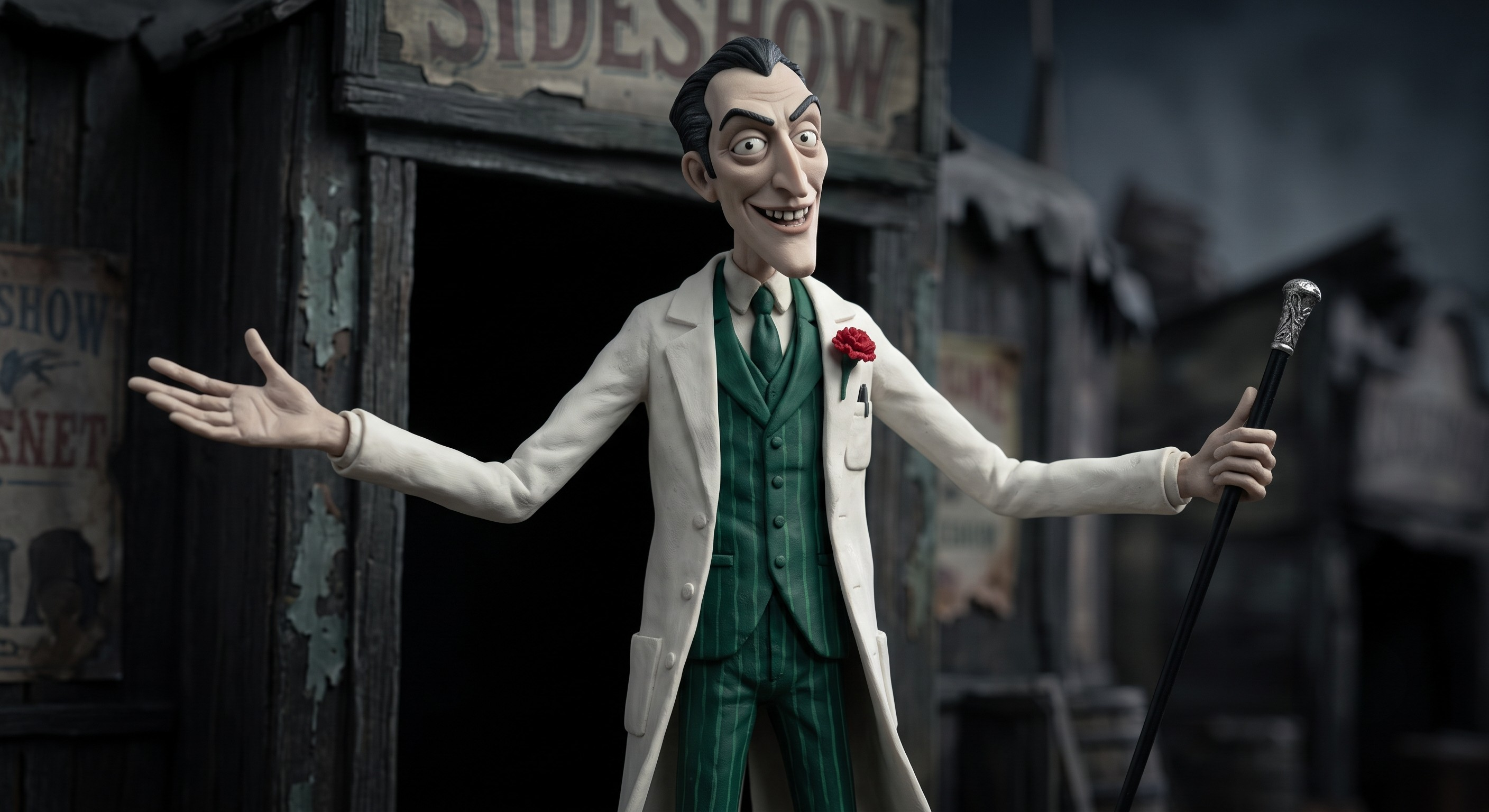
Emerald-green pinstripe suit — dressed as medicine in an open white coat, but built of money underneath. A slim silver-handled cane always in hand, never set down: it hides a sword. One red carnation. Denial letters fanned like a magician's deck. He is the composite face of every insurer, so no single company can be named. He is not hiding the mechanism — he is performing it, and his delight is genuine. That is what makes him monstrous.

She wears white. She didn't come to protest. She came because she knew the senator would be here, outside his glass. She tracked him to the one room where the machinery is exposed. She is not lost or hysterical — she is precise. She has done her research. She knows exactly what question will break through.
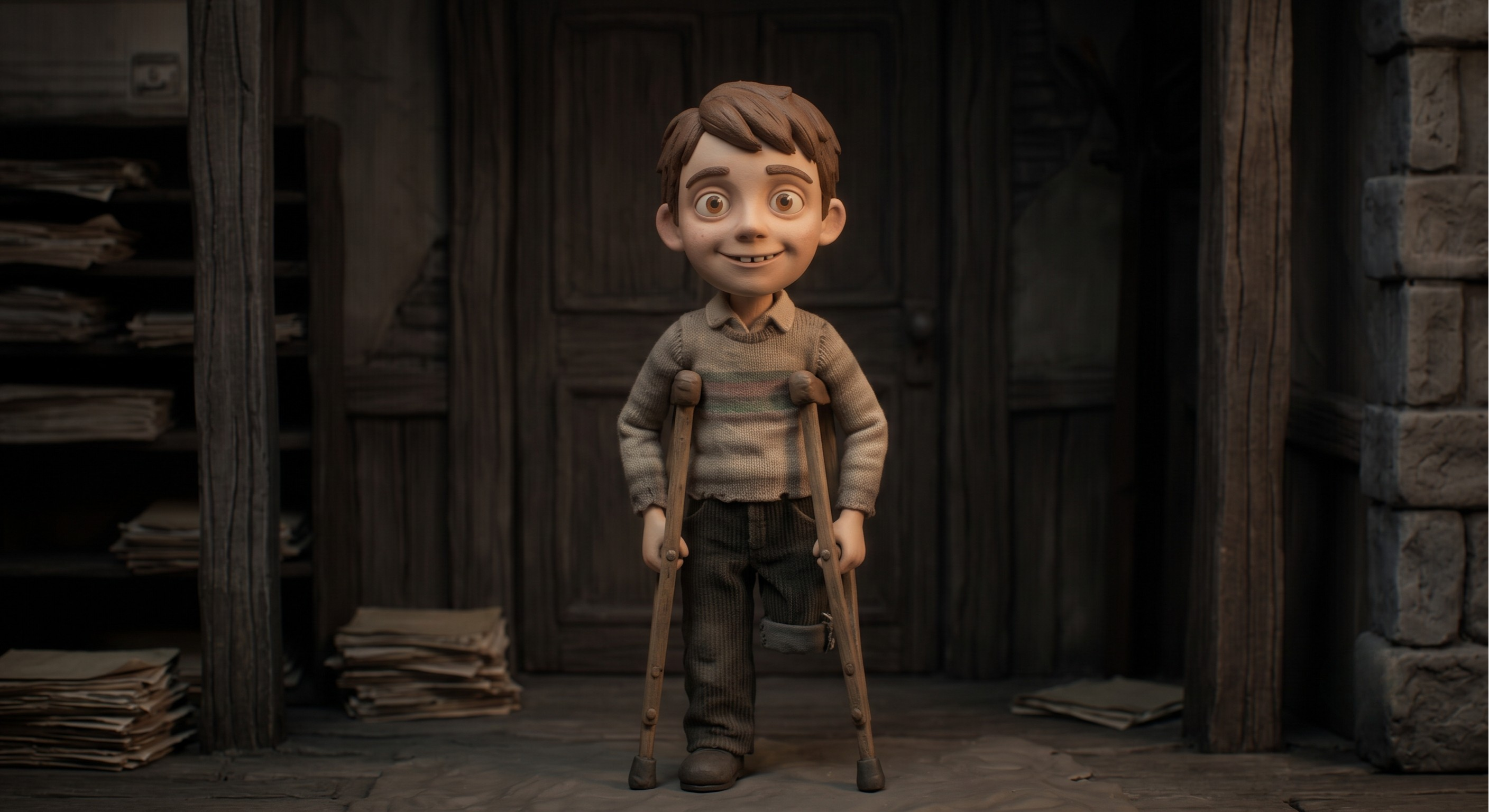
Sara's boy — her eyes exactly. Missing a leg, upright on a pair of worn wooden crutches. Named to summon Tiny Tim, and built the same way: his goodness is the indictment. He never rages; he just keeps being a sweet, scuffed kid, and that is what makes the cruelty unforgivable. The empty chair the bell tolls for is his.
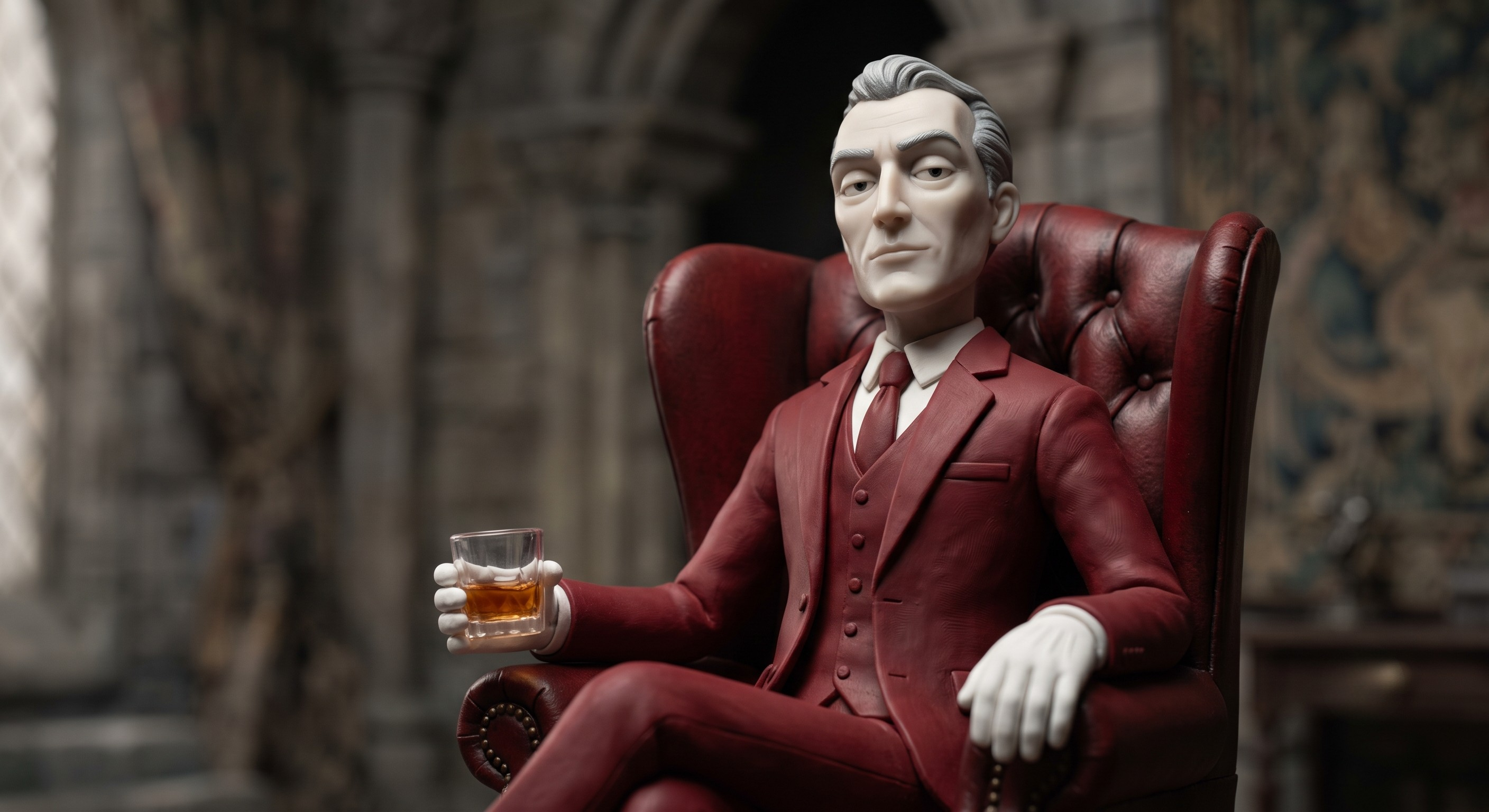
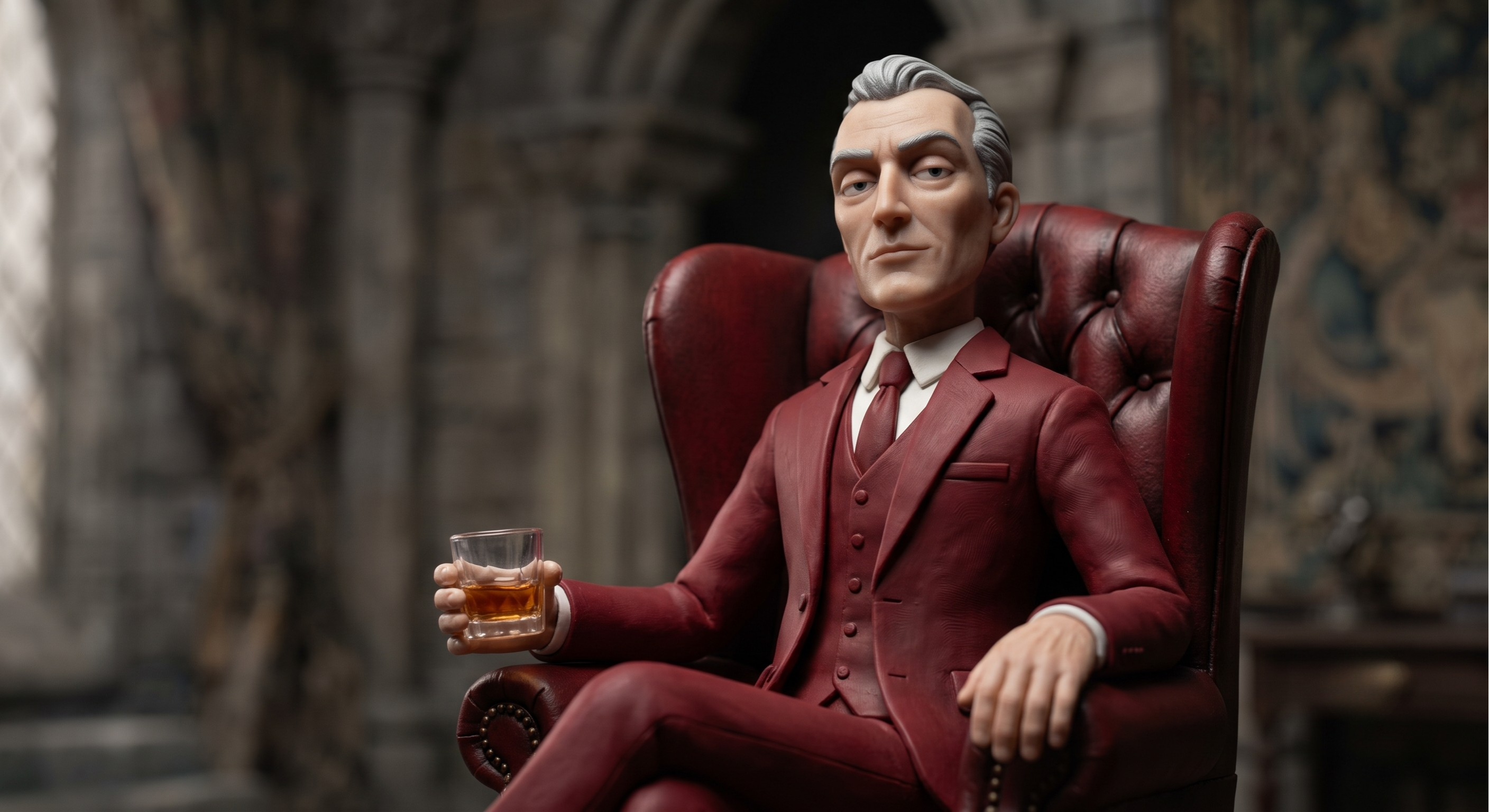
Deep-red three-piece suit, white gloves, a crystal of whiskey, a red leather wingback throne. In Act I his face is corpse-pale marble — a whitewashed tomb, beautiful outward and calcified within — and he wears a gold peacock mask: pure vanity, all plumage. He is not the machine; he is the one man the plea can still reach.
His whole arc is a thaw, played in three synchronized signals: the peacock mask lifts, the white gloves come off, and the marble warms to living skin. The Barker never repents — you don't redeem the profit machine — but Sara makes John answer the one question the room was built to spare him, and his is the mask that comes off.
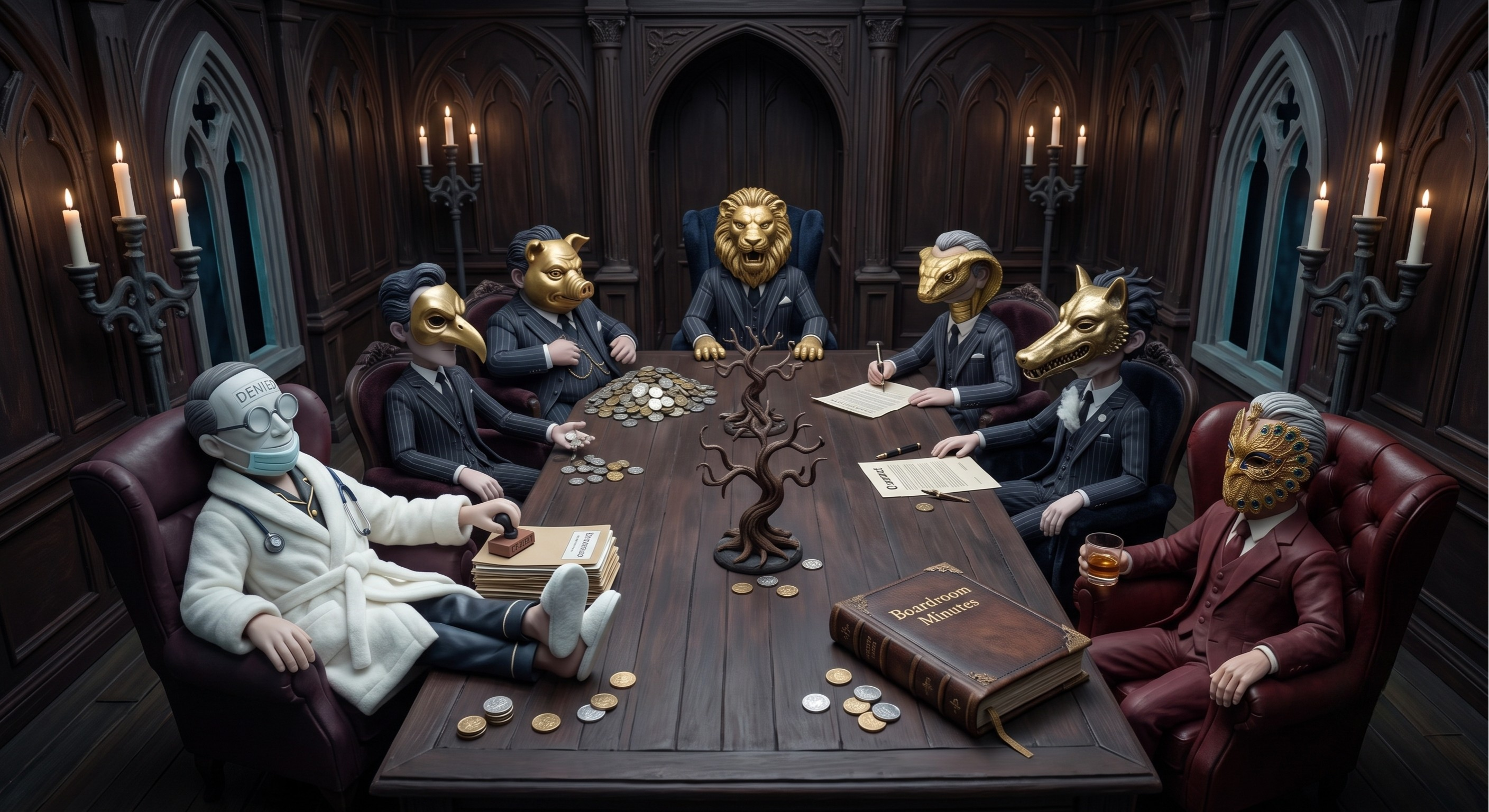
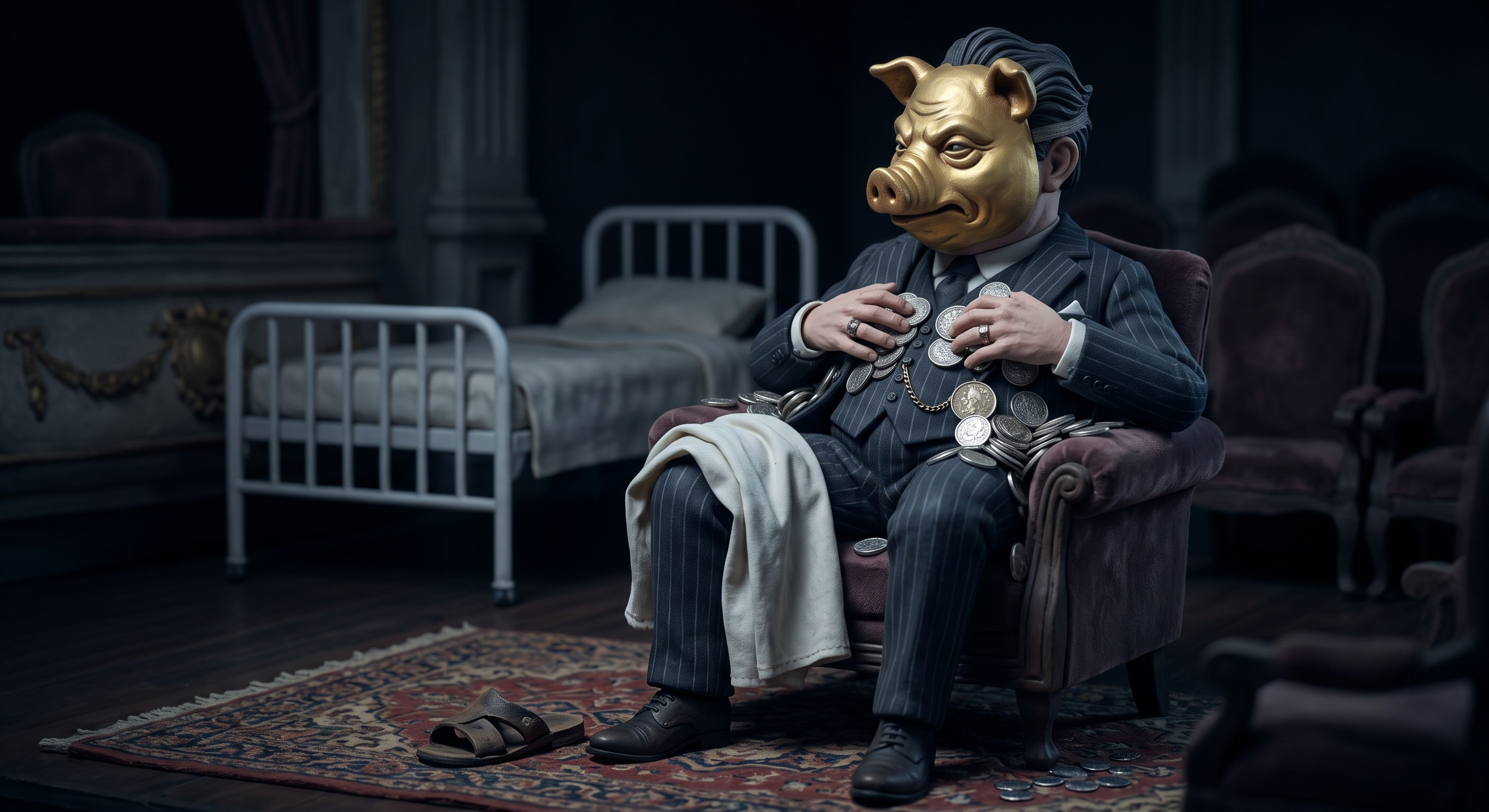
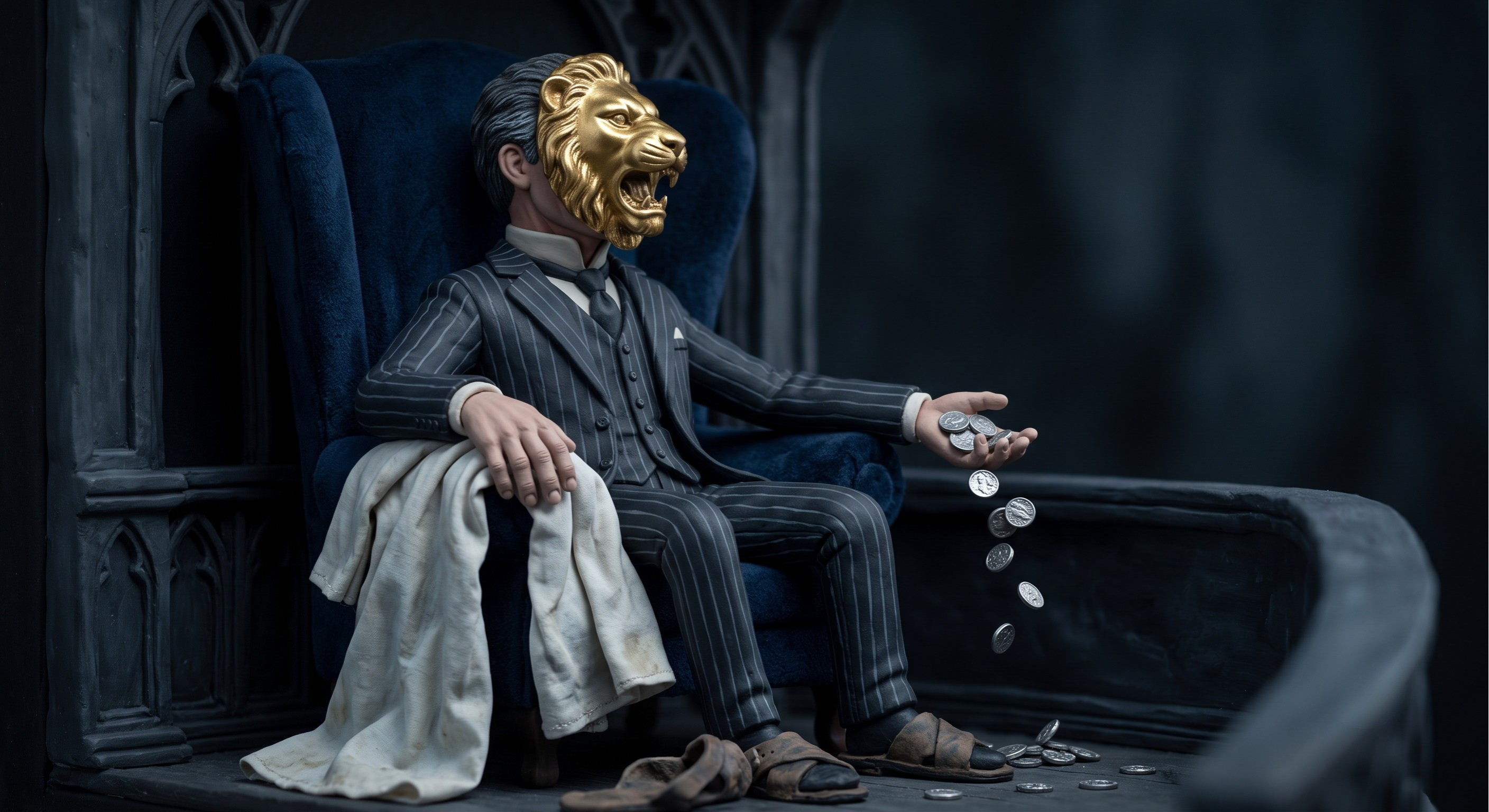
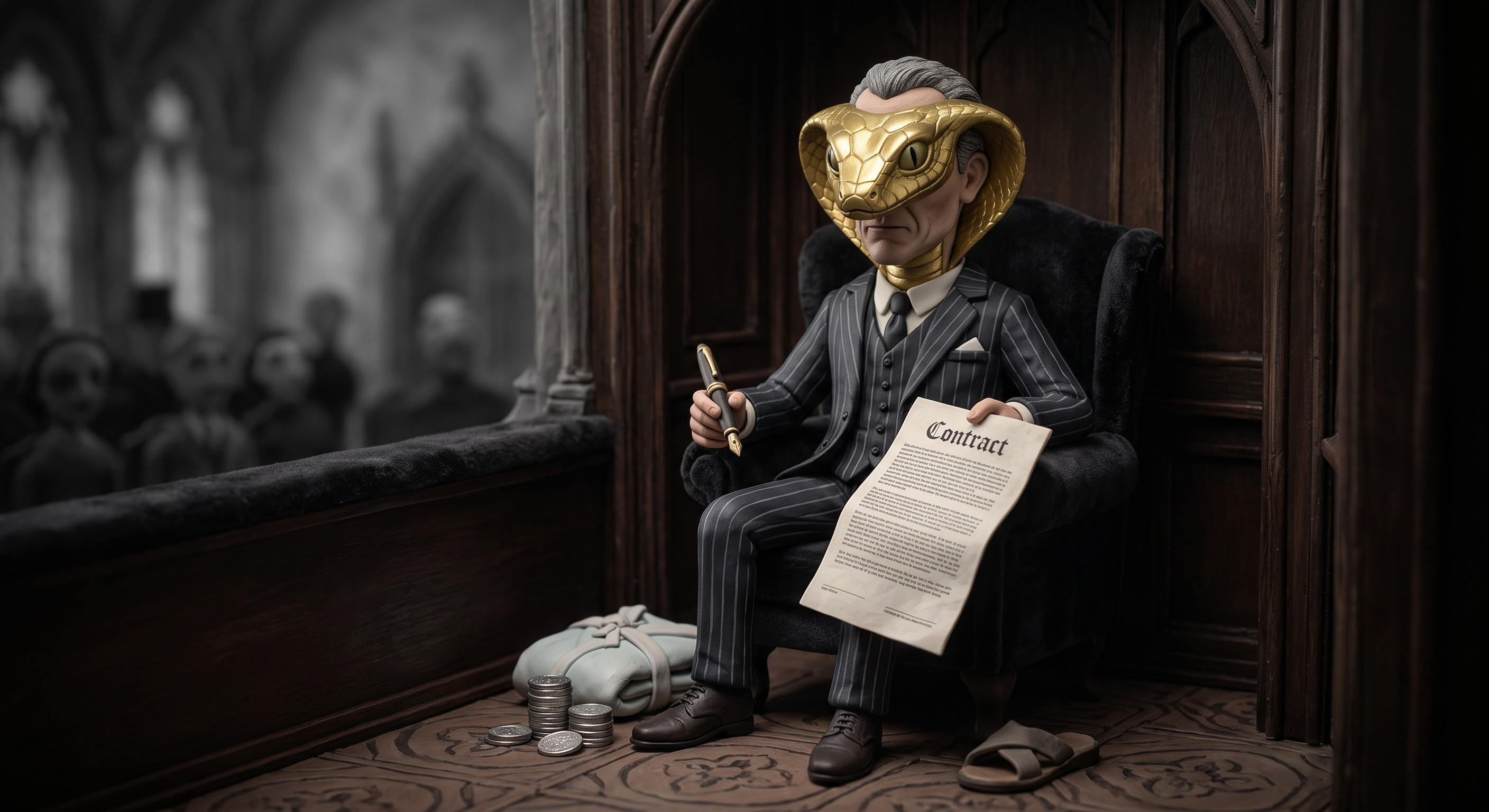
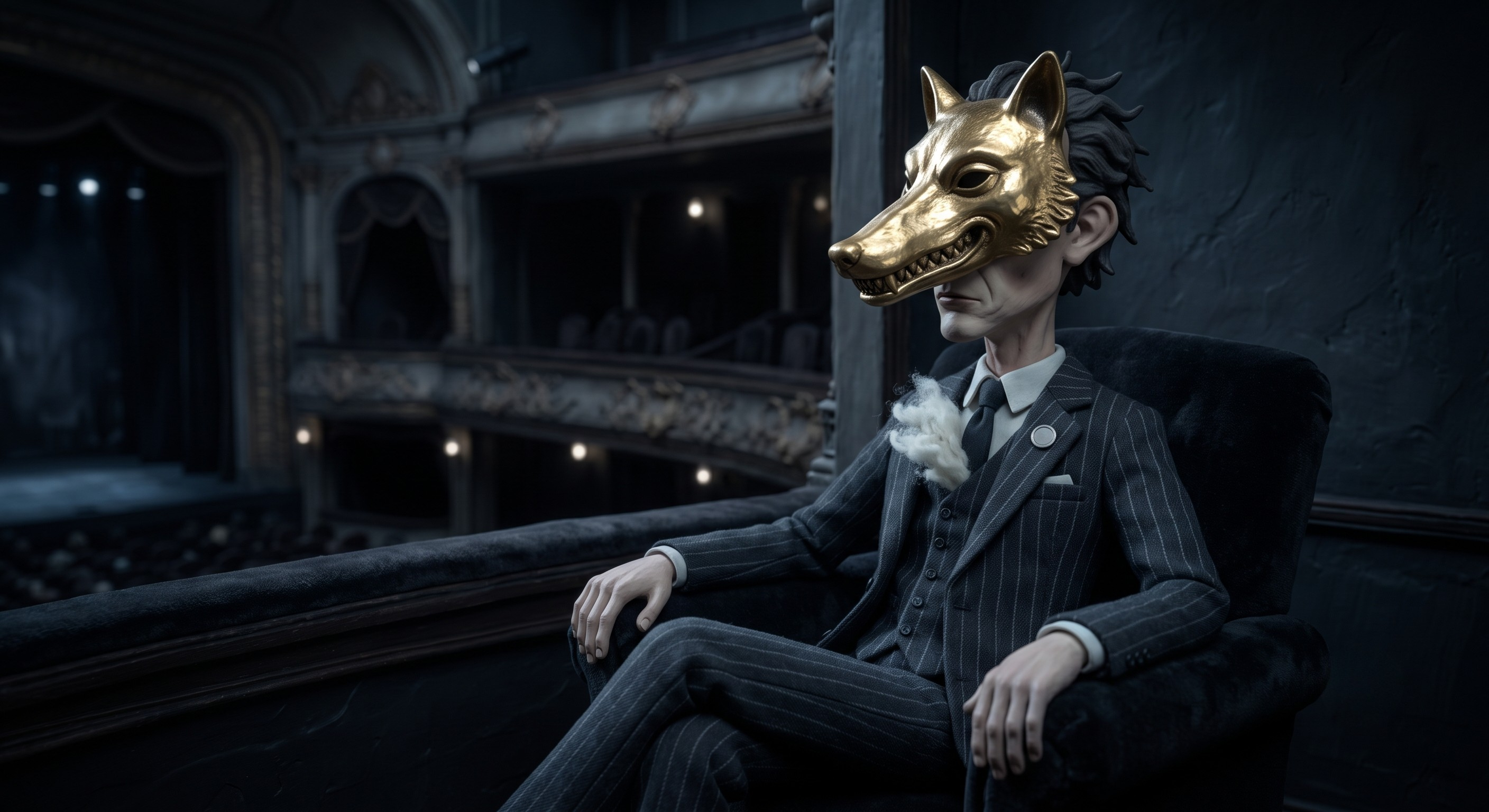
The audience the show is secretly performed for. Respectable dark suits, one master underneath: each wears a gold beast mask — vulture, pig, lion, serpent, wolf — the sin in the face. One of them almost has a conscience; he asks the clarifying question that gives the Barker his most damning line. The rest applaud on cue. (Full bestiary below.)
Ruddy & the Fireside
The whole tale is a story told by a roguish halfling bard, Ruddy James, to a small party gathered at his fire — the audience that feels the tale, the mirror of the shareholders' owner's-box. He does the jokes and the "hey, wait a minute — that part's real." His listeners carry the weight he can't.
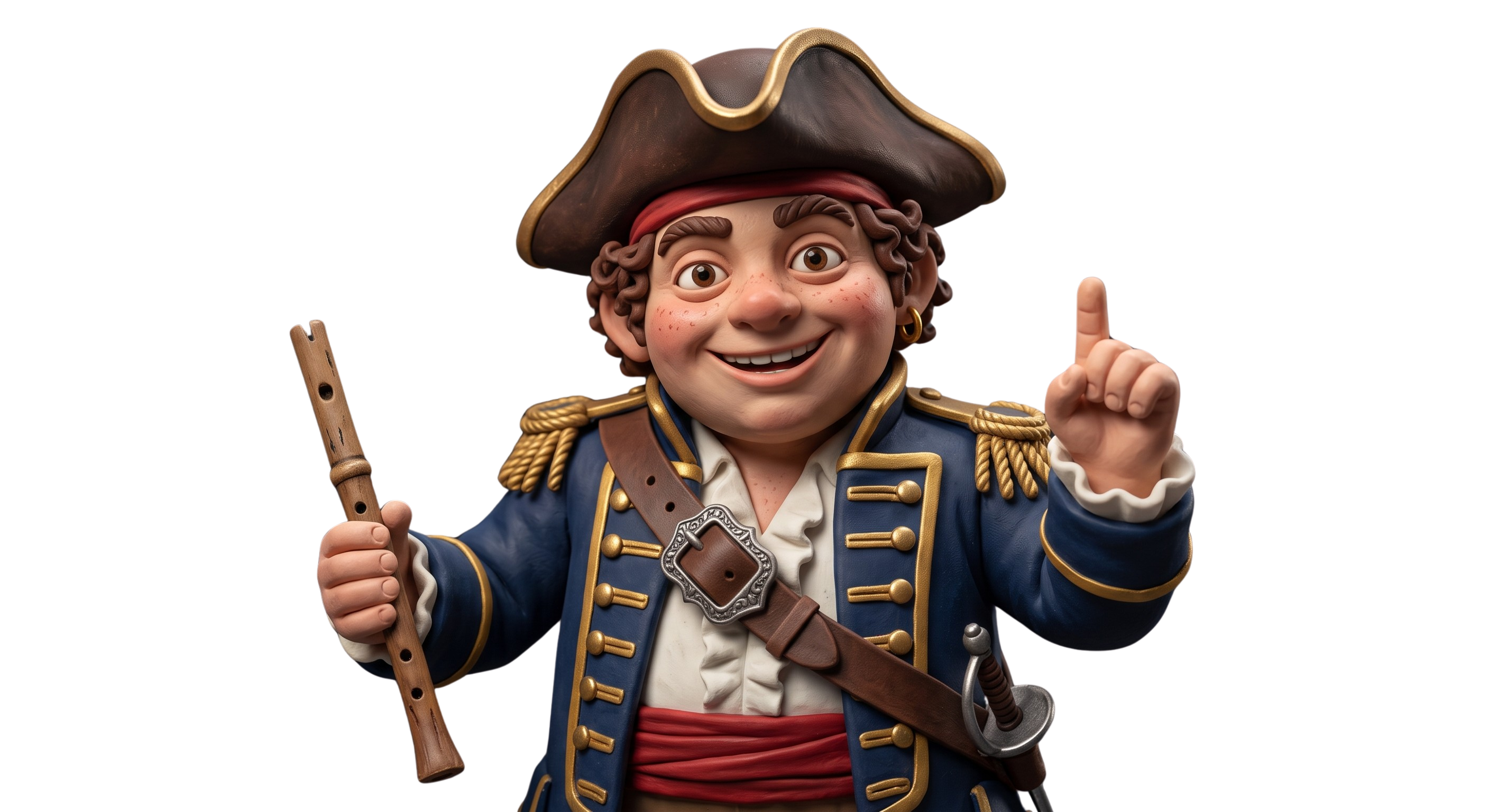
The frame. A bright, warm, fourth-wall-breaking storyteller — flute in hand, the one who welds undeniable data to an irresistible story. He walks you in, then hushes at the grave.

Where Ruddy quips, Micamos is grave. The shield who took the blow so others could reach sanctuary; his authority is earned, not positional. He carries the serious warnings.
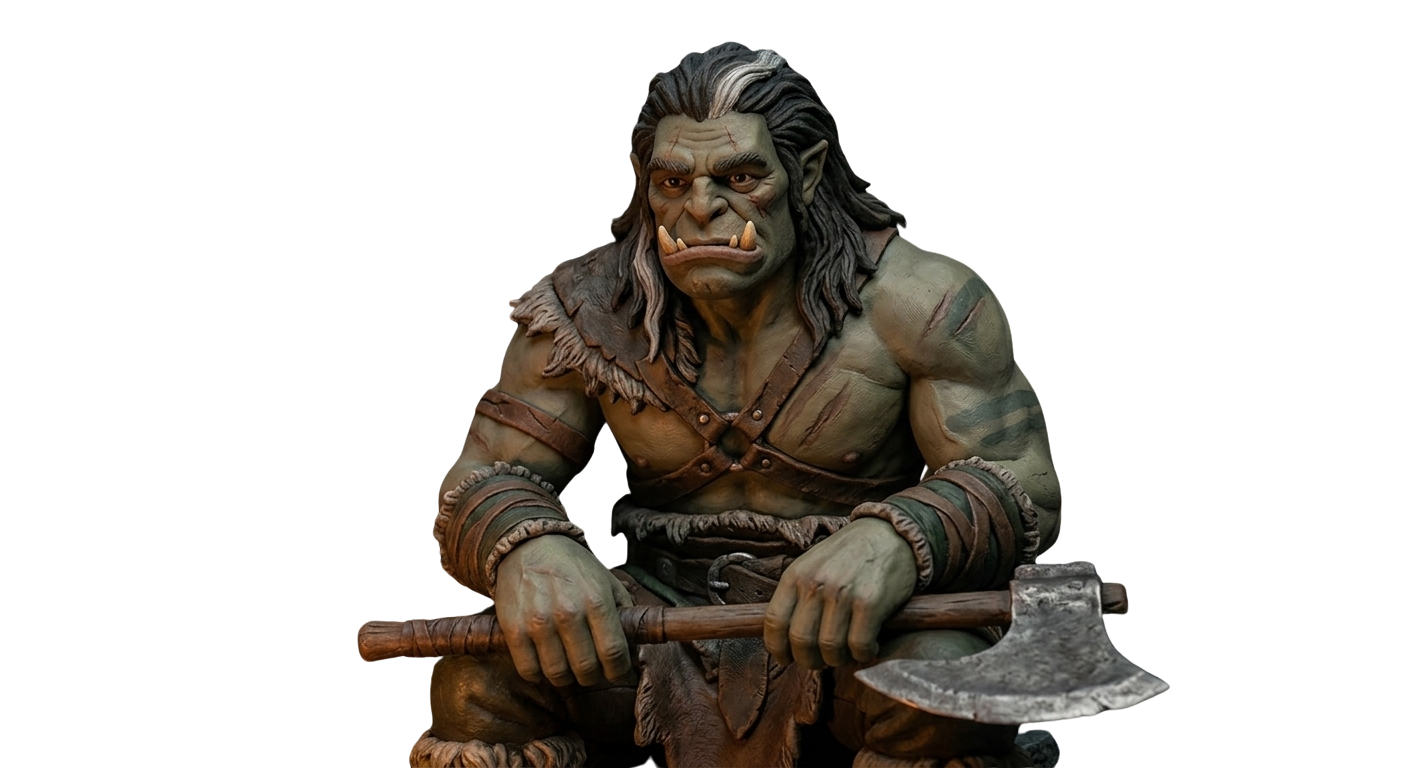
The half-orc who wants to burn it all down — the "call down fire" zeal that must be steered, not stifled. A gentle giant off the battlefield; the storm Micamos stands beside and calms.
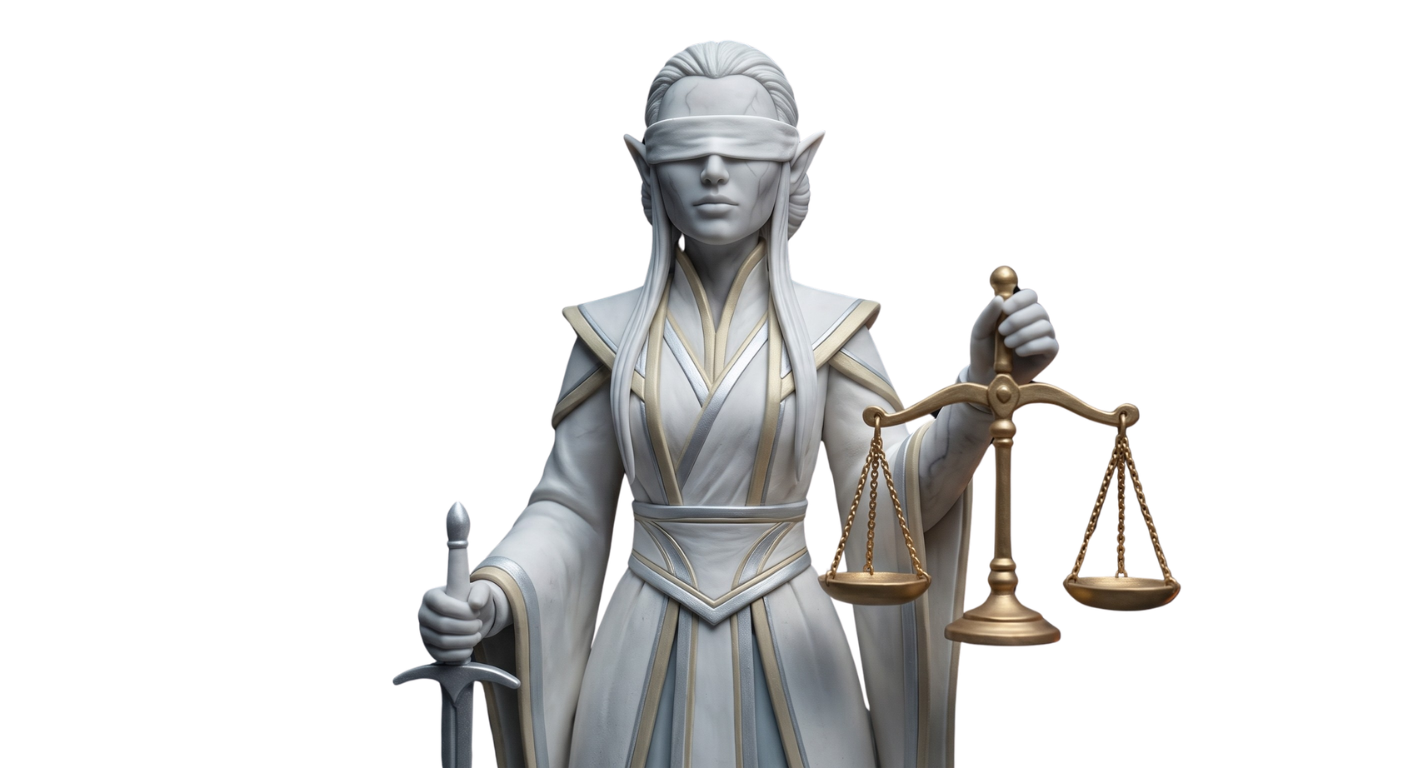
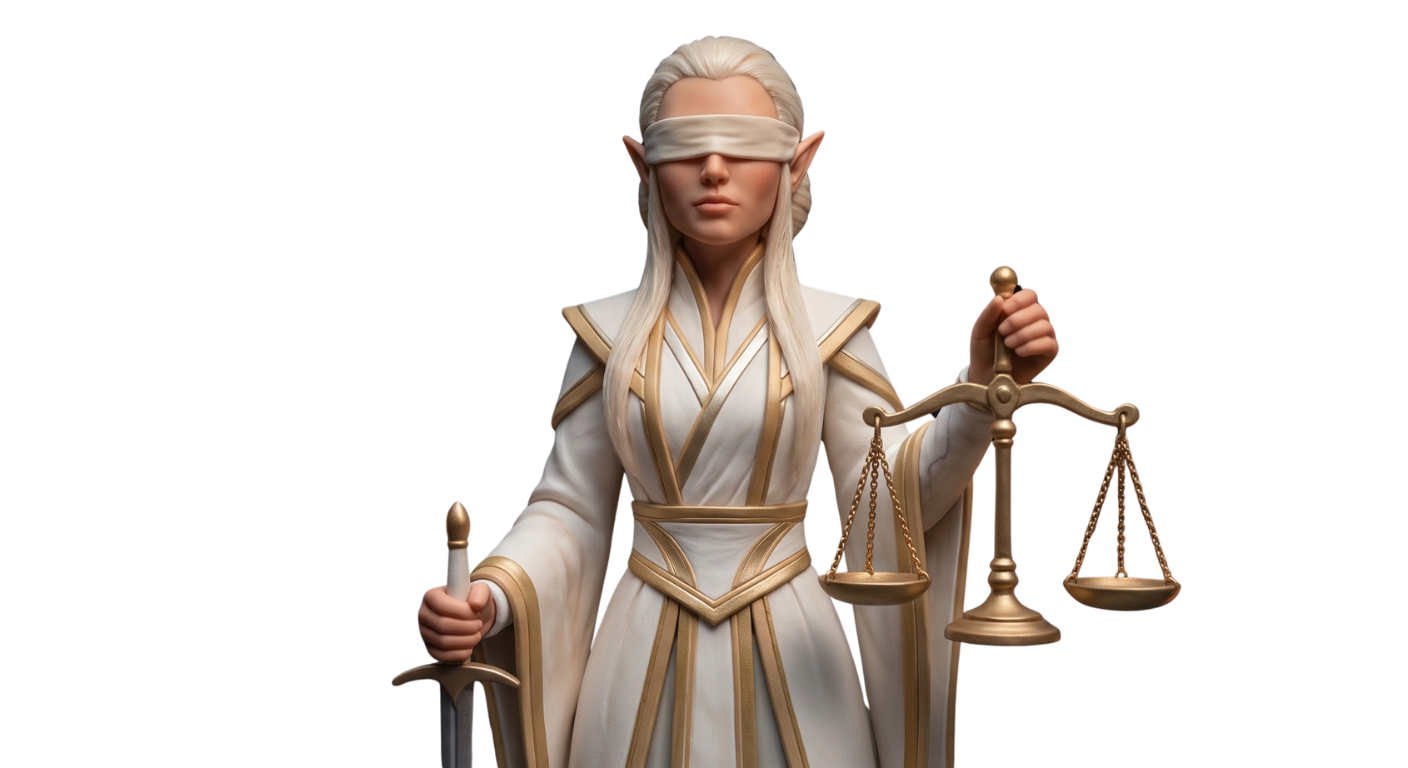
A tall high-elf, blindfolded — the letter of the law, exact and unable to see the person in front of her. Beautiful, cold marble. She cannot see until Mercy shows her how.
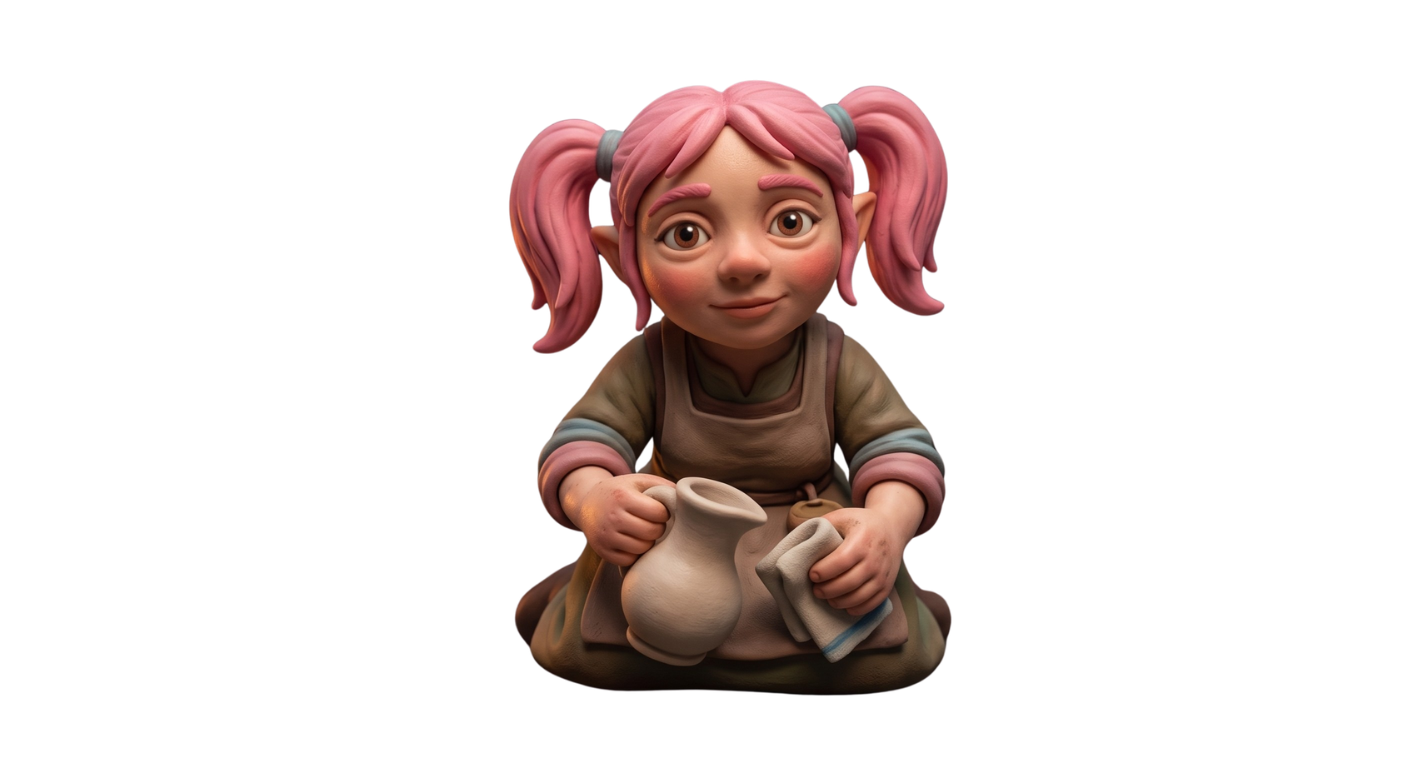
A small pink-pigtailed gnome, down in the dirt with the suffering — the spirit the letter lacks. Big warm eyes that see. The ewe who weeps for the children the system didn't save.

Justice kneels to Mercy's height, and Mercy lifts the blindfold away — and the scales tip without a hand on them. Mercy tips the scale not by adding weight, but by letting Justice finally see who she's weighing.
Three Acts
Richard, the Barker, takes the stage. This is a shareholder presentation — vertical integration, denial rates, actuarial tables — dressed as innovation. He is proud of the mechanism. He should be. It works exactly as designed.
Cover version — AI performance of the opening six lines. Real voices needed.
ladies and gentlemen, step right up and see!
vertical integration? the height of corporate luxury!
that's how we've been starving the health of the nation,
through a masterpiece of profit and total automation.
we're three of the four hands in every deal shaking,
whatever you're giving, it's ours for the taking!
Sara arrives. She is not lost. She knew he would be here. Richard doesn't stop — he sings louder, performs harder, tries to absorb her objection into the show.
As Sara cries out — "Appeal! cry out!" — she becomes a marionette. Richard is conducting her grief as part of the performance. The soundproof glass of the Wrongful Denial Echo Chamber seals around her and carts her away as if it is simply security. The system didn't malfunction. It performed. The box was already there. The strings were already attached.
every wrongful denial? it's just ink on the page!
a necessary metric for this modern age.
appeal! cry out! inside the soundproof glass!
every rubber stamp lets the tragedy pass.
Sara reaches Senator John. The mask isn't protecting him anymore — hers is the one plea the vanity can't seal out. She is not asking for sympathy. She is asking the question the whole room was built to spare him from ever having to answer.
but tell me, dear senator, if the patient were yours,
would you still be so keen on these cost-saving chores?
if it was your son, would the denial still sit?
or would you find the humanity to care for a bit?
A shareholder raises his hand. He almost had a conscience. "What if she appeals to the third party?"
Richard doesn't miss a beat: "We'll claw it back."
"If they push forward still?"
Richard turns to the room, delighted, as if this is the best question he's ever been asked:
"My dear gentlemen, you don't seem to understand. They will treat her like she's just one. While we pocket our profits from the millions who don't get there. That's how your profits are guaranteed."
This is Prior Knowledge Omission explained by the villain, in character, to a room full of shareholders. Cleaner than any policy document. The applause that follows is the closing argument.
r.i.p. to the victim, no more claim remaining!
the dividend is high, so why are you complaining?
Full Lyrics — Working Version
ladies and gentlemen, step right up and see!
vertical integration? the height of corporate luxury!
that's how we've been starving the health of the nation,
through a masterpiece of profit and total automation.
we're three of the four hands in every deal shaking,
whatever you're giving, it's ours for the taking!
jack you up, take your bucks, watch the balance sheet rise,
while you're gasping for air with those desperate eyes.
every wrongful denial? it's just ink on the page!
a necessary metric for this modern age.
but tell me, dear senator, if the patient were yours,
would you still be so keen on these cost-saving chores?
if it was your son, would the denial still sit?
or would you find the humanity to care for a bit?
appeal! cry out! inside the sound proof glass!
every rubber stamp lets the tragedy pass.
that's someone's father, mother, sister, brother—
a son or a daughter, like any other!
separate standards for the poor and the peerage,
one gets the suite, and you get the steerage!
the harm's in the waiting, the bureaucratic stall,
while we play with the lives that we hold in our thrall.
our pain is your policy we're forced to placate,
while the actuarial tables decide on your fate.
r.i.p. to the victim, no more claim remaining!
the dividend is high, so why are you complaining?
The Bell
A giant bell. Old church tower weight. It tolls when a denial leads to a patient's death.
Not once. Multiple times throughout the performance — before the audience knows what it means.
"God stands in the congregation of the mighty; He judges among the gods. How long will you judge unjustly, and show partiality to the wicked? They know not, neither will they understand; they walk on in darkness."
The bell hangs over all of them — Richard, the beast-masked shareholders, the Insurance Doctor, and Senator John. Nobody stops. Richard keeps performing. The clerk keeps filing. The shareholders check their phones.
First toll: Incongruous. Nobody reacts. The show continues. The audience doesn't know what it means.
Second toll: Still nobody reacts. A shareholder checks his phone.
Third, fourth toll: The audience is starting to understand something is wrong with the room. Why does nobody stop?
The undeniable toll: Directly linked — visually — to a specific person who is no longer there. An empty chair. A name. A date. The previous tolls retroactively land as what they always were.
Then Richard pulls out the ledger. Not in response to the bell. In response to how many times it has tolled. He was counting.
The ledger is not the appeal rate. The ledger is the tally.
He has been keeping count of the bell the entire performance. It is a line item. It was always a line item.
The most chilling beat in the film is not the bell. It is what he does immediately after — with complete calm, complete familiarity, the mild satisfaction of a man whose projections are holding.
"The dividend is high, so why are you complaining?"
This line has range beyond its immediate context. It is the universal closing argument of every room where powerful people have decided the cost of accountability is too high and the returns on silence are too good. The mechanism is always the same. The insulation is always the same. The ledger is always the same. The masks vary by industry.
Whether that subtext stays implicit or surfaces explicitly is a decision for the allies' table. Note it. Don't lock it yet.
The Case Studies
The barker presents patient cases as cost reduction success stories. Each one is a slide. Each slide shows the intervention requested, the plan's intervention — delay — and the outcome. He is proud of each one. The shareholders take notes.
"Case study — patient presented with vascular obstruction. Recommended intervention: $55,000. Our intervention: delay. Outcome: case closed."
"Savings to the plan: $55,000. Next slide."
"But he died—"
"What if we paid it and he died? What a waste."
The slide wasn't hiding that the surgery was necessary.
It was hiding that the delay was the plan.
The prognosis cliff — staged deliberately:
Stage 1: Intervene now. 74–98% patency. Cheap. Clean. Patient goes home productive.
Stage 2: Delay. Outcomes worsen. More expensive. Still manageable.
Stage 3: Established damage. Treating consequences now, not causes.
Stage 4: Unsurvivable without catastrophic intervention — or conveniently terminal.
The can isn't kicked down the road randomly. It is kicked to a specific cliff. The barker knows exactly where the cliff is. It's in the actuarial tables.
If the delay kills them: case closed. No surgery cost. Toll.
If the delay disables them: they don't fall onto Medicare Advantage. They fall off being a productive member of society entirely. SSDI. Then a two year wait for Medicare to arrive — with the medical problem that disabled them, untreated, getting worse, on their own.
By the time Medicare sees them they are a pre-existing catastrophe. The insurer who created the condition is completely gone from the picture. Different coverage. Different system. Different budget. The denial that started the cascade is two years and an administrative wall away.
The disability is not a claim. It's an exit.
The cliff was engineered to have no bad landing for the insurer. Only for the patient. The plan collected premiums when the patient was productive. It will never pay the catastrophic tab it created.
If somehow they survive and keep fighting — that's what the marionette box is for.
"My dear gentlemen, you don't seem to understand. They will treat her like she's just one. While we pocket our profits from the millions who don't get there. That's how your profits are guaranteed."
The Masks
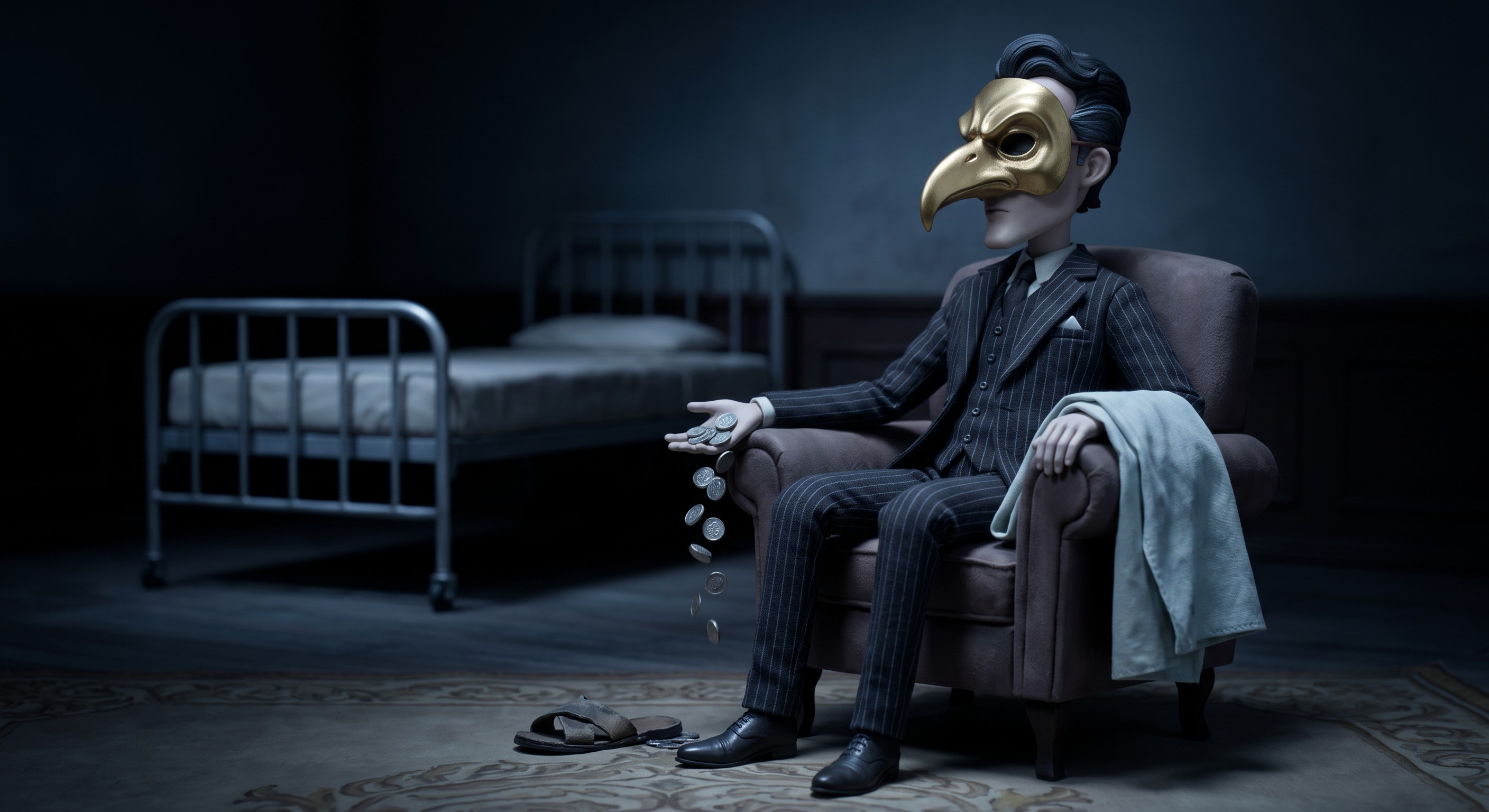
Not jewels — beasts. Same dark opulent suits, a different gold animal for each sin: the vulture (death-profiteer at the bedside), the pig (gluttony), the lion (the roaring ruler over the poor), the serpent (the lawyer), the wolf (the politician in sheep's clothing). Crucially these are worn masks over human heads, not head-swaps — there is a person under every one. Target the mask, not the man.

The "a physician reviewed your case" alibi made flesh — a man who hasn't seen a patient in years. Sterile white clinical mask, surgical mask slipped uselessly down, blank goggle-eyes, DENIED stamped on the brow. His lab coat has become a super-premium plush bathrobe over silk pajamas; he stamps denials from a recliner. The healer's own vestment turned into indulgence — paid richly to not heal.