Independent Voices — Voices of Faith
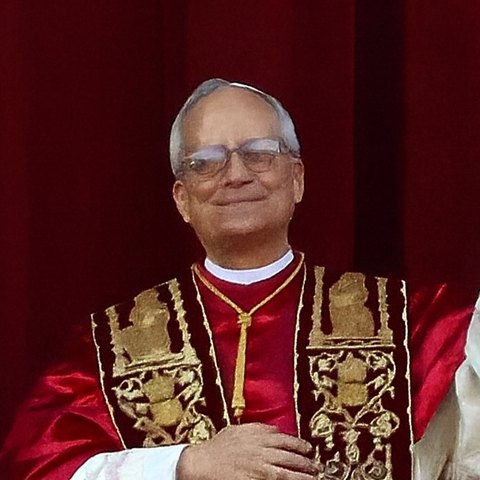
Photo: Edgar Beltrán / The Pillar, May 8, 2025 · Wikimedia Commons · CC BY-SA 4.0 · cropped
Pope Leo XIV
Robert Francis Prevost · Bishop of Rome · Elected May 8, 2025
Born in Chicago · Augustinian friar · Years of ministry in Peru · The first pope from the United States
Why He Is Here
Most voices in this room come at the problem from one angle: the physician who watched a denial land, the patient who lived it, the investor who asked a company to answer for itself. Pope Leo XIV comes at it from the oldest angle there is — that a society is judged by how it treats the sick.
In 2026 he said it again and again, to doctors, to bishops, to the World Health Organization’s European office, to the families of pollution victims outside Naples, and to a nation’s leaders weeks after his own cancer surgery. Everything quoted below is his own public words, with the source linked.
Section I · Health Care · 2026
“Health Cannot Be a Luxury for the Few”
February 16, 2026 · Pontifical Academy for Life, Clementine Hall
The Academy’s plenary assembly met under the theme “Healthcare for All. Sustainability and Equity.” The pope told them the gaps in health are not an accident of nature: the conditions communities live in are “the result of social and environmental policies,” and when we look closely, “we discover enormous inequalities.”
“All lives are not equally respected and health is neither protected nor promoted in the same way for everyone.”
— Pope Leo XIV, February 16, 2026
He warned that talk of caring for everyone is “hypocritical if, at the same time, we ignore the structural causes and policies” behind the gaps, and asked for decisions based not “on immediate profit, but on what will be best for everyone.” He also cited his predecessor, Pope Francis, that health “is not a consumer good, but a universal right,” so access to care “cannot be a privilege.”
And he named war as a health issue: “wars that impact civilian structures, including hospitals,” are among “the most grave attacks that human hands can make against life and public health.”
Full address — vatican.va →March 18, 2026 · “Today Who Is My Neighbour?” conference, the Vatican
A month later he addressed a health-equity conference organized by the Council of the Bishops’ Conferences of Europe, the World Health Organization’s European Region, and the Italian Bishops’ Conference. This is the line that has since traveled the internet:
“Universal health coverage is not merely a technical goal to be achieved; it is primarily a moral imperative for societies that wish to call themselves just.”
— Pope Leo XIV, March 18, 2026 (as translated by Vatican News)
“Health cannot be a luxury for the few.” It is “an essential condition for social peace.”
— Pope Leo XIV, March 18, 2026
Care, he said, “must be accessible to the most vulnerable, not only because their dignity requires it” but “to prevent injustice from becoming a cause of conflict.”
Vatican News report → · Full address — vatican.va →November 6, 2026 · Independence Square, Montevideo, Uruguay
His first address in Uruguay was to the country’s political and civic leaders. CBS News reported it came weeks after his surgery for lung cancer, and he opened with his own hospital stay:
“I experienced firsthand the limitations imposed by illness, and I received care for which I am deeply grateful.” It made him think of “the many men and women who lack the means to obtain a timely diagnosis or receive the treatments they need.”
— Pope Leo XIV, November 6, 2026 (English as printed by America Magazine)
“Ensuring that health care is accessible to everyone, regardless of their resources, is a duty that confronts every society.”
— Pope Leo XIV, November 6, 2026
He added that the economy’s benefits “must also translate into goods and opportunities that effectively reach everyone,” and that people facing “sickness, disability, physical pain, loss of autonomy, poverty, unemployment or social exclusion” “do not cease to be full members of society.”
Section II · Pollution · May 23, 2026
The Land of Fires: “Here Is Death, of the Land and of Mankind”
The area around Acerra, outside Naples, is known as the Terra dei Fuochi — the Land of Fires — for years of illegal toxic-waste dumping and burning. On May 23, 2026, the pope went there. In the cathedral he met bishops, clergy, and the families of people he described as “killed by environmental pollution caused by unscrupulous individuals and organizations who for too long have been able to act with impunity.”
“And yet, here is death, of the land and of mankind.” It came from “a deadly combination of obscure interests and indifference to the common good.”
— Pope Leo XIV, Cathedral of Acerra, May 23, 2026
“Faced with this reality, there can be two attitudes: indifference or responsibility.”
— Pope Leo XIV, Cathedral of Acerra, May 23, 2026
Speaking afterward to the area’s mayors and residents, Reuters reported, he urged them to “reject temptations of power and enrichment linked to practices that pollute the land, water, air, and social coexistence,” and criticized “the dizzying profits of a few, blind to the needs of people, their work and their future.”
Cathedral address — vatican.va → · Reuters report →September 2, 2026 · International Theological Commission
Three months later, the Vatican’s International Theological Commission published “Caring for Our Common Home: A Responsible and Fraternal Response to the Triune God.” It names harm to the natural world a “sin against creation and the Creator” — a more precise term, it says, than Pope Francis’s “ecological sin” — and says that harm falls on “neighbors, especially the poorest and future generations.” Among the harms it lists: air and water pollution.
To be precise: this is the Commission’s document, not a papal teaching. It was presented to Pope Leo XIV before release and cites his emphasis on choosing that wording, but the phrase is the Commission’s.
OSV News via America Magazine →Where This Connects
Acerra is an ocean away from Willow Grove and Warminster, but the pattern is the one documented on our PFAS pages: contamination that profited a few, families who paid with their health, and years before anyone answered for it.
The PFAS Plan →From the Scripture Archive · AbilityForge’s Note
Elisha and the Enemy: Healing Without a Price, Bread Instead of a Sword
On October 27, 2026, in a message to the interfaith peace meeting in Assisi, Pope Leo said: “There is no such thing as a holy war: only peace is holy.” The prophet Elisha lived that out twice, both times toward the commander and the soldiers of an enemy nation.
2 Kings 5 · The enemy general is healed — and the prophet takes no payment
Naaman, “captain of the army of the king of Syria,” Israel’s enemy, had leprosy. A captive Israelite girl told his household a prophet in Samaria could heal him. Elisha did — then refused the gift Naaman pressed on him:
“As the LORD lives, before whom I stand, I will receive none.”
— 2 Kings 5:16 (World English Bible) · Read 2 Kings 5 →
2 Kings 6 · The captured army is fed — and the raids stop
Later, a Syrian raiding force came to seize Elisha himself. Struck blind, they were led into Samaria, surrounded. The king of Israel asked, “My father, shall I strike them? Shall I strike them?” Elisha answered:
“You shall not strike them. … Set bread and water before them, that they may eat and drink, then go to their master.” He prepared a great feast for them. … So the bands of Syria stopped raiding the land of Israel.
— 2 Kings 6:21–23 (World English Bible) · Read 2 Kings 6 →
Our read (opinion): Healing that was not for sale, offered even to an enemy. A meal where a massacre was expected — and it ended the raids where a sword would only have bought the next one. That is the old shape of what the pope is asking for.
Source: Independent Catholic News — Pope Leo: There is no such thing as a holy war (Oct. 27, 2026) →Section III · Reading It Fairly
He Named the Goal, Not the Vehicle
The pope has not endorsed any American bill, party, or payment model. “Universal health coverage” describes an outcome — everyone able to get the care they need — and countries reach it different ways: a single public payer, regulated private insurance, or a mix of public and private options.
His words also belong to a wider body of Catholic teaching that people across the political spectrum agree with in some places and disagree with in others. This page quotes only what he has said about health care and pollution, and leaves the rest of that teaching to the Church’s own sources.
AbilityForge’s read (opinion): Whatever the vehicle, his test is the one this site keeps returning to — whether the person who needs care can actually get it, in time.
The Ways In — Glossary
Primary Sources & Links
Cited Public Voice
AbilityForge cites Pope Leo XIV’s public statements, with links to the originals. The Holy See is not affiliated with AbilityForge and has not reviewed or endorsed this page. Quotes are from official English translations or English-language news reports, as noted.