Independent Voices — Allied Physician & Spine Surgeon
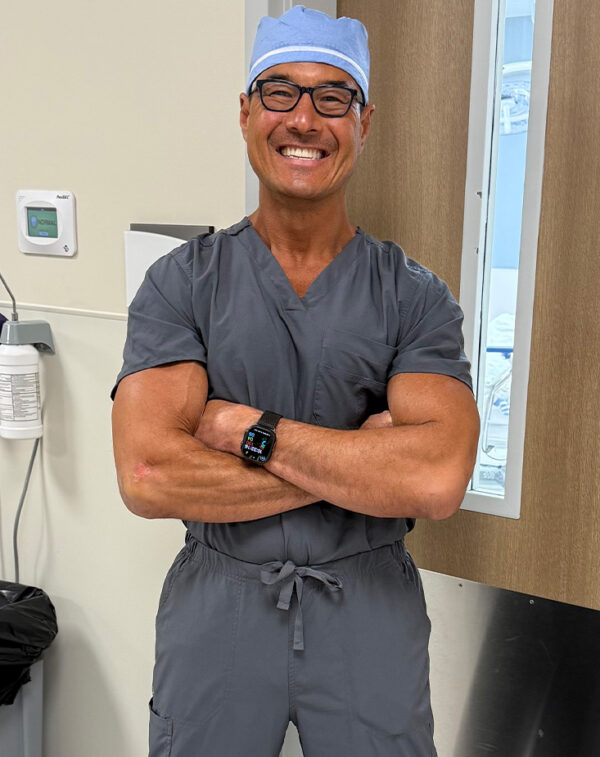
Dr. Juris Shibayama, MD
Orthopaedic Spine Surgeon · Endoscopic & Minimally Invasive · Nashville, TN · @spinesurgeryworks1
Why He's Here
Dr. Juris Shibayama is a Nashville orthopaedic spine surgeon who does something most physicians are too tired or too cautious to do: he narrates the insurance fight out loud, from inside the operating surgeon's chair. Then he does the thing insurers quietly count on almost no one doing: he hands patients the steps to appeal their way out of the wrongful-denial echo chamber — the external review the law already owes them. He sits through the prior-authorizationPrior AuthorizationA health-insurance process that requires your doctor to get advance approval from your plan before it will cover a specific service, procedure, or drug. calls, watches an out-of-specialty reviewer overrule a spine surgeon, and then turns to the camera and explains exactly how to get the "No" overturned.
"Stupid games insurance companies play. Not on my watch." AbilityForge features his work — with his permission — because it meets the standard we hold: specific, sourced, patient-first, and unafraid to name what's happening.
On This Page
Section I · The Centerpiece
The External-Review Playbook — The Appeal They Hope You Never Use
Passing along a follower's tip, Dr. Shibayama lays out the steps most patients never hear: when a claim is denied, first request a formal internal appeal. If that's denied, escalate to an external review — an independent, outside decision your insurer is legally required to offer. Get the confirmation details in writing; use email if the phone line stalls. His message is simple: the "No" you were handed is very often not the final word — but only if you ask for the next step.
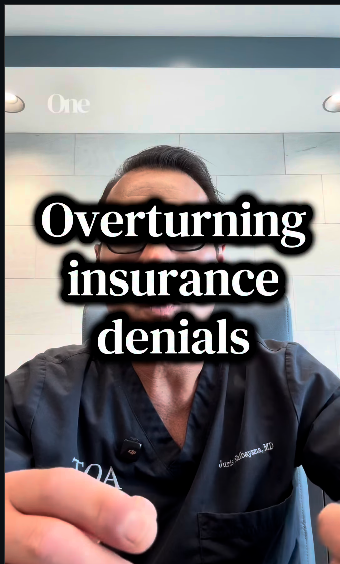
"Overturning insurance denials" — opens on Instagram.
"Call for a formal appeal. If they deny it, you request an external review — which they are legally required to provide. The numbers I've seen: 80 to 90% of external reviews get approved."
— Dr. Juris Shibayama (@spinesurgeryworks1), paraphrasing his how-to reel
Where Those Two Numbers Come From
"80 to 90%" isn't a vague range — to people who live in this data, each number points to a specific, documented finding:
- ~80% — Medicare Advantage. Of the MA prior-authorization denials that were appealed in 2024, KFF found 80.7% were fully or partially overturned — yet only 11.5% of denied requests were ever appealed. (KFF, 2024)
- ~90% — AI-driven denials. The figure attached to algorithmic denial tools — most notoriously UnitedHealth's nH Predict, now at the center of a federal class action, where a reported ~90% of the model's denials were alleged to be reversed on appeal or review. (Allegations in active litigation.)
A separate, broader bucket — ACA marketplace external reviews — runs closer to half overturned, and there fewer than 1% of denials are ever appealed. Whichever bucket yours falls in, the pattern holds: challenged denials get reversed far more often than not, and almost no one challenges. The denial usually stands not because it was right — but because no one asked again.
Do This If You've Been Denied
- Request a formal internal appeal from your insurer, in writing.
- If denied, request an external (independent) review — your legal right under the Affordable Care Act.
- Get confirmation and reference numbers in writing; follow up by email if the phone line stalls.
- Ask your doctor's office to submit the clinical records and a letter of medical necessity.
Federal external-review rights and how-to: HealthCare.gov — External Review.
Section II
Wrong-Specialty Reviewers & the "Exact Words" Denial
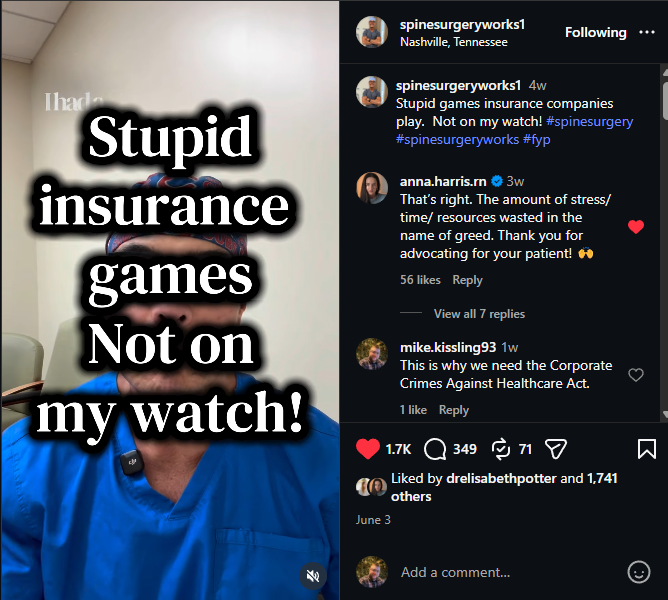
"Stupid insurance games. Not on my watch!" — liked by Dr. Elisabeth Potter; Anna Harris, RN in the comments.
Sometimes the peer-to-peer reviewer is actually a spine surgeon. Often, Dr. Shibayama says, it's someone from OB-GYN or family practice sitting in judgment on a spine operation — a clinician who would never be permitted to perform the surgery being asked to veto it. The person deciding whether the care is "necessary" frequently isn't qualified to deliver that care at all. That is the accountability gap in one sentence.
"The report said: displacing the traversing right L5 nerve root, possibly abutting the exiting right L4 nerve root, mild-to-moderate biforaminal narrowing. So it is narrow. And I said to her, 'You're a surgeon — can't you read the report and see there's compression even though they didn't use those words?' And she said, 'Nope. This insurance company needs those exact words in the report.'"
— Dr. Shibayama, on a denial that hinged on whether the radiologist typed the phrase "nerve compression"
Why This Belongs in the Record
This is the same argument Rep. Neal Dunn, MD made on the House floor — that prior authorization is the practice of medicine. When a denial turns on whether a radiologist used two specific words, and the reviewer won't read the anatomy underneath them, the coverage decision has stopped being administrative and become clinical — made by someone with no license to make it for that patient.
Section III
Take Care of Our Veterans — The Reimbursement Gap
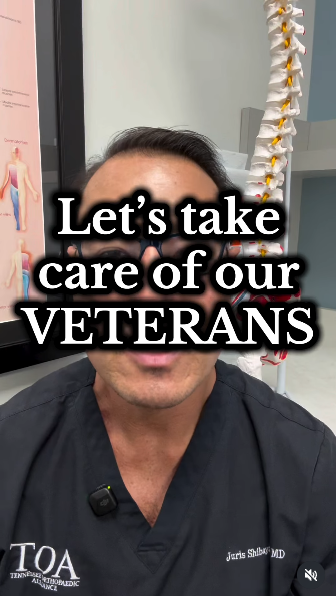
"Let's take care of our VETERANS" — opens on Instagram.
Dr. Shibayama makes a blunt structural point: the VA and TRICARE pay physicians the lowest rates of any payer — often below a practice's own overhead, so a surgeon can lose money on every veteran's case. The predictable result is that many physicians opt out of these programs entirely, which quietly narrows the care available to the people who served. His fix is simple: pay veterans' care at the highest private-insurance rates, and physicians will compete to provide top-tier care to those who earned it.
Why It Lands Here
This site's fight is personal to a veteran: the father-in-law of AbilityForge's founder, a Navy veteran, has spent years fighting the VA over service-connected care. Shibayama names the supply side of that same failure — when the system underpays the people who deliver care, the veteran is the one left without it.
Section IV
Tax Dollars Wasted — The Ray Collazo Case
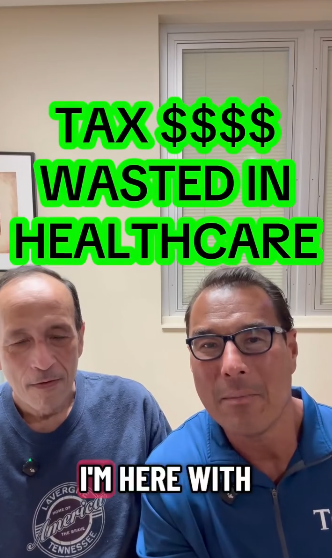
"Tax $$$ wasted in healthcare" — opens on Instagram.
By Dr. Shibayama's account, his patient and friend Ray Collazo — injured on the job, with an infected spinal-cord stimulator removed — sat in a hospital bed for 19 days waiting for the insurer to approve standard IV antibiotics. The cheaper, standard-of-care option was to finish the course at home on IV antibiotics; approved on time, he'd have been home by day three. Instead the denial kept him admitted, running the bill higher every day, away from a family that missed him. Shibayama's word for it: abuse.
Cheaper Care, Denied — More Days, More Cost
The maddening part is that the denial made the bill bigger. Home IV antibiotics are the cheaper, standard-of-care path; refusing them didn't save money, it just kept a man in a hospital bed for weeks, running up facility charges taxpayers or a workers'-comp system ultimately absorb. Dr. Shibayama's word for it is blunt: abuse — of the patient, and of the public dollar.
Who Ray Is — On Dr. Shibayama's Account
By his own on-camera account, Dr. Shibayama has been a friend of the family for some twenty years, and identifies Ray as the father of Michael Collazo — showing the photo of Michael receiving the Medal of Valor from President Biden for his part in stopping the Covenant School attack on March 27, 2023. A family that gave Nashville one of its bravest, while the system left the father stranded in a hospital bed over a routine antibiotic. (Detective Collazo's role and Medal of Valor are public record. The family relationship is attested by Dr. Shibayama — a friend of some twenty years — and independently corroborated by a City of La Vergne, TN civic record naming "Michael Collazo, on behalf of his father, Rey Collazo.")
Note: the account of Ray Collazo's hospitalization, denial, and the family relationship comes from Dr. Shibayama's own public statements. Detective Michael Collazo's role at Covenant and his Medal of Valor are matters of public record.
Section V
The Surgeon Who Partners His Team With God
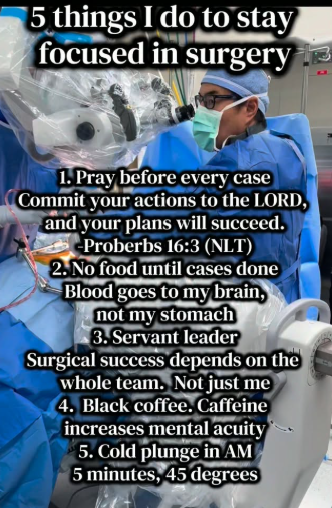

The same surgeon who fights denials starts every case in prayer. In his "5 things I do to stay focused in surgery," the first is to pray and commit the work to God — Proverbs 16:3 — and the third is to lead as a servant: "Surgical success depends on the whole team. Not just me." The advocacy and the faith aren't separate tracks; they're the same conviction that the person on the table is owed everything he has.
"Do not withhold good from those to whom it is due, when it is in your power to do it."
— Proverbs 3:27 · the verse Dr. Shibayama says he thinks about every day
The Bridge
Proverbs 3:27 is, quietly, the whole ethic of this site — do not withhold the good you have the power to give. It's also a verse you can read in full on AbilityForge's own hosted Scripture: Proverbs 3 →
Section VI
Follow the Work
Instagram · @spinesurgeryworks1
Spine surgery explainers, insurance-fight narrations, and faith — from the operating surgeon's chair.
nashvillespinesurgeon.com
His practice — endoscopic and minimally invasive spine surgery, Nashville, TN.
A Note on This Feature
Dr. Shibayama's content is his own; AbilityForge features it as an allied voice, with his permission, and neither controls nor hosts his videos — the clips above are screenshots that link out to his Instagram. Biographical and clinical accounts (including the Ray Collazo case and the family relationship he attests to) reflect Dr. Shibayama's public statements. Overturn rates are attributed by source: ~80% is KFF's 2024 Medicare Advantage figure (80.7% of appealed MA denials overturned); ~90% tracks the alleged reversal rate of AI denial tools like nH Predict (allegations in active litigation); ACA marketplace external reviews run closer to half. The consistent point across all three: denials are reversed far more often than not when challenged — and most are never challenged. Nothing here is medical or legal advice.