Case V · The Story
Fighting Back, in 20 Chapters
A first clot at 15. A stent three doctors recommended, denied. Years of wounds, then a leg. A learner knee that kept buckling, and a better knee denied as more than he needed, until Medicare's independent reviewer overturned it.
This is the long version, built from Michael's own phone, his medical records, and the letters insurers sent him. For the short version and the evidence summary, see the case page.
How to read this page
Record Dated and checked against a medical record, letter, or the original phone file.
His account Michael's own telling. Records may exist but are not yet posted or checked.
Dates to confirm Being pinned down. Nothing here is guessed.
Some chapters include medical photos of open wounds. They stay hidden until you choose to open them.
Part One · Before the Leg
Chapter 1
The Football Player Who Clots
July 2008 – June 2011 Record
Michael played left guard on offense and right tackle on defense. In July 2008, three weeks after he turned 15, his left thigh started to hurt. It was called a muscle strain. The pain got worse, and at the Children's Hospital of Philadelphia it was diagnosed as an extensive deep vein clot.
prev. healthy male… developed (L) lateral thigh pain… dx w/ muscle strain, dev ↑ pain & diagnosed w/ extensive nonocclusive DVT. CHOP nursing transfer summary, 7/14/2008
He also has protein C deficiency, an inherited clotting disorder. He was too young, he was told, for a stent.
Three years later, on his senior class trip to Orlando, a week before graduation, it happened again. He was at Universal, headed for the Harry Potter section to get a wand, when his girlfriend noticed his leg had swollen until his jeans were tight. She told a chaperone. He almost didn't go. A new clot filled the left leg, and a scan found a small clot in his lung. He was moved by ambulance to a hospital that could treat it. Doctors threaded a catheter from behind his knee and dripped clot-dissolving drugs into the vein. He was 17, working at Wendy's, and starting nursing school that fall.
The patient is here on vacation from Pennsylvania on a school trip with his senior class and chaperones… high school student that is graduating next week. Orlando Regional Medical Center, history & physical, 6/1/2011
Chapter 2
Immune to Rat Poison
2008 – about 2013 His account Record
Coumadin (warfarin, the drug also sold as rat poison) is the classic blood thinner. After the first clot, his doctors raised the dose month after month, up to 17 mg a day, and his blood test numbers barely moved. Eventually they stopped it to see how he did without it.
He was fine until the flight to Orlando. Afterward came Lovenox: shots in the belly, twice a day, every day, for someone who hates needles, with bruises that left him spotted like a cow. When someone finally let him switch to Xarelto, a pill, it held.
He had been on Coumadin but had difficulty achieving therapeutic INR. He was transitioned to Xarelto approximately 7 years ago. Dr. Neil Belman, hematology, 8/15/2020
Chapter 3
Preexisting Condition
2012 His account
At 19½, his CHIP coverage ended. He had gone more than a year without a major medical event. It didn't matter. Before the Affordable Care Act's protections took full effect, being on blood thinners was enough for insurer after insurer, UnitedHealthcare among them, to turn him away.
Chapter 4
A Decade of Stability
2011–2017 His account
Xarelto held. He married Kate, and went to work as a production tech at Nestlé: 12-hour shifts on a job that required being very active. For a while, the leg was something he managed, not something that managed him.
Chapter 5
The Evidence for Stenting
Nov 2017 – Apr 2018 Record
At 24, the leg turned heavy and hard to move. At LVHN, a hematologist, a vascular surgeon, and an interventional cardiologist worked him up in sequence.
Definitely he has May Thurner Syndrome (MTS). We discussed that criteria for intervention included LCIV compression in the setting of (1) leg edema/venous claudication with associated venographic findings… or (2) left leg deep venous thrombosis. He has both. Dr. Don J. Park, 11/21/2017
Chapter 6
The Stent Denied
2018 His account
The stent was denied. In Michael's telling, one of the conditions for coverage was the kind of non-healing wound a stent placed early is meant to prevent. When he later asked UnitedHealthcare for the denial letter, he was told to get a subpoena.
That letter is one of the records still wanted.
Chapter 7
The Chronic Wounds
Late 2019 – 2021 Record
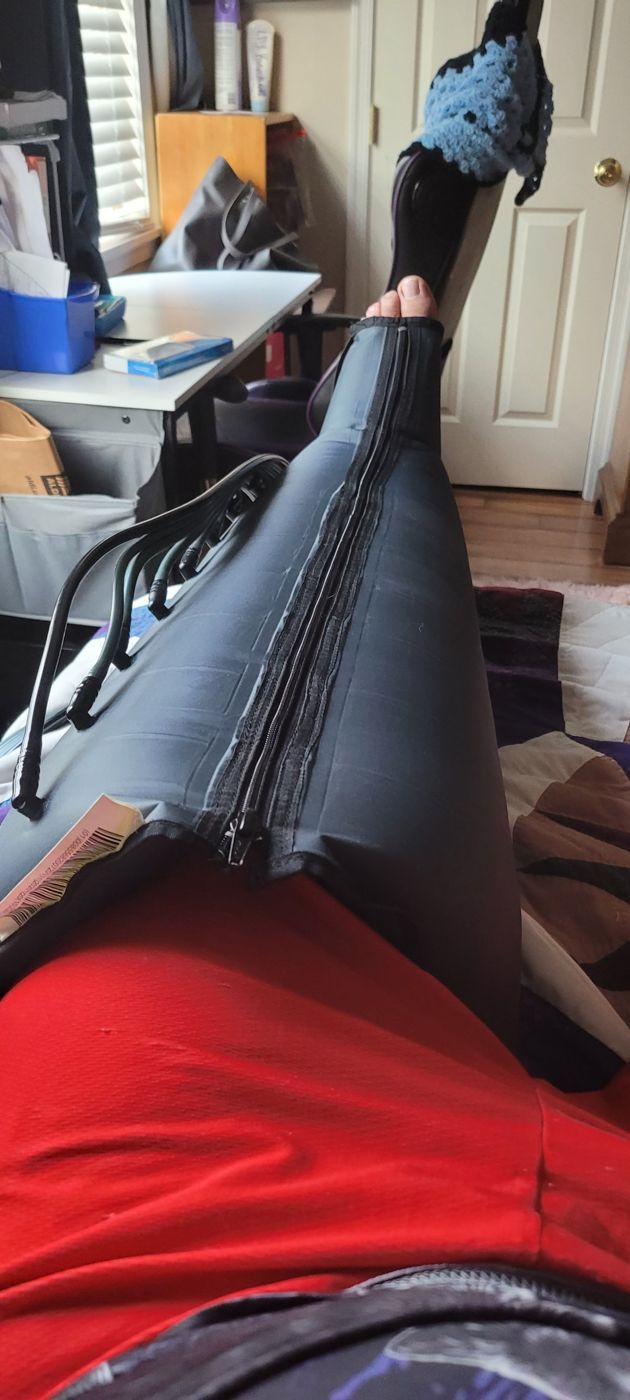
By the end of 2019, open wounds on the left leg were limiting what he could do. In July 2020 he had to leave Nestlé. The stents finally came in May 2020. Within three months, they clotted.
…he had unhealed open ulcer in his left lower extremity for which he underwent left iliac venous stent placement… His insurance company back in September 2020 did not approve dabigatran which I suggested. Dr. Hikaru Nakajima, 4/22/2021
Chapter 8
Allograft Works
Dates to confirm His account
Apligraf is an FDA-approved living skin substitute for venous leg ulcers. In Michael's account, it took about a year and a half of delays to get it. Once it was applied, it closed the wounds.
He states that the last time he had an ulcer, the only thing that helped heal it was the Apligraf. Wound care note, 6/23/2022
Chapter 9
Return of the Wounds
May 2022 – Jan 2023 Record
In May 2022 a calf wound opened and kept growing. The wound clinic measured it every visit.
We discussed that unfortunately this exhausts his options for venous recanalization. Dr. Noy Bassik, interventional radiology, 10/7/2022
Has been dealing with this condition… since age fifteen and would like to be free from pain/stress of ulcerations. Wound care note, 12/7/2022
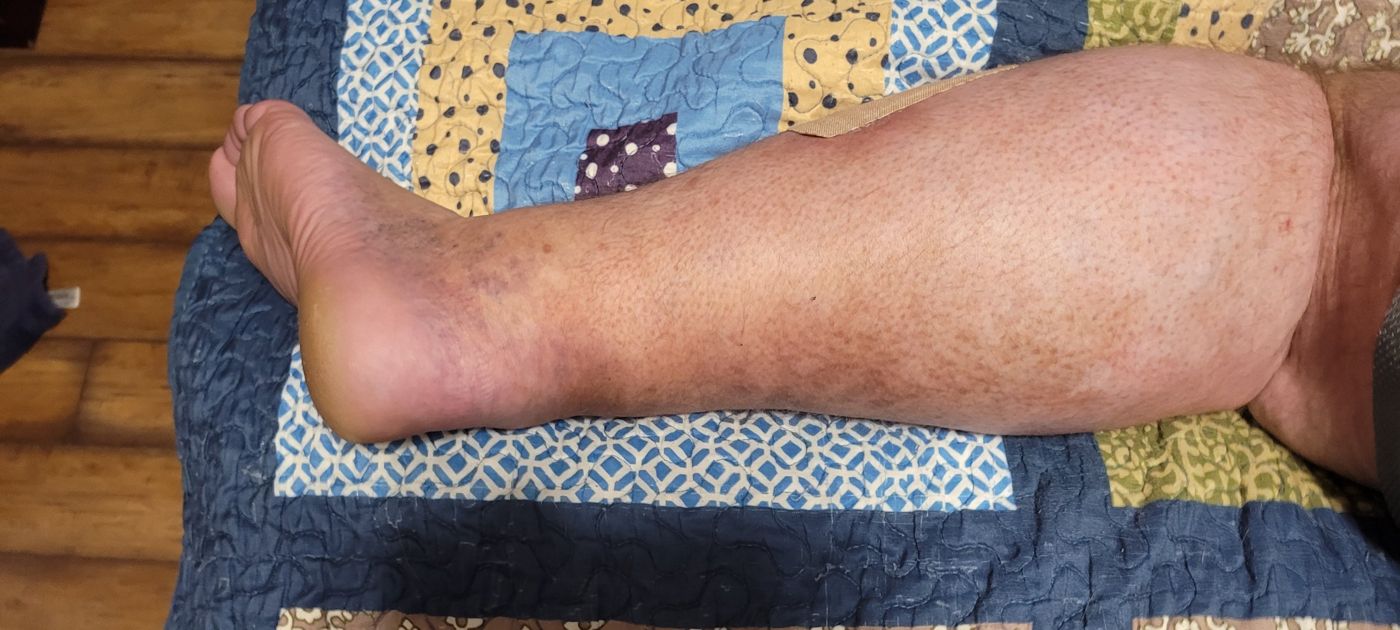
⚠️ Medical photos: open wounds. Tap to view.
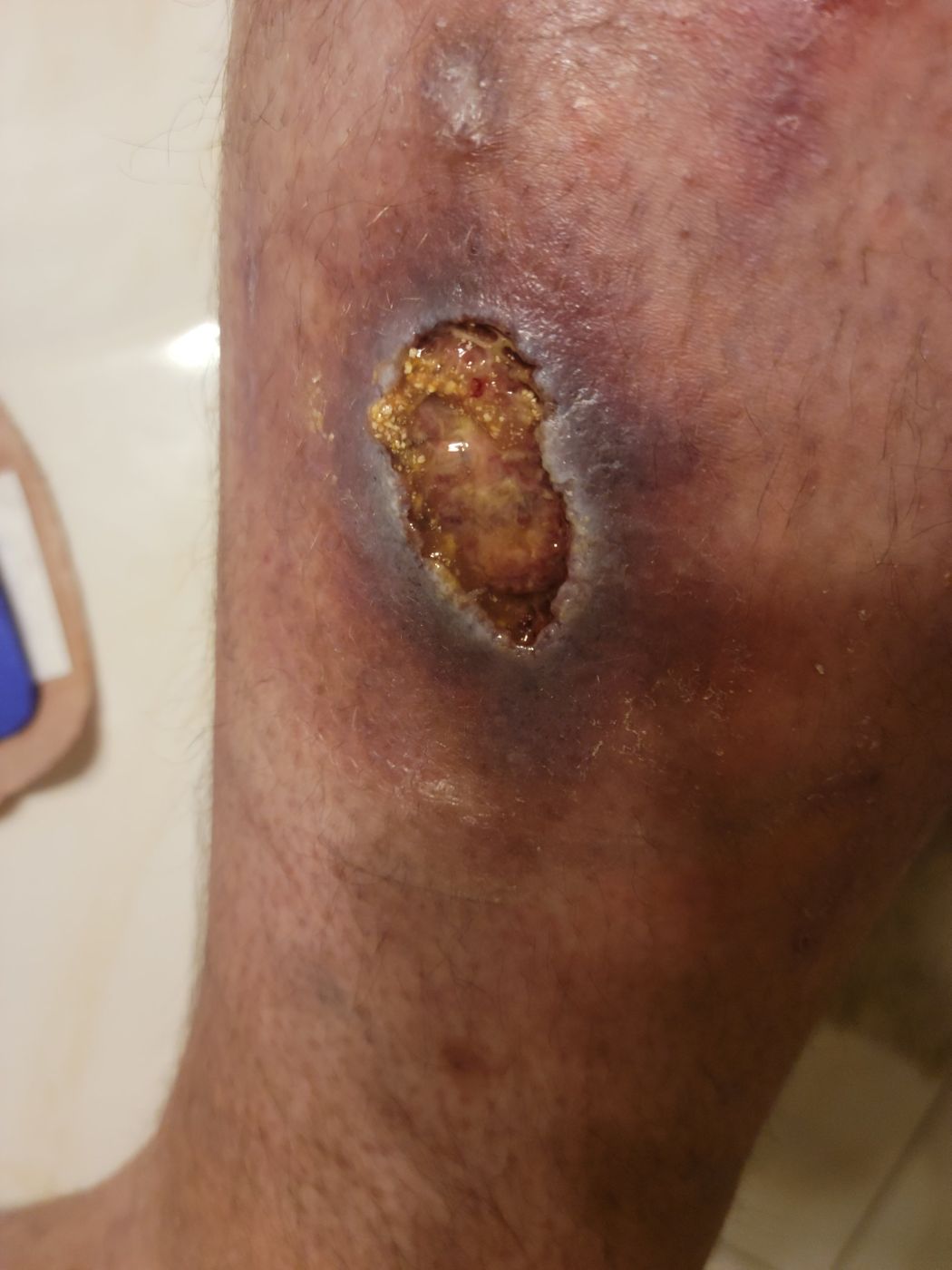
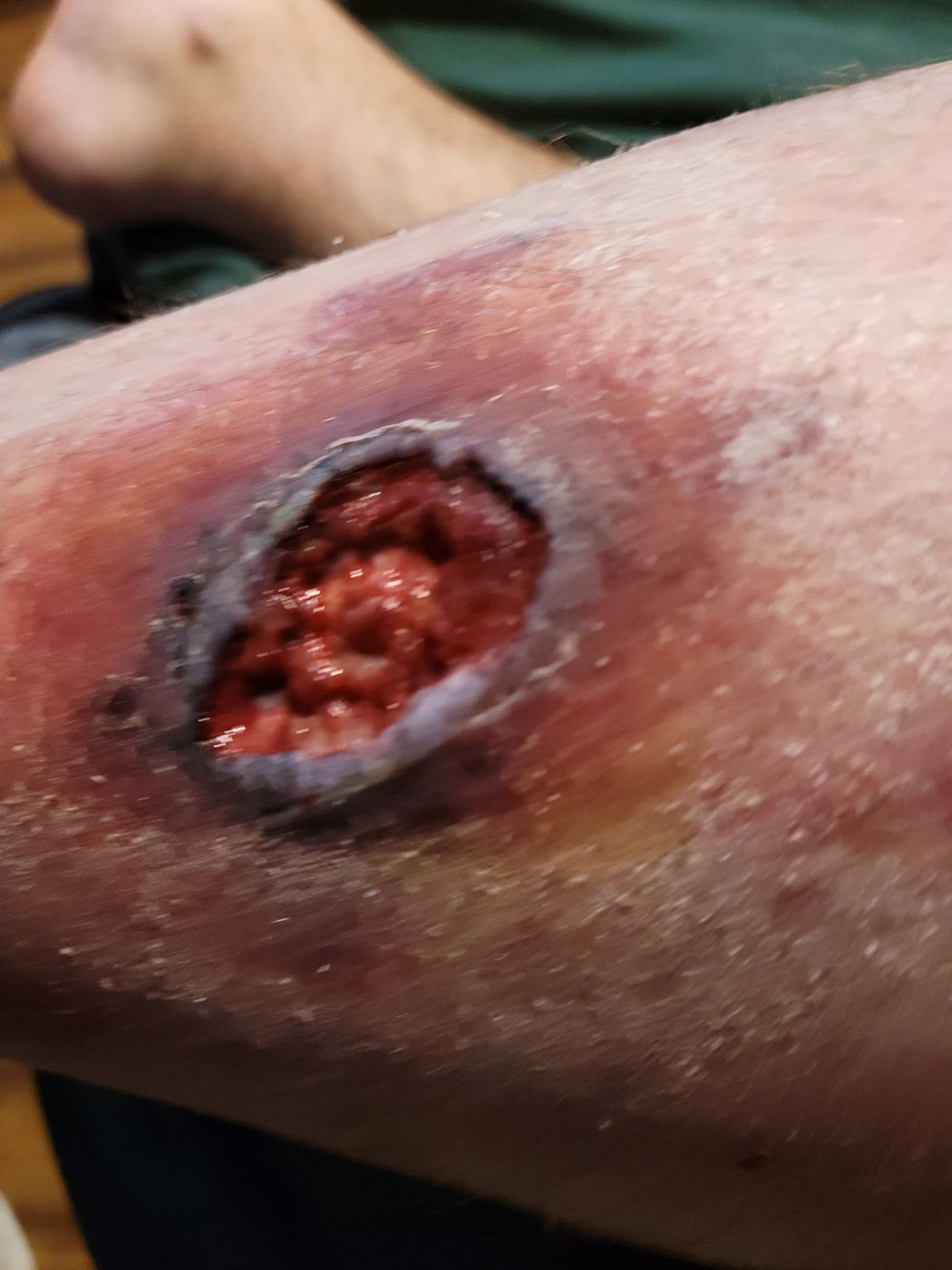
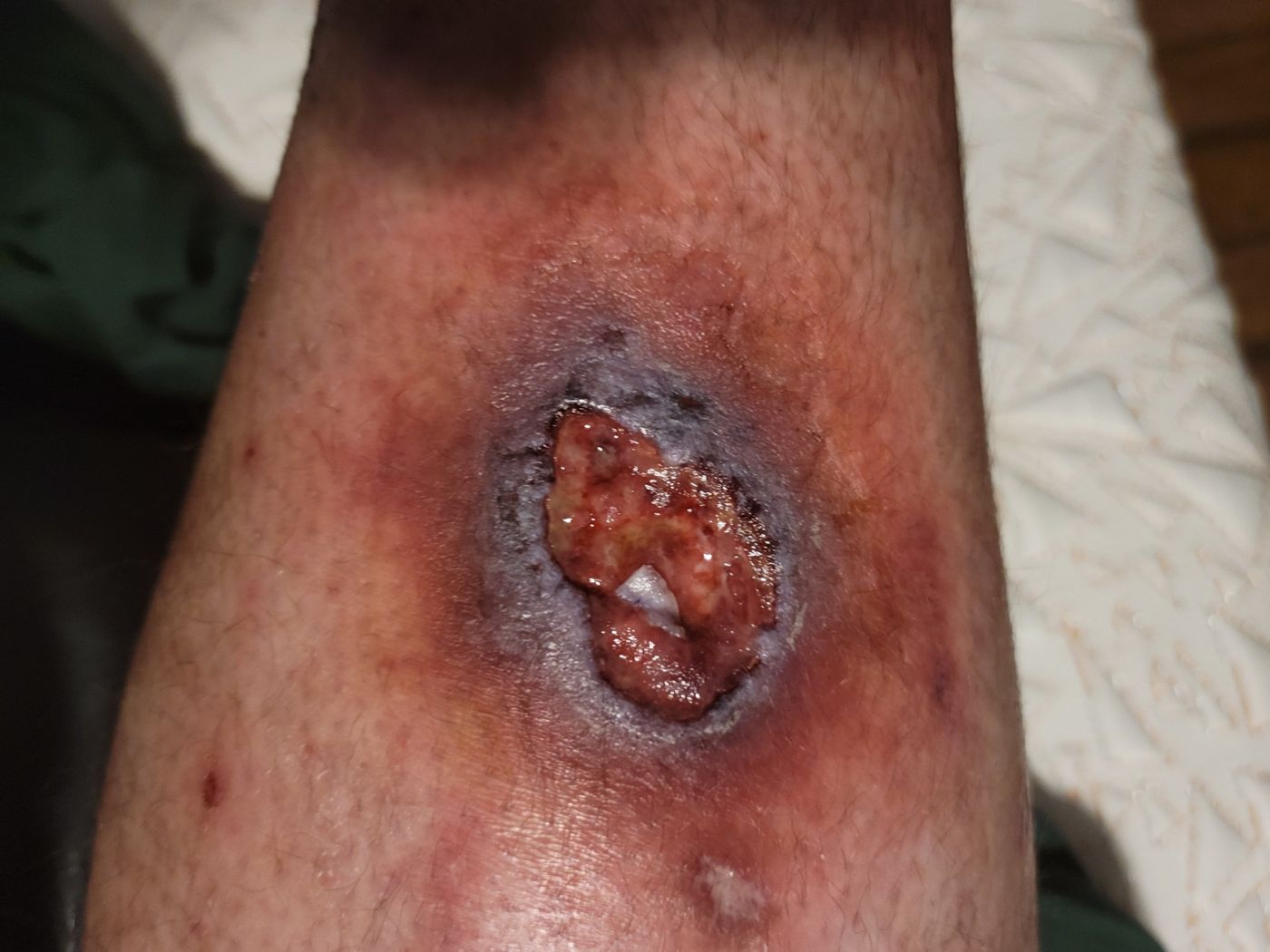
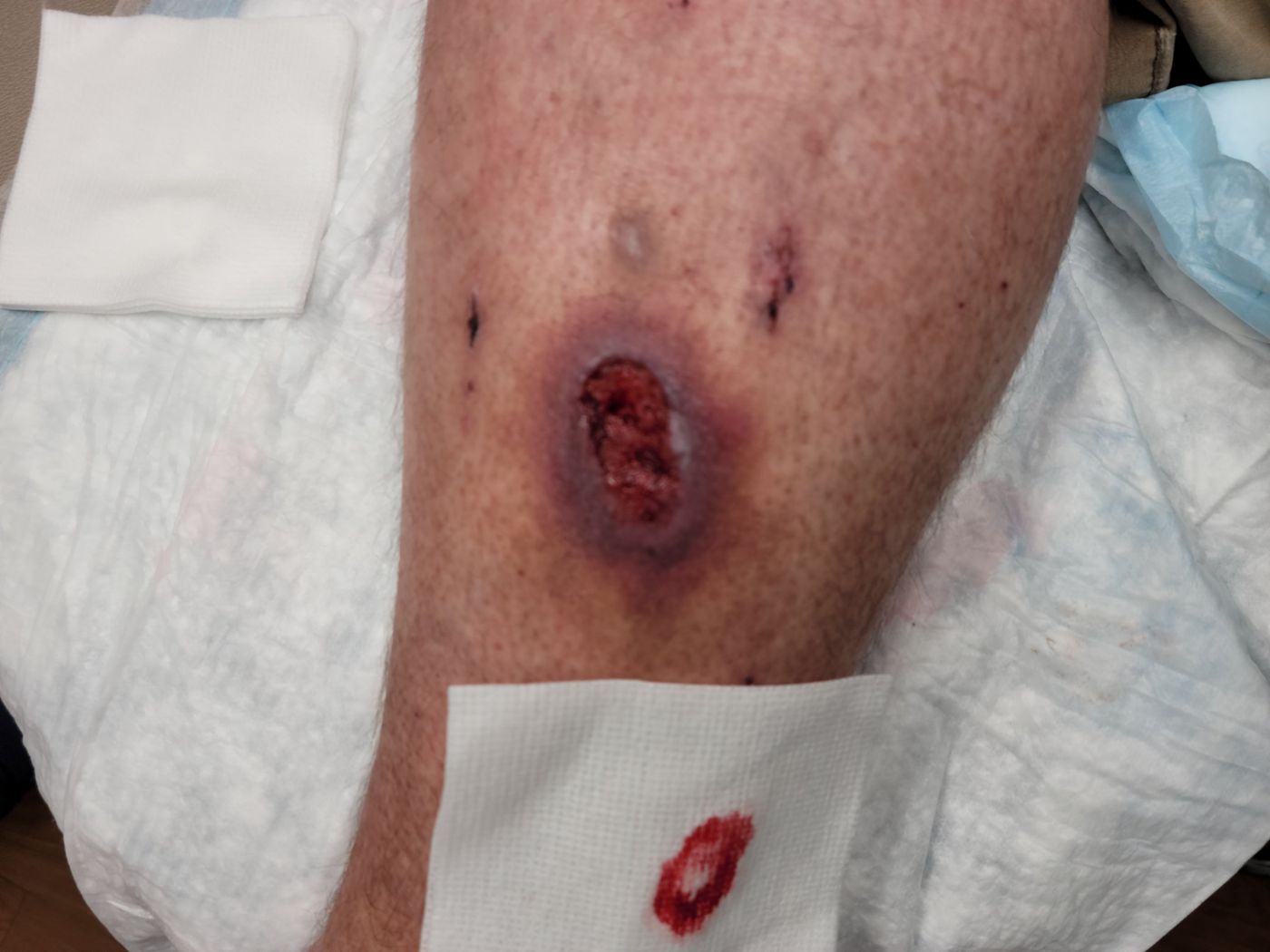
Michael's left calf, 2022. Individual dates to confirm.
Part Two · The Leg
Chapter 10
A Limb Lost
Feb 1–3, 2023 Record
At 11:07 that morning, he took one last photo of both legs. Later that day, Dr. Maggie Lin amputated the left leg above the knee.
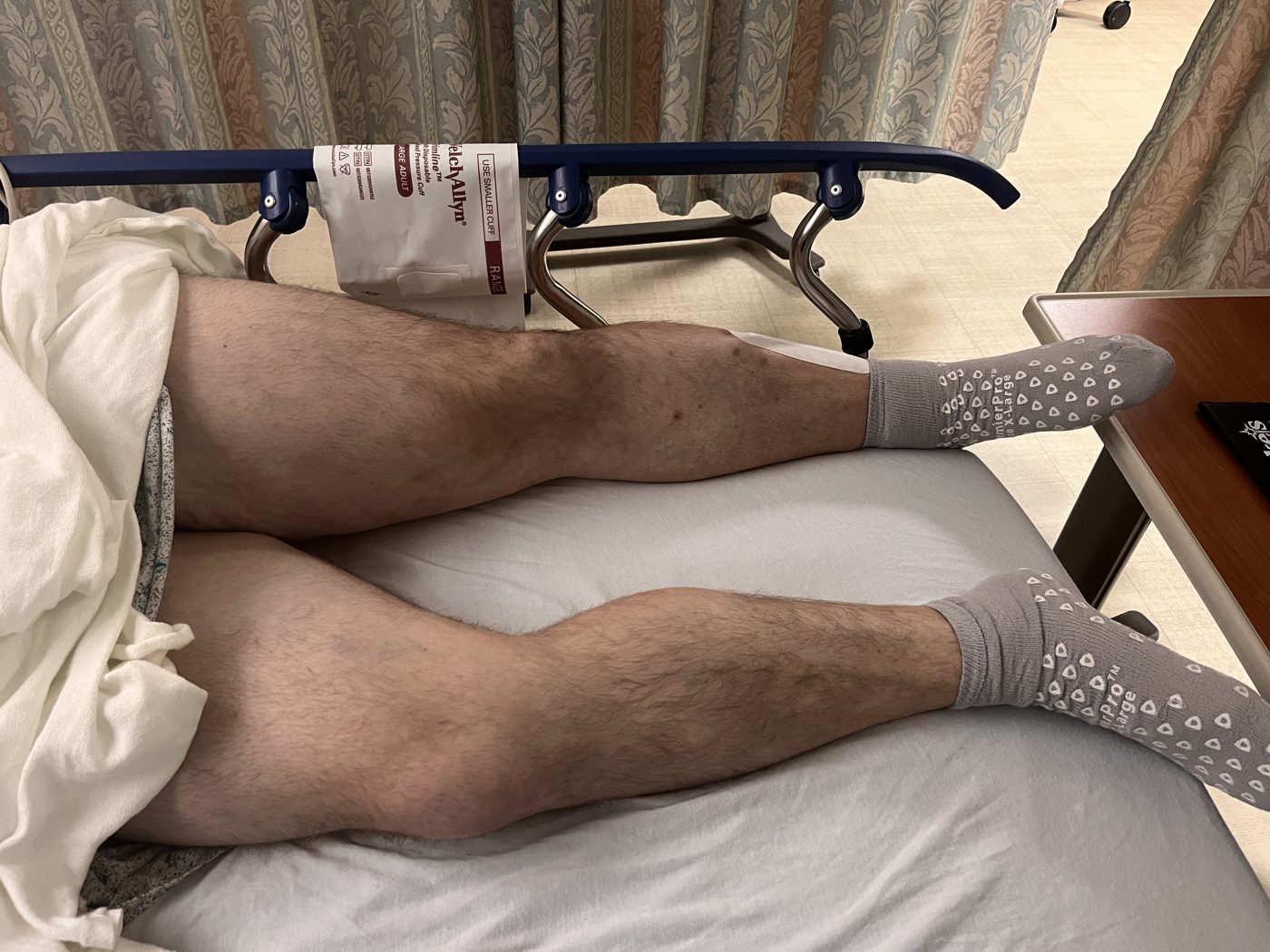
He has considered his options over the last several months and has decided to pursue left lower extremity amputation due to continued nonhealing and poor quality of life. Dr. Maggie Lin, 2/1/2023
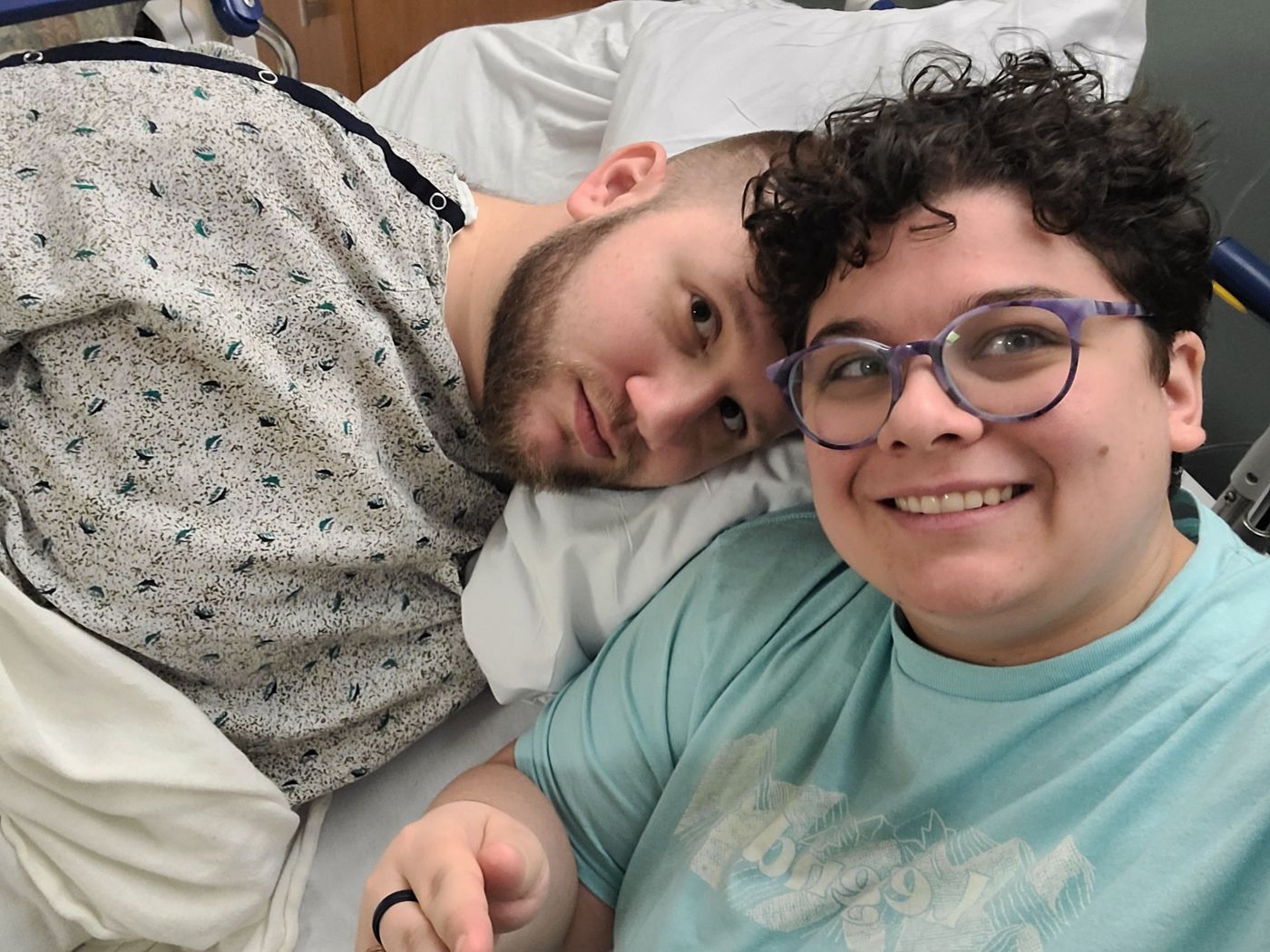
The next morning he was up and walking the hallway.
Chapter 11
Rebuilt to Earn Mobility
Mar – May 2023 Record
Six weeks after surgery, before he had any prosthetic, his physical therapist tested what he could do on one leg.
Per AMPnoPRO he is currently prospectively scoring at the upper K3 level… active lifestyle that involved regular running, weightlifting, and keeping up with his wife and young daughter. George Fischer, PT, St. Luke's, 3/16/2023 (AMPnoPRO 35)
Mike received his prosthesis on Tuesday and contacted our offices. Unfortunately, his change in insurance plan does not participate with SLUHN. George Fischer, PT, addendum signed 5/12/2023
Chapter 12
A Leg Denied
Jun – Sep 2023 Record
The learner knee's lock kept letting go. He fell, again and again. His physiatrist documented it and prescribed a microprocessor knee, the kind that senses a stumble and stiffens to catch it.
Unfortunately, there appears to be a problem with the locking mechanism of his polycentric knee in his training prosthetic. This has resulted in multiple episodes of the knee giving out and buckling causing falls. Dr. Sean T. Stockhausen, physiatry, 7/19/2023
Falls on old knee x ~ 20. Has had one fall since getting new prosthetic when he was walking his dog on hiking trail and knee gave out. Dr. Sean T. Stockhausen, 9/25/2023
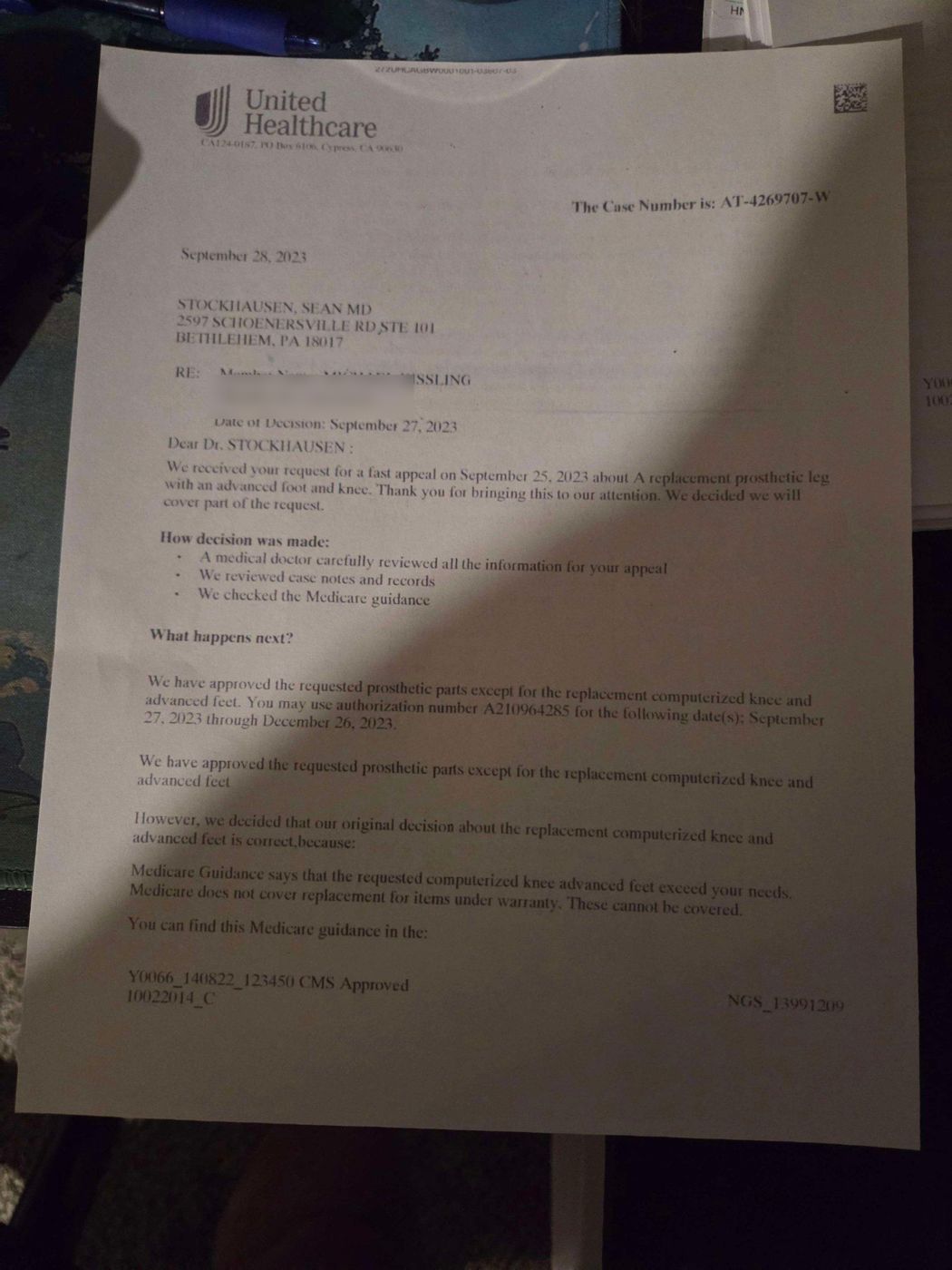
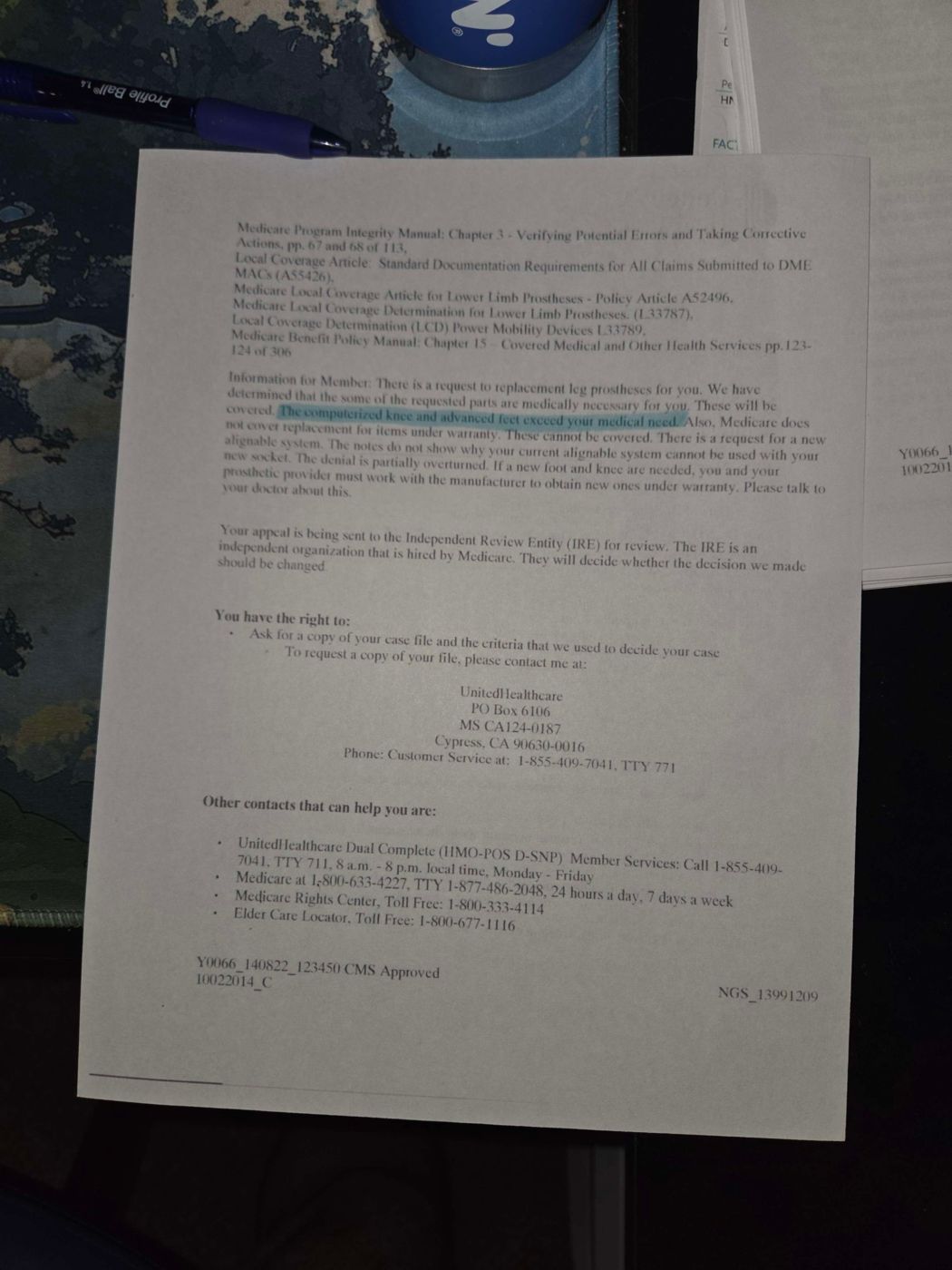
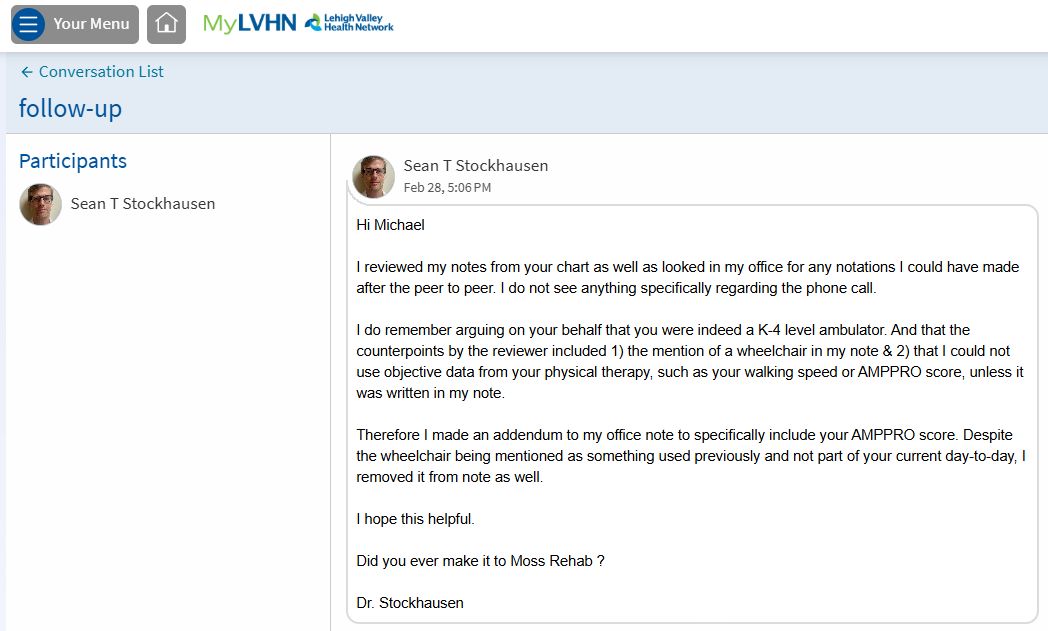
Medicare's rules cover a microprocessor knee at functional level 3 or above. His records had put him at upper K3 since March, and at K4 by September.
Chapter 13
The Denial Overturned
Sep 29 – Oct 2023 His account
The appeal went to Maximus, the independent reviewer Medicare hires. Maximus overturned UnitedHealthcare's denial with a decision dated September 29. UnitedHealthcare sent word by overnight mail on October 2. By early October, the definitive socket was in.
Chapter 14
Finding the Pain Source
Aug 2023 – Aug 2024 Record
In his PT notes from August 2023, while he was still on the learner leg, he reported soreness at the tip of the femur. By April 2024 he could wear the leg only about three hours a day, and was started on gabapentin. In June came an X-ray of the femur. By August, his surgeon had diagnosed a bone spur on the cut end of the bone.
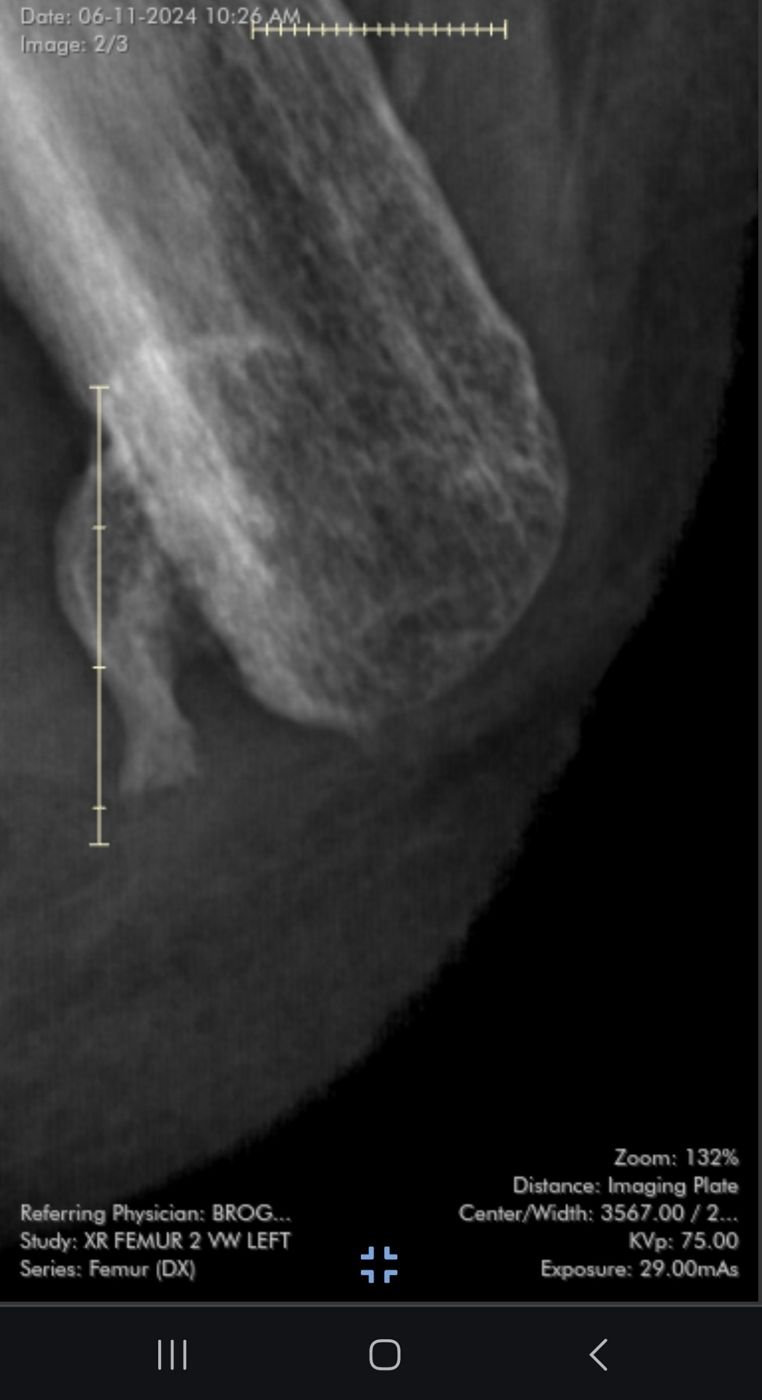
…subsequently had several falls and poor fitting prosthetic. He ultimately developed a bone spur and has been unable to use his prosthetic for the last 2 months and is severely limited by shooting pain… Dr. Maggie Lin, 8/8/2024
Chapter 15
Amputation Revision
Aug 19–21, 2024 Record
The revision was approved. Dr. Lin opened the limb, removed the spur and a fluid pocket around it, and took the femur back 2–3 cm to healthy bone. Two days later he went home.
Seroma evacuated underneath fascia with bone spur along posteromedial aspect of previously transected femur. Femur was taken back 2-3 cm to a healthy segment. Operative report, Dr. Maggie Lin, 8/19/2024
Chapter 16
The Coverage Scare
Aug 2024 His account Documents being gathered
The day after he left the hospital, UnitedHealthcare mailed a letter saying his Medicaid eligibility had changed. He was told he had no coverage, not even to have his staples and sutures removed.
In Michael's account, the Medicare Ombudsman, Pennsylvania Medicaid, and his Medicaid plan all later said his eligibility never lapsed. It was fixed after Rep. Susan Wild's office asked the Ombudsman to step in.
Chapter 17
The Unsafe Bathroom
Spring 2025 His account Complaint, 4/8/2025
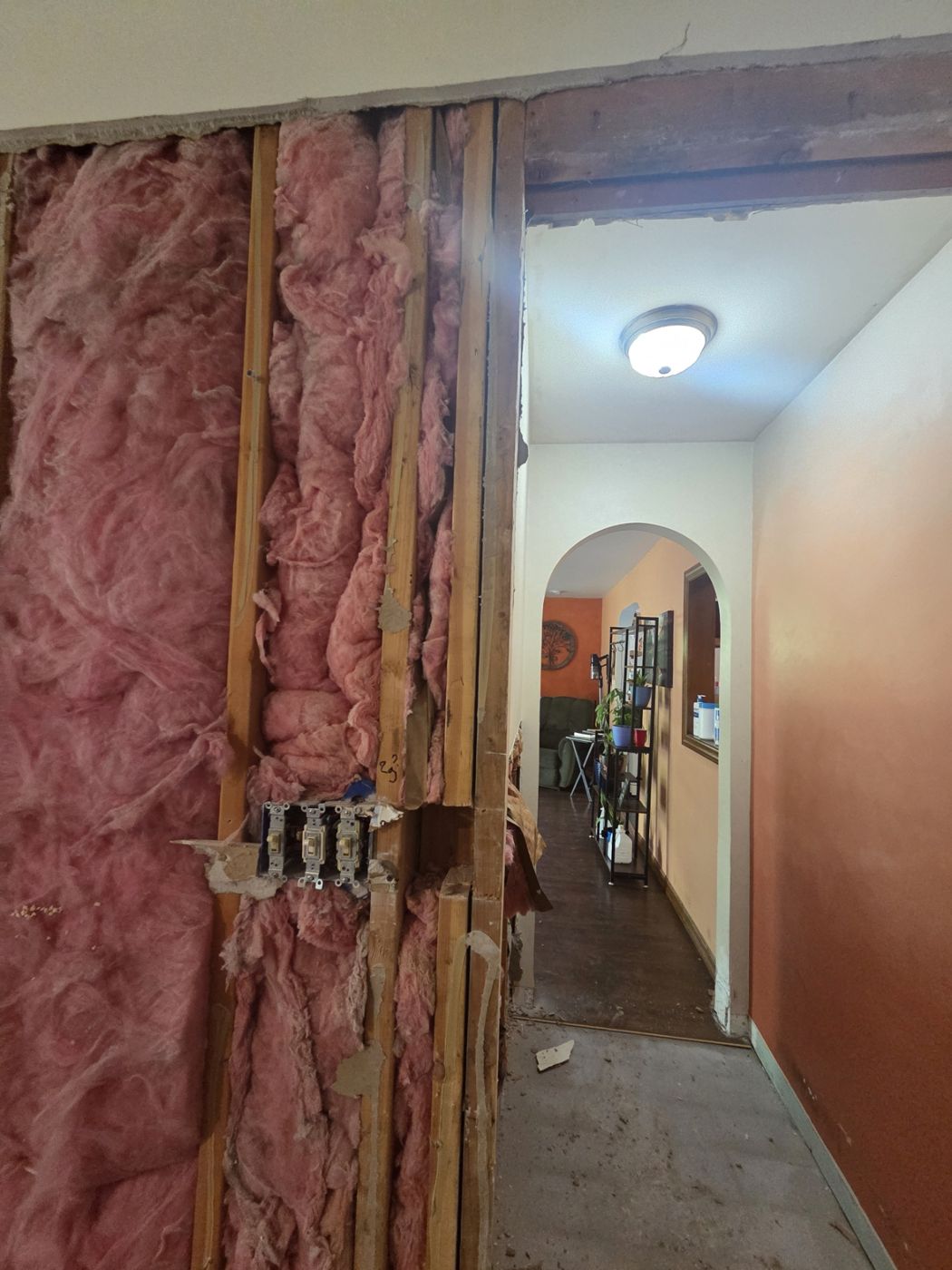
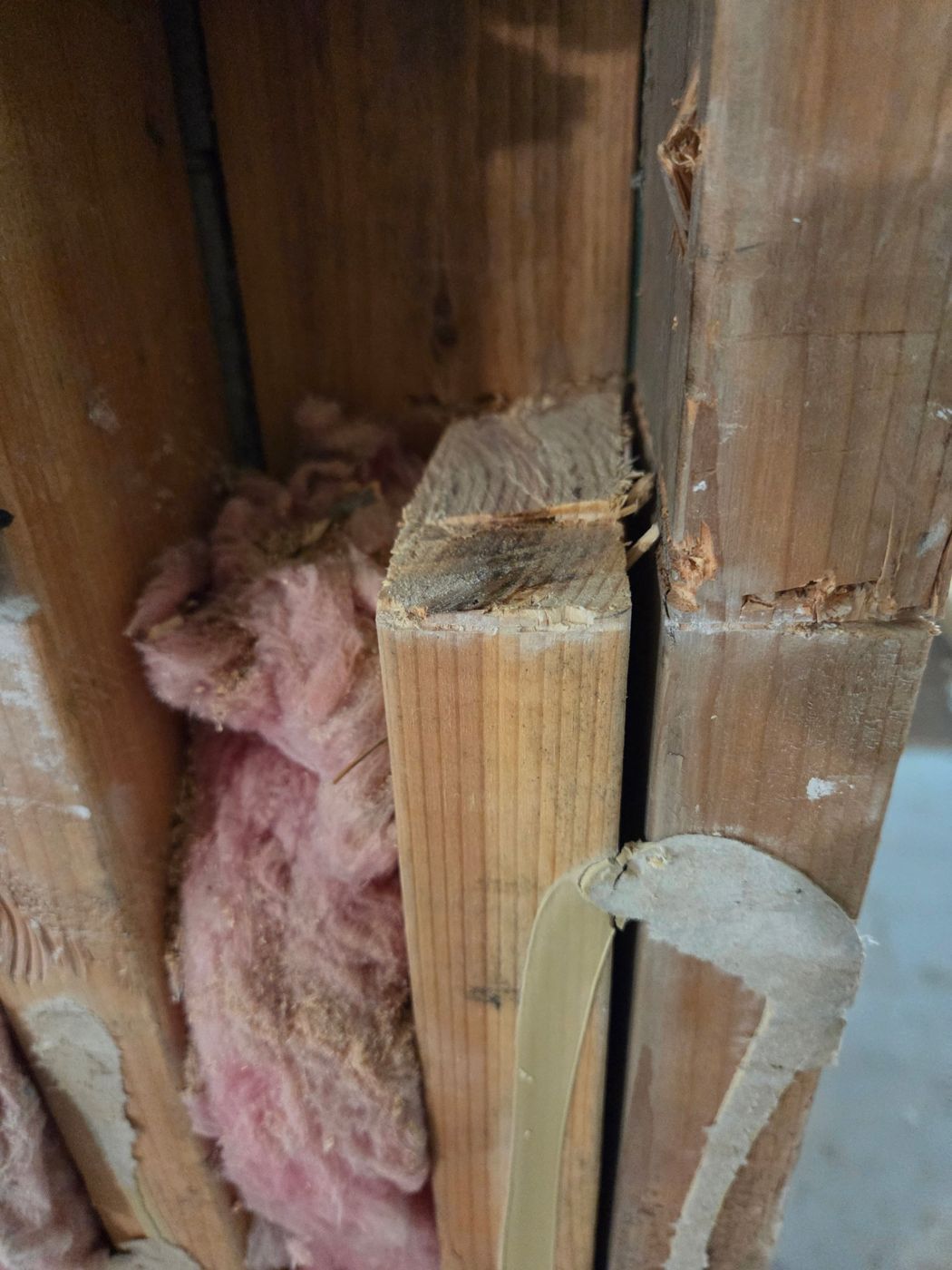
Losing a leg means rebuilding the house around it. Through his Medicaid plan, AmeriHealth Caritas, the family's bathroom was approved for an accessible remodel, about $28,000 of work. They were told it would take five days. Five weeks in, Michael sent a 37-page complaint with photos.
The shower seat's arms were held by short screws into tile, with screws missing. One arm broke off when he rested on it. The floor sloped water away from the drain. The sink counter sat on L-brackets and bare 2x4s. A doorway meant to widen to 38 inches for his wheelchair stayed the size it was.
He knew what a failed shower chair meant. On February 16, 2023, two weeks after the amputation, a donated shower chair broke under him and he landed on the stump. Ten days later he fell again, when his over toilet commode's legs bent when he leaned forward, and that fall put him in the hospital with bleeding inside the residual limb.
Patient is s/p 2 falls - 1. 2/16/2023- he fell from a shower chair when it broke and landed on the stump, 2. 2/26/2023 - patient fell off a commode. Physical therapy evaluation, St. Luke's, 3/16/2023
The part that went right
The home-modification broker, Accessible Solutions Brokerage, reviewed the complaint, found it valid, and removed the original contractors. Its project manager, Seth Werner, brought in a crew that did the job right, and found problems beyond the ones in the complaint.
Part Three · With the Right Tools
Chapter 18
Recovering, Advocating
Dec 2024 – Nov 2025 Record
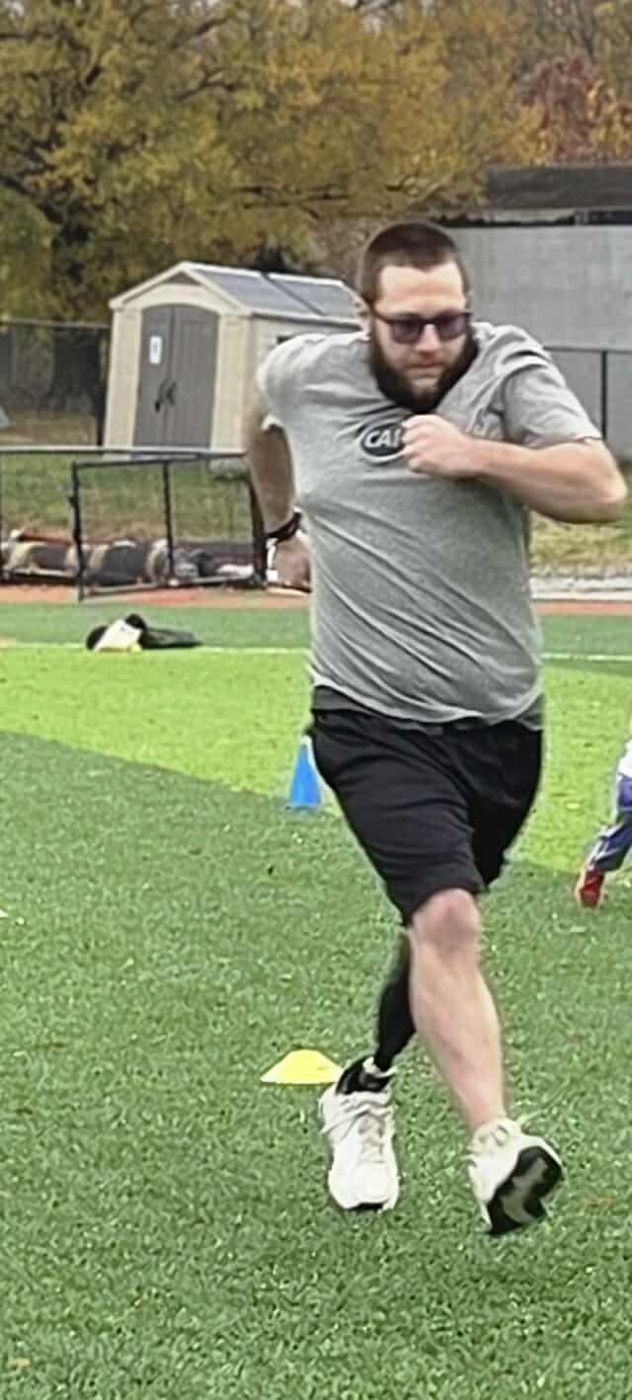
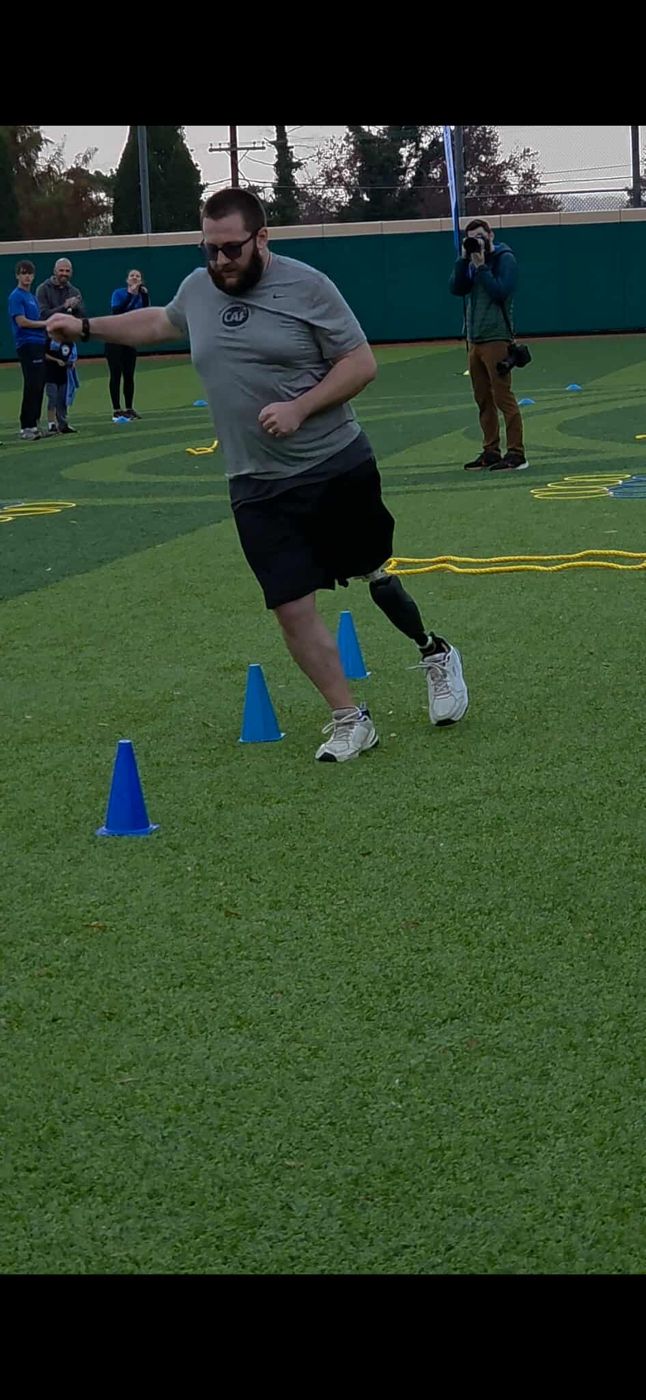
Four months after the revision, on Christmas Eve, he was doing step-ups onto plyo boxes. Less than a year after that, he was at a running clinic run by Össur, the company that makes his knee, with the Challenged Athletes Foundation.
On November 9, 2025, at the Össur + CAF Running and Mobility Clinic at the Washington Nationals Youth Baseball Academy, he ran cone drills on his Rheo microprocessor knee, worked the agility ladder, and ran the obstacle course. Slowing down turned out to be a skill he had to learn, too.
About the fall on the course
Light rain on turf, a backward jog into a turn, and the prosthetic foot didn't land clean. He went down, got up, and finished the course. On the learner knee in 2023, the falls came from walking, about 20 of them.
Chapter 19
The Widowmaker
Dates to confirm
A saddle pulmonary embolism. This chapter is being documented.
Chapter 20
Survivor-Advocate
He began building AbilityForge so the next patient could have a map of the system, and hopefully create change so patients have better outcomes.
Read the PSI briefing (PDF) →With the right tools, people get better.
Same person, same drive. In July 2023, a knee that swung loose in his living room. In November 2025, cone drills at a running clinic. The difference was the equipment.