Case V
Michael Kissling
Allentown, Pennsylvania · UnitedHealthcareUnited HealthcareThe largest health insurer in the United States by revenue. UnitedHealth Group operates two primary business segments: UnitedHealthcare (health insurance) and Optum (pharmacy care… Medicare Advantage
Firsthand AccountThe Story
Michael Kissling was 15 when doctors at CHOP cleaned out his first DVT and found the defect behind it — May-Thurner syndrome, an artery pressing the main vein of his left leg shut. They would not stent a patient so young. Nine years later, at 24, the leg turned heavy and hard to move. At LVHN, three separate specialists worked him up and agreed on the fix: an iliac vein stent — a $2,000–$4,000 device, roughly $55,000 for the surgery to place it — with excellent patency if placed before chronic wounds set in. UnitedHealthcare denied it, after extracting the out-of-pocket maximum for the imaging that proved its necessity across two benefit years.
Over the next several years, UHC also denied ApligrafApligrafAn FDA-approved living cell therapy and bioengineered skin substitute used in chronic wound care, including diabetic foot ulcers and venous leg ulcers. — an FDA-approved wound care treatment cleared in 1998 and 2000 — for 17 months while non-healing wounds progressed. When Apligraf was finally approved, it closed the wounds in two weeks. It had taken 17 months and bone demineralization to get there.
On February 1, 2023, Kissling's leg was amputated above the knee. Pathology from the surgery described bone that had demineralized to a consistency "cuttable with a scalpel" — severe osteomyelitis caused by the prolonged wound care delays. His treating physician confirmed the amputation would not have been elective had the prior pathology been known; Kissling was "one bad step from compound fracture and deathDeaththe act of dying; the end of life; the total and permanent cessation of all the vital functions of an organism. by bleeding out" due to his anticoagulant therapy.
The Prosthetic Denial — Prior Knowledge Omission Documented
K-Level — Medicare assigns each amputee a functional classification (K0–K4) that determines prosthetic eligibility. What is a K-Level? →
Six weeks after the amputation, UHC approved a learner prosthetic — officially acknowledging Kissling's K3 functional mobility status (AMPnoPRO score: 35). This classification became mandatory knowledge in UHC's possession. Six months later, UHC denied the transition to a permanent tertiary prosthetic, claiming Kissling did not demonstrate sufficient functional ability to qualify.
UHC approves learner prosthetic — officially establishing K3 functional mobility status. This is mandatory knowledge in UHC's possession.
Six days after K3 establishment, UHC changes the beneficiary's plan — making all existing physicians and physical therapists out-of-network. Care continuity disrupted.
UHC denies permanent prosthetic — claiming insufficient functional ability — while possessing the K3 approval and an updated K4 physical therapy evaluation (AMPnoPRO: 44/47). UHC's reviewing physician explicitly refuses to acknowledge the K4 PT data because it was not written in his specific office note.
UHC final denial letter, signed by Senior Appeals Representative Christopher Toland, states: "Medicare Guidance says that the requested computerized knee advanced feet exceed your needs" — issued with documented prior knowledge that the patient was K3–K4, in direct violation of Medicare Policy Article A52496.
Maximus Federal Services (Independent Review Entity) immediately overturns UHC's denial. Finding: medically necessary. This overturn is equivalent to summary judgment — UHC's position was indefensible.
Medicare lowers the microprocessor knee standard from K3 to K2 — meaning Kissling would have qualified under even the future relaxed standard. UHC's denial had no medical or regulatory basis at any point in time.
The Smoking Gun — Dr. Stockhausen's Written Documentation
The attending physician, Dr. Sean T. Stockhausen, documented in writing that during the peer-to-peer reviewPeer-to-Peer ReviewA call between the treating physician and the insurer's medical reviewer to appeal a coverage denial., the UHC reviewing physician:
- Confirmed he remembered arguing that the patient was K4
- Stated he could not use the objective PT data — including walking speed and AMPnoPRO score — because it was not written directly in his own office note
- Subsequently amended his own office note specifically to include the AMPnoPRO score
This is the Wrongful Denial Echo Chamber documented by the treating physician in writing: standardized, Medicare-approved assessment scores excluded on a procedural pretext manufactured by the corporate reviewer. Under Medicare LCD L33787LCD L33787A Local Coverage Determination issued by Medicare Administrative Contractors governing skin substitute coverage — including Apligraf. and Policy Article A52496, only one of three qualifying conditions was required for prosthetic replacement. Kissling met all three. UHC's reviewer knew this and denied anyway.
The Park
While using the inadequate learner prosthetic — the one UHC denied replacing — Kissling took his autistic daughter to a park. She became distressed and bolted toward the parking lot. He tried to run after her. The learner prosthetic failed. He nearly fell. He had to remove the prosthetic entirely. He could not reach her in time.
Another parent intervened and stopped her before she reached traffic.
Kissling has not taken his daughter outside alone since that day. UnitedHealthcare's denial removed his fundamental capacity to protect his child in an emergency. He has documented this in federal submissions. This is one of the damages in his case.
The Taxpayer Cost
The Wrongful Denial Echo Chamber does not save money. It transfers costs from the insurer onto taxpayers and onto the patient's body:
- A denied $55,000 stenting surgery triggered cascading wound failures over years
- 17 months of Apligraf delays allowed wounds to progress to bone-level infection
- The resulting amputation, revision surgeries, wound care, HBO therapy, prosthetics, and ongoing treatment costs: over $1.1 million in taxpayer-funded medical costs — and climbing
- Two university withdrawals: Kutztown University (3.92 GPA, Public Administration / paralegal) and Full Sail University (4.0 GPA, Course Director Award in Programming)
The $55,000 denial became $1.1 million in taxpayer costs. The insurer paid nothing. The patient paid with his limb. The public paid with their taxes.
What This Case Is Doing
In March 2026, Kissling submitted a formal briefing to the Senate Permanent Subcommittee on Investigations detailing the Prior Knowledge OmissionPrior Knowledge OmissionA denial issued without referencing documented clinical evidence already present in the patient's medical record that establishes medical necessity. mechanism as a documented, prosecutable fraud pattern — with a timestamped paper trail, physician corroboration, and an IRE-validated overturn as the evidentiary foundation.
The Clinical Integrity & Patient Safety Amendment — proposed as an addition to S.3829 — was drafted directly from this case. The Amendment's § 1 (Prohibition of Prior Knowledge Omission) names exactly what happened here. The § 5 Malpractice Trigger would have made the reviewing physician's refusal to acknowledge the K4 PT data a reportable act to the State Medical Board the moment Maximus overturned the denial.
Read the full PSI Briefing and Clinical Integrity Amendment in The Remedy Room →Ways We've Tried to Get the Message Out
Spreading awareness through media outreach is how this story has reached a wider audience — and how it continues to move.

Shadowbanned Magazine — "Delay, Defend, Depose"
Issue 04's feature investigation traces the full arc of this case: the first clot at 15, years of denied vascular care, the amputation at 29, and the fight for a prosthetic that should never have required a fight. It is the most complete single account of this case in print. Read the full article →
Original reporting by Shadowbanned Magazine. Editor: Sydney Ziems. Linked with attribution.
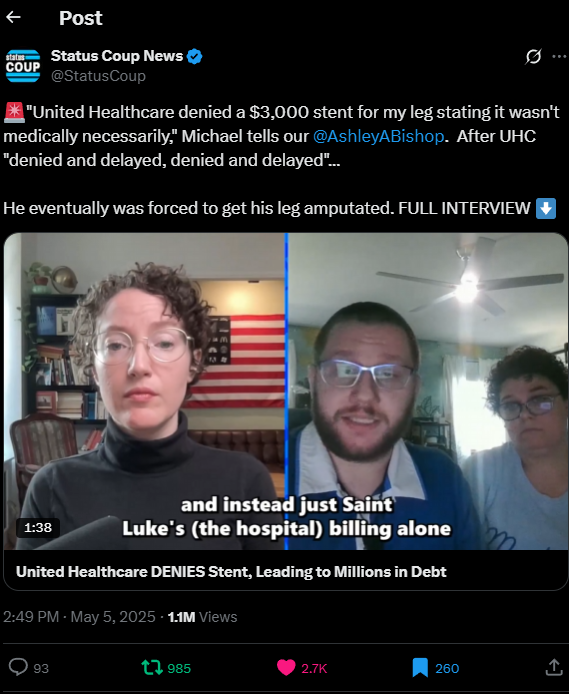
Status Coup News Interview
This interview brought national attention to the human costHuman CostThe aggregate framework for documenting what wrongful denial actually produces — not claim statistics or appeal rates, but life outcomes. of insurance denials, reaching over 1.1 million viewers. Watch the full one-hour interview here.
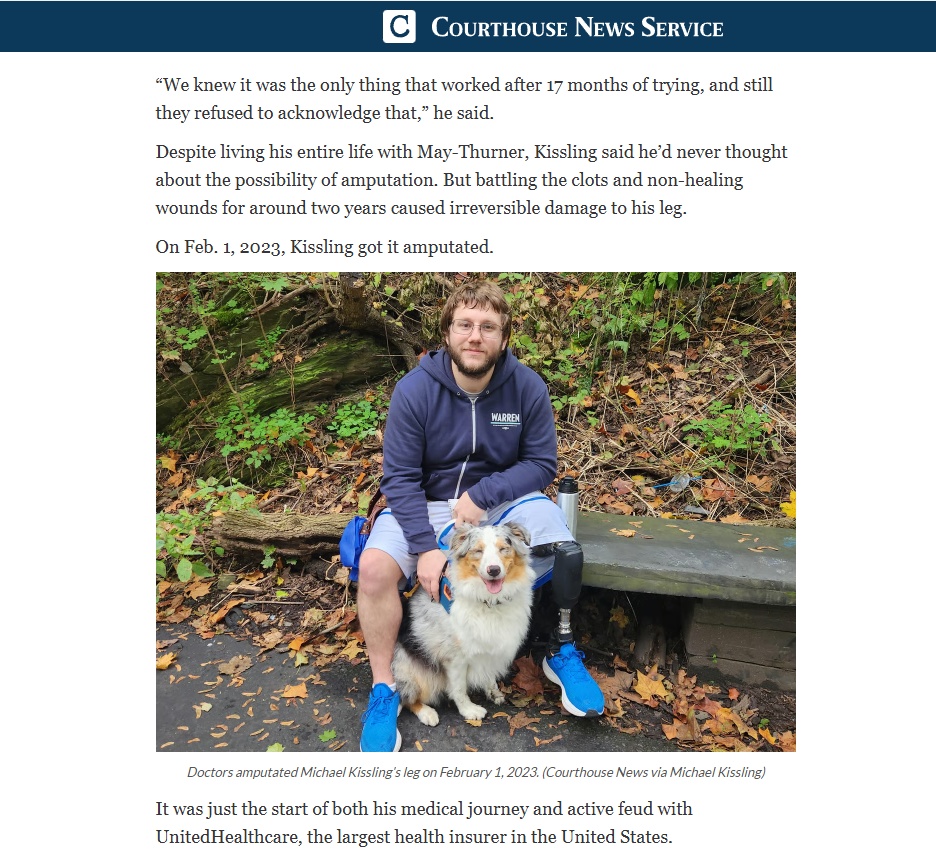
Courthouse News Service Feature
This feature detailed the long battle with UnitedHealthcare, explaining how years of denied care for non-healing wounds ultimately and unnecessarily led to amputation.
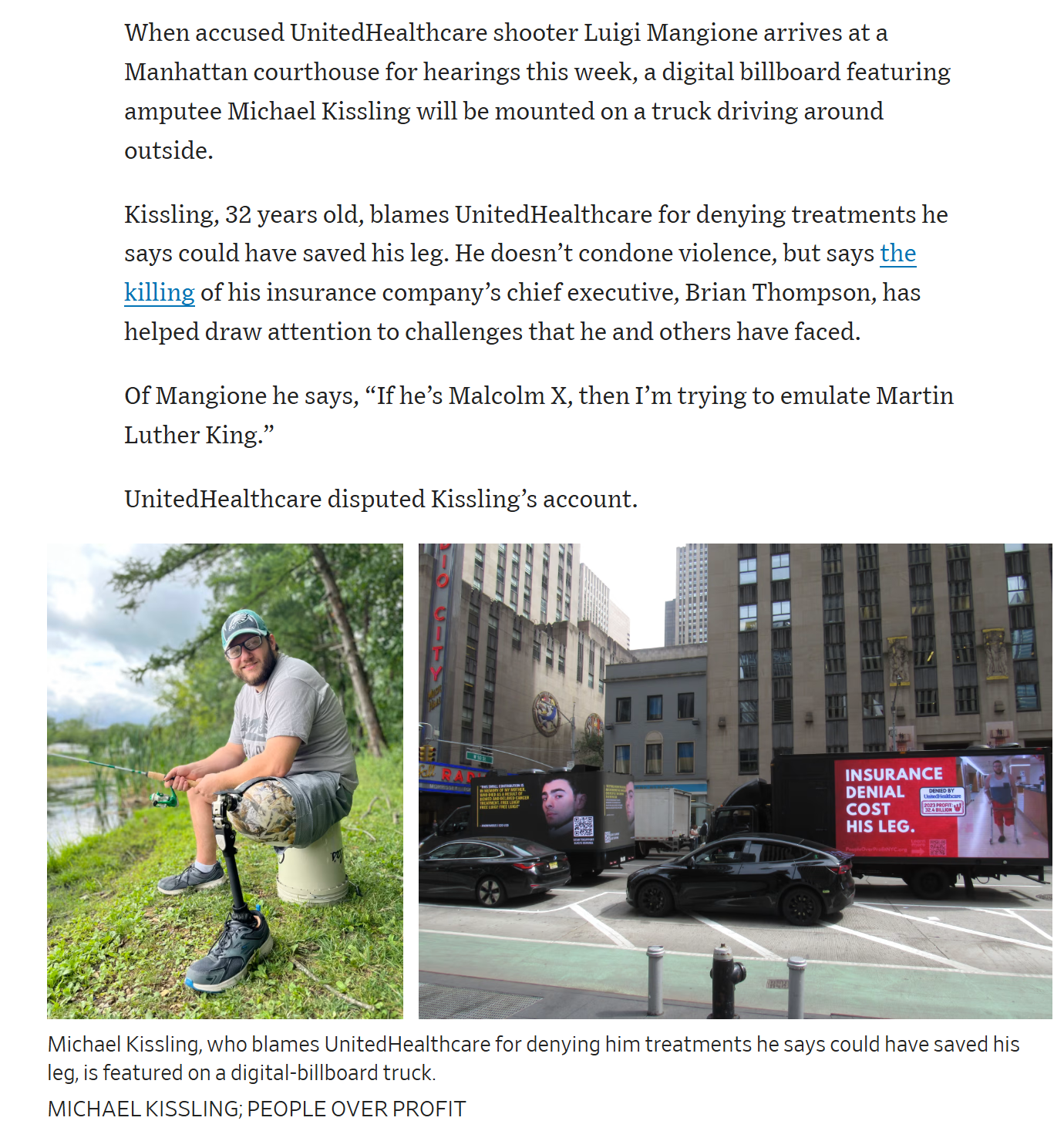
Wall Street Journal Feature
The Wall Street Journal featured Michael Kissling and the mobile billboard campaign in its coverage of the national response to the UHC CEO shooting. On Mangione: "If he's Malcolm X, then I'm trying to emulate Martin Luther King."
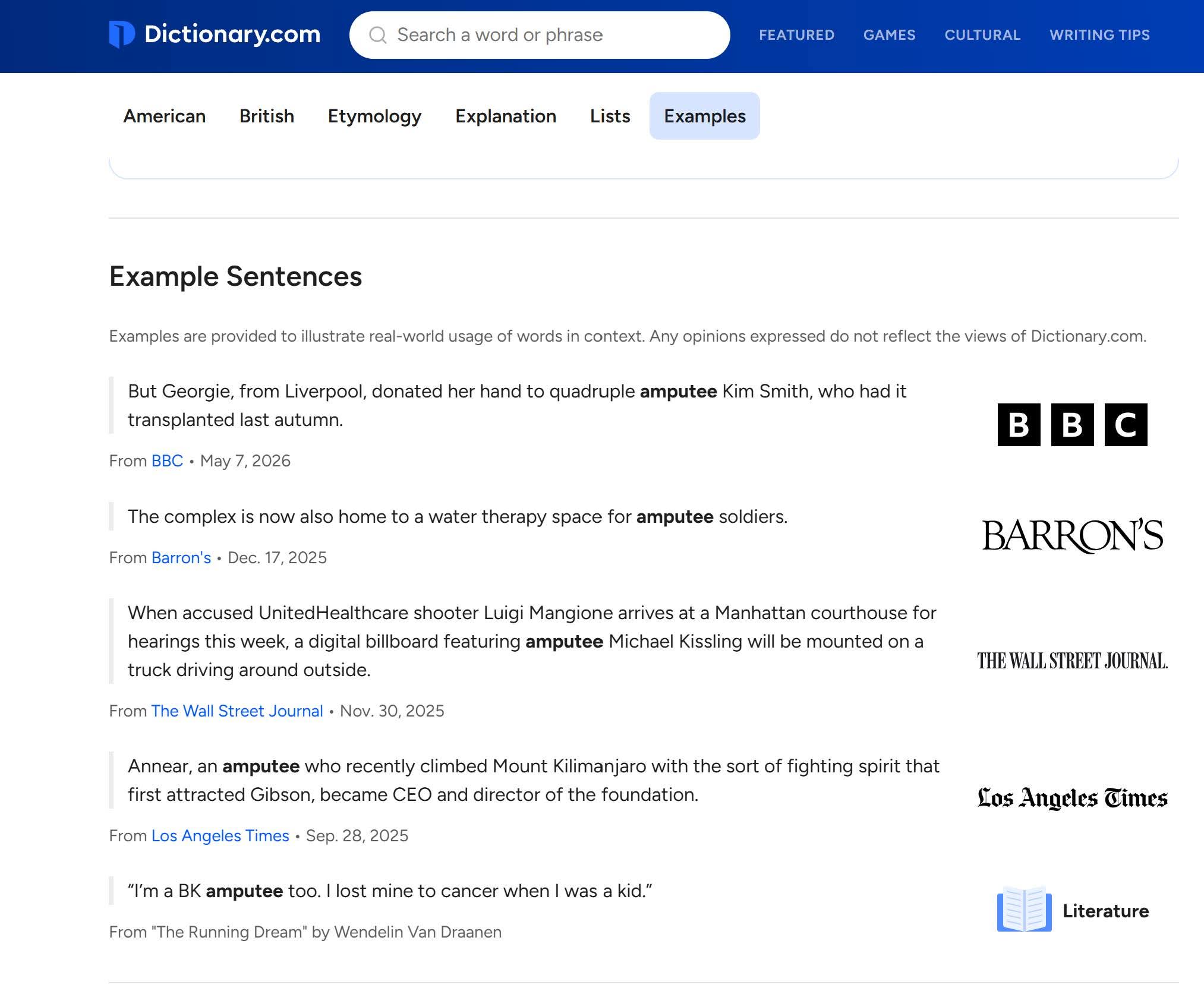
Dictionary.com — the Definition of “Amputee”
It came full circle. Dictionary.com now uses the Wall Street Journal line as a real-world example sentence for the word amputee — listed beside the BBC, Barron’s, and the Los Angeles Times: “…a digital billboard featuring amputee Michael Kissling will be mounted on a truck driving around outside.” From fighting a wrongful denial to helping define the word itself.
Mobile Billboard Campaign
In partnership with People Over Profit, this mobile digital billboard took the stories of insurance denial directly to the streets, confronting corporate headquarters with the human cost of their policies. Learn more about the campaign here.
Criminal Justice Journalists — "As Mangione Faces Court for Killing, Many View Him as a Folk Hero"
This piece from Criminal Justice Journalists documented the broader public response to the Thompson killing — including the role of advocates like Kissling in channeling that anger toward legislative reform rather than further violence. Read the article → · Download PDF →
Primary Sources
Has this happened to you?
Every documented case adds to the evidentiary record. Your story matters.