
The Plan
Forever does not have to mean forever. The regulatory tools exist. The medical science is advancing. The legal accountability is moving through courts. What the plan needs now is political will that doesn't reverse course when industry pushes back.
Updated federal momentum
Congressional bill H.R. 3639 — the VET PFAS Act — adds bipartisan weight to the Plan by recognizing PFAS harms for veterans, dependents, and family members at contaminated installations.
⚠ The Plan Is Under Active Attack
In 2024, the EPA finalized the first enforceable maximum contaminant levels for PFAS in drinking water — 4 ppt for PFOA and PFOS. That standard is now being challenged. The current administration has signaled intent to rescind several of these limits, approved new PFAS-containing pesticides, and moved to narrow federal water protections while placing former industry lobbyists in the top four positions at the EPA's chemical safety office.
The victories documented on this page are real. So is the rollback. The plan requires active defense.
Table of Contents
The Regulatory Framework
EPA 2024 PFAS Rule
The 2024 EPA National Primary Drinking Water Regulation established enforceable maximum contaminant levels for six PFAS compounds — the first such limits in U.S. history. Key limits:
Compare: Willow Grove on-base wells — 13,700 ppt PFOS.
The Class-Based Argument
A major scientific review argues that regulating PFAS compound-by-compound is a failed strategy. With over 12,000 variants, manufacturers can simply switch to slightly modified alternatives and repeat the cycle.
Scientists are calling for class-based regulation — treating all PFAS as a single category — to close the substitution loophole that has allowed the industry to evade accountability for decades.
Read the Case for Class-Based Regulation →Medical Countermeasures
Cholestyramine: The Most Promising Treatment
A clinical trial published in Environment International (2024) demonstrated that Cholestyramine — an anion exchange resin originally developed as a cholesterol drug — can substantially decrease PFAS levels in the body. The mechanism interrupts the enterohepatic recirculation of PFAS, preventing reabsorption in the gut.
This is a landmark finding. For decades, PFAS contamination has been treated as an environmental problem with no clinical solution. Cholestyramine offers the first viable pathway to actually reduce body burden in exposed individuals.
Water Filtration: Anion Exchange Resin
The same chemical mechanism that makes Cholestyramine effective for body burden reduction also works at the water treatment level. Studies confirm that anion exchange resin treatment produces substantial decreases in PFAS levels in drinking water — offering both a source-control and a body-burden-reduction approach from the same class of technology.
German researchers have also developed nanoscale "covalent organic frameworks" — filter materials with pores just nanometers across that trap PFAS molecules. The material is produced using an environmentally sustainable ball-mill technique, offering a path toward industrial-scale filtration.
For Clinicians: PFAS Exposure Provider Guide
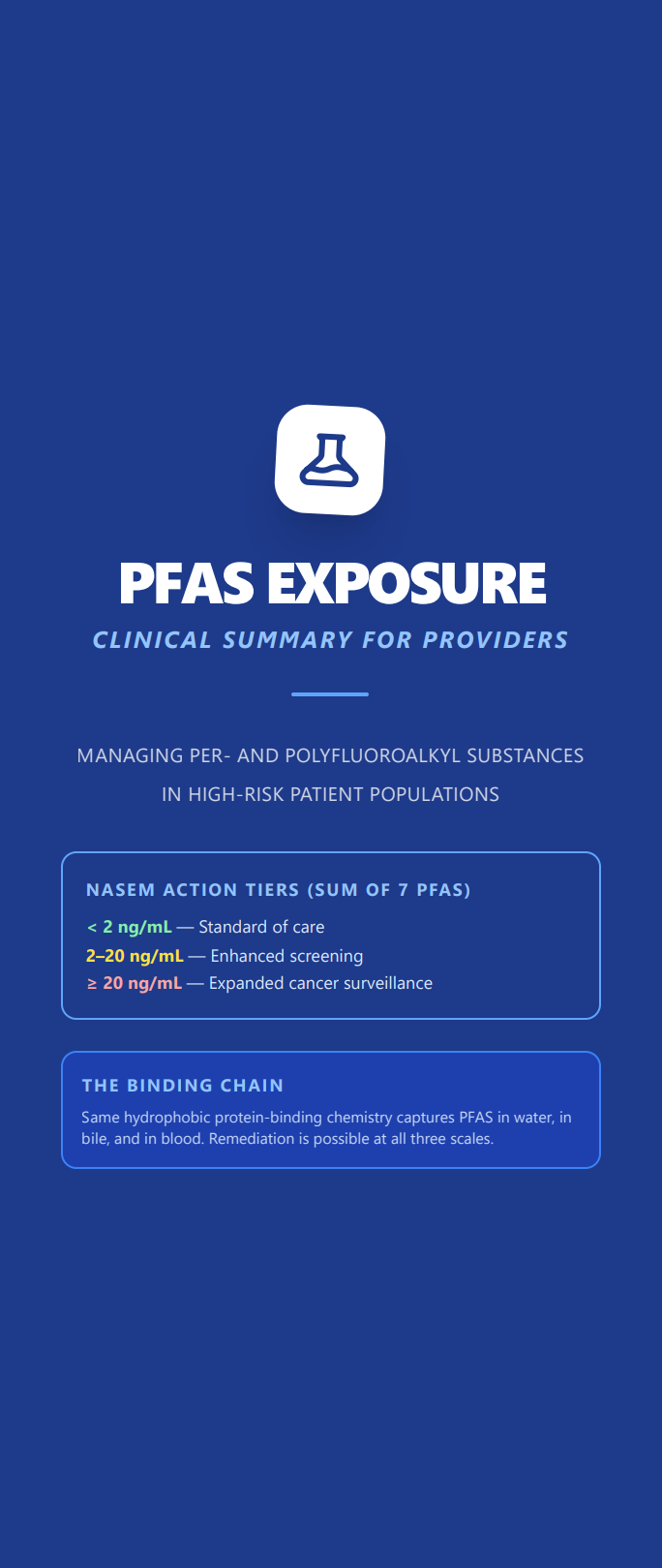
PFAS Exposure: Clinical Summary for Providers
A concise clinician reference for physicians and practitioners managing patients with potential PFAS exposure. Covers risk stratification, diagnostic protocol, remediation thresholds, and evidence-frontier findings not yet reflected in EPA/ATSDR guidance.
- ✓ NASEM 7-analyte summation panel protocol (Quest Diagnostics)
- ✓ Three-tier clinical action framework (<2 / 2–20 / ≥20 ng/mL)
- ✓ Cholestyramine sequestrant threshold and mechanism
- ✓ Enterohepatic loop disruption — the accessible intervention point
- ✓ Evidence frontier: HMGCS2 downregulation, NF-κB invasion pathway
- ✓ Veterans Note: VA service-connection precedent for Willow Grove NAS
AbilityForge Clinical Resource · v1.4
NASEM 2022 aligned · For clinicians and patients
Bio-Remediation: Nature's Filter
The same chemistry that makes PFAS persistent — its affinity for protein hydrophobic binding sites — is also the key to its removal. Naturally occurring proteins bind PFAS at the molecular level. This is not speculative. It is being confirmed in peer-reviewed research at the water source, in the gut, and in the bloodstream simultaneously.
Ovalbumin — Egg White Protein
Research published in Cell Reports Physical Science (2026) by teams at NDSU and Iowa State confirmed that ovalbumin — the primary protein in egg whites — binds PFOA and PFOS spontaneously at the atomic level. The arginine and lysine residues in ovalbumin act as molecular hooks, wrapping around and trapping PFAS molecules with high affinity.
- ✓ Binds 7+ PFAS types including PFOA and PFOS
- ✓ More efficient than activated carbon filtration
- ✓ Deployable as gels or sheets for municipal water treatment
- ✓ Bio-based, scalable, sustainable production pathway
The same protein-binding chemistry that makes PFAS persistent in the body is the mechanism used to extract it from water.
Okra — Natural Mucilage Filtration
Okra's natural mucilage — the viscous polysaccharide that makes it distinctive in cooking — has been identified as an effective, low-cost PFAS-binding agent for water filtration. The mucilage acts as a natural flocculant, capturing PFAS and other contaminants and allowing them to be separated from the water supply.
- ✓ Abundant, inexpensive, globally available crop
- ✓ Biodegradable — no secondary contamination from the filter itself
- ✓ Applicable at household, community, and municipal scale
- ✓ Represents an accessible remediation pathway for under-resourced communities near contamination sites
The communities most likely to be contaminated are often the least resourced to address it. Okra changes that equation.
The Binding Chain principle: The same hydrophobic protein-binding chemistry captures PFAS in water, in bile, and in blood. Remediation is possible at all three scales — water source, gut lumen, and blood serum. These are not three separate problems. They are one mechanism at three scales.
Legal Accountability: The Settlements Are Moving
$2B
New Jersey secured from DuPont, Chemours, and Corteva — largest environmental settlement in state history. Funds remediation at four major industrial sites.
$4.9M
Paid to 60,000 New Jersey water customers from 3M and Middlesex Water Co. This case may become a template for communities nationwide.
$4M
Columbus, Ohio received initial settlement from 3M and others. City Attorney: "These companies — not ratepayers — are on the hook for cleaning up their mess."
The VA Gap
While civil courts move forward, the VA still offers no presumptive service connection for PFAS-related cancers. Veterans are required to individually prove their cancer was caused by their service exposure — placing the full burden of proof on sick servicemembers while the VA states it is "reviewing scientific evidence."
Civil lawsuits are now defining the specific damage list that regulators are too slow to acknowledge. The legal record is building the case that the VA is not yet required to accept.
The Legislative Path
State-Level Movement
As of 2025, at least 14 states have passed legislation establishing PFAS remediation funds, phasing out AFFF use, or setting enforceable drinking water limits. Massachusetts, New Jersey, and others are models for state-level action that does not wait for federal movement.
The AFFF Ban
A ban on PFAS-containing AFFF has been legislated — but faces active efforts to delay implementation. The foam used at 630 military bases has been confirmed to contaminate drinking water or groundwater. Delaying the ban extends that contamination footprint in real time.
Cleanup Funding
The DOD has delayed PFAS cleanup at more than 100 military bases. Cleanup funding has been the subject of congressional battles — with documented efforts to cut remediation budgets alongside the contamination evidence. The cleanup roadmap exists. The appropriations remain contested.
VET PFAS Act: Bipartisan Momentum
House Bill H.R. 3639, the "Veterans Exposed to Toxic PFAS Act" or "VET PFAS Act," was introduced May 29, 2025. It has bipartisan sponsors from both sides of the aisle, and it explicitly expands the federal response to include veterans, dependents, and family members exposed at PFAS-contaminated military installations.
Key provisions in the bill include:
- Hospital care and medical services for veterans exposed to PFOA and other PFAS at covered military installations, even when direct causation is not fully documented.
- A new VA care authority for family members and dependents who lived at the same contaminated installations or were exposed in utero.
- A presumption of service connection for certain PFAS-related diseases and conditions, including high cholesterol, ulcerative colitis, thyroid disease, testicular cancer, kidney cancer, and pregnancy-induced hypertension.
- A federal standard for treating reserve-component service at contaminated sites as active-duty service for these benefits.
Case Study: Charles Desautel
Published With Patient Permission
Willow Grove NAS — A Veteran's Documented Exposure
Charles Desautel served at Willow Grove Naval Air Station — a confirmed PFAS contamination site where AFFF firefighting foam was used extensively. His PFAS blood panel, drawn December 2025, returned a NASEM summation of 9.06 ng/mL — placing him in the enhanced screening tier. But that number tells only part of the story.
PSA Trajectory — The Timeline of Institutional Failure
Normal range: <4.0 ng/mL. Annual PSA velocity >2.0 ng/mL is independently associated with significantly shorter time to death from prostate cancer. (D'Amico et al., NEJM)
Biopsy Result
Gleason 4+3
Grade Group 3 · 5/35 cores positive · Perineural invasion present · Right posterior medial dominant (75% core involvement)
PFAS Panel (Dec 2025)
9.06 ng/mL
NASEM summation · PFHxS 5.40 ng/mL (7–8 yr half-life) · Linear PFOS: assay interference — unmeasurable · Peak burden estimated 4–10× higher at exposure
Current Status
PET CT: Apr 24
NM PET CT Skull Base to Mid Thigh · Cholestyramine active · Treatment decision pending staging · VA service connection claim in process
The Lagging Indicator Problem — In One Person's Blood
Chuck's exposure at Willow Grove NAS occurred approximately 16 years before his blood was tested. PFHxS carries a 7–8 year serum half-life. At 16 years post-exposure, his current 5.40 ng/mL PFHxS back-calculates to an estimated 21–27 ng/mL at peak — for that single analyte alone. Linear PFOS, the compound most strongly associated with military AFFF and the primary Willow Grove contaminant, could not be measured due to assay interference from his active cholestyramine treatment.
His NASEM summation of 9.06 ng/mL today — more than a decade of decay into his cancer diagnosis — almost certainly represents a peak burden that cleared the ≥20 ng/mL expanded cancer surveillance threshold years before any clinician looked. The damage preceded the diagnosis. The diagnosis preceded the action. The action is now a race.
"I want people to know what was found. People can get blood testing. People can get treatment to remove the chemical. Hopefully that reduces cancer clusters. We need to clean it up as well so more people don't get sick."
— Charles Desautel, Willow Grove NAS Veteran · Published with permission
Are you a Willow Grove NAS veteran or family member? PFAS serum testing is available direct-to-consumer through Quest Diagnostics (NASEM 7-analyte panel). Cholestyramine, an existing approved medication, has been shown in a landmark randomized controlled trial to reduce PFOS serum levels by 60% in 12 weeks. The VA has recognized PFAS contamination at Willow Grove NAS as a qualifying exposure basis. You do not have to wait for the system to act first.
The Infestation & Final Truth
The Infestation & Final Truth
AbilityForge · Michael Kissling · 2026
Powerful cinematic hard rock · 95 BPM
Willow Grove NAS · Charles Desautel · PACT Act
Full Lyrics
This song was written on April 16, 2026 — The 1979 reference was written about by ProPublica.The 1996 date referenced in verse 2 is documented in the ATSDR Public Health Assessment for NASJRB Willow Grove. The name in the lyric is real. The data behind it is real. He gave permission to publish.
"Forever does not mean permanent — it means persistent."
The science exists. The treatment pathways are emerging. The legal accountability is moving. What the plan requires is political will that holds — and a public that understands what is at stake.