

The Affected
Every data point is a person. The science has finally caught up to what families downstream of Willow Grove have lived for decades. Here is the documented pathway — from contaminated water to the bodies of children not yet born when the foam first hit the ground.
Table of Contents
The Family Legacy
My father-in-law served at Willow Grove Naval Air Station. He now battles service-linked colorectal cancer. My wife lived near the base; she suffered severe preeclampsia during her pregnancy. Our daughter, born of that high-risk pregnancy, navigates autism every day.
This is not a cluster of bad luck. This is a documented biological chain of custody. The contamination traveled from the base through the groundwater, into the family's water supply, through the placenta, and into the next generation. The science below describes exactly how.
Maternal Transfer: The Breastmilk Pathway
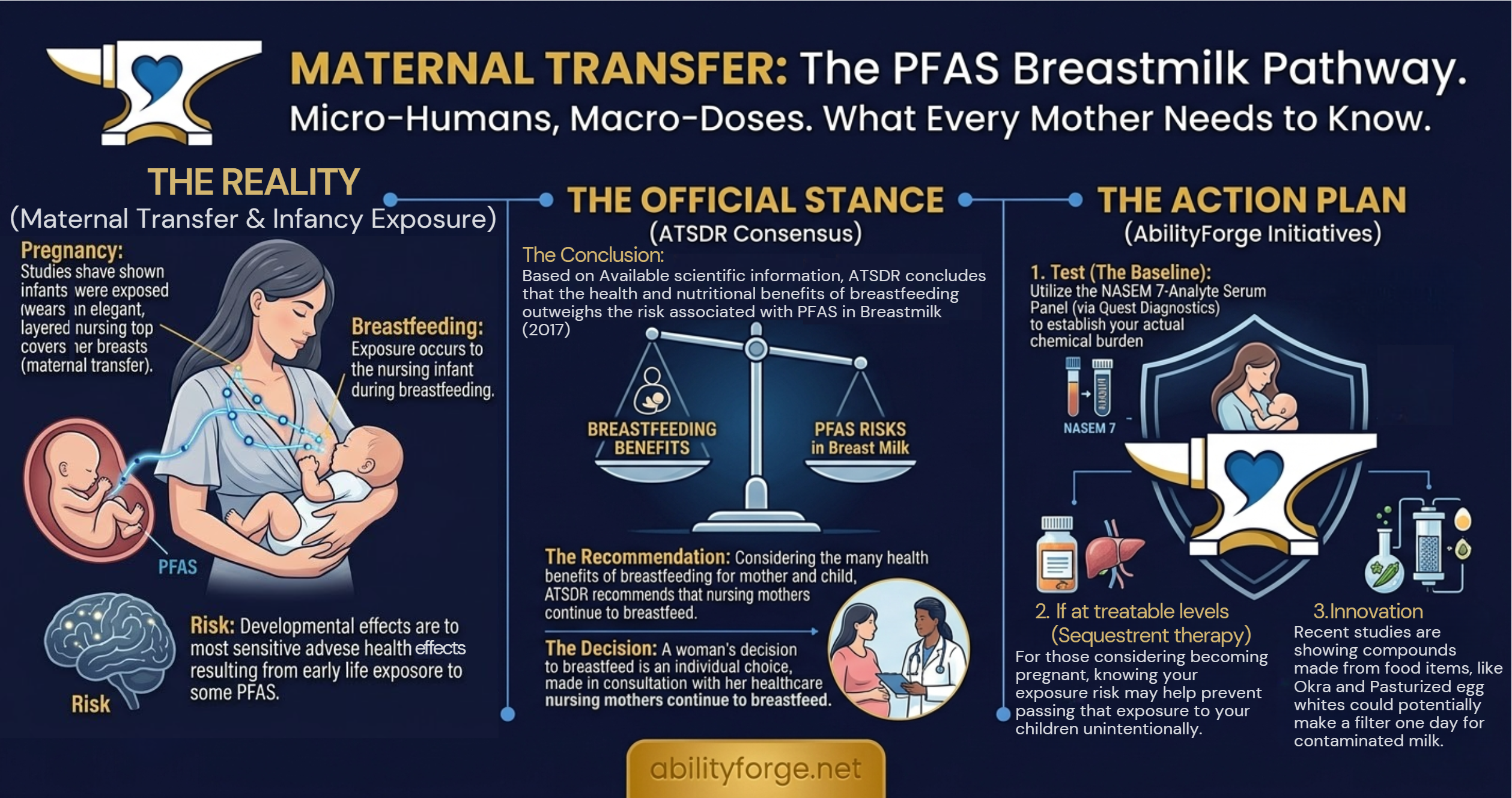
On the ATSDR recommendation: The official 2019 ATSDR guidance concludes that breastfeeding benefits outweigh PFAS risks and recommends nursing mothers continue to breastfeed. That guidance predates multi-study confirmed associations between early-life PFAS exposure and ASD/ADHD markers, and documented elevated infant mortality rates in communities downstream of confirmed contamination sites. The recommendation is not to stop breastfeeding — it is to reduce PFAS exposure at the source. The mother is not the variable. The contaminated water is.
The Biological Chain of Custody
1. The Placental Breach
We were told the placenta protects the unborn child. Research published in Environment International (2025) demonstrates that PFAS exposure causes "maternal vascular malperfusion" — structural damage to the placenta itself.
- Syncytial Knots: PFAS causes premature aging of the placenta, reducing oxygen exchange to the fetus.
- Reduced Intervillous Space: The chemical literally chokes off the supply line to the developing child.
- Documented Outcome: This damage is directly linked to preeclampsia and Small for Gestational Age (SGA) births.
"PFHxPA quantification was associated with an increase in the percentages of villi with syncytial knots... suggesting impaired fetal maternal exchange."
— Environment International, 2025
2. Transplacental Transfer
PFAS cross the placental barrier directly. Studies on transplacental transfer efficiency confirm that multiple PFAS compounds pass from maternal blood into fetal cord blood — delivering the contamination to the developing child before birth.
Transfer efficiency varies by compound but is documented across PFOS, PFOA, PFHxS, and other variants. The fetus cannot eliminate these compounds any more than the mother can.
3. The Toxic Inheritance: Breast Milk
A systematic review in Toxicological Sciences confirms a devastating finding: lactation is a cleaning mechanism for the mother, but a dosing mechanism for the child.
Mothers effectively offload their accumulated body burden of PFAS into their infants through breast milk. Studies show that longer breastfeeding duration is associated with significantly higher PFAS levels in infant serum. The very act of nurturing was hijacked to transfer the toxin to the next generation.
This finding does not recommend against breastfeeding — the nutritional and immunological benefits are documented and significant. It indicts the contamination, not the mother.
4. Neurodevelopmental Disruption
The Thyroid Mechanism
PFAS disrupt thyroid hormone function — specifically T4, which is critical for fetal brain architecture during development. Reviews in Current Environmental Health Reports link early-life PFAS exposure to:
- ADHD and Autism Spectrum Disorder
- Motor development delays
- Language development deficits
- Reduced cognitive performance scores
The Timing Problem
Fetal brain development is time-sensitive. Thyroid hormone disruption during critical windows cannot be compensated for later. The damage is not reversible.
This is why communities near contaminated military bases report elevated rates of autism and developmental disorders in children born to residents with documented PFAS exposure.
5. Carcinogenesis & Metabolic Disease
Prostate & Colorectal Cancer
Studies in Chemosphere (2024) and Nutrients document a compounding effect:
- PFOS downregulates HMGCS2, a key enzyme for gut microbiome health
- PFAS exposure combined with a high-fat diet synergizes to accelerate prostate and colorectal cancer development
- PFAS disrupts the body's natural tumor-suppression mechanisms
BPH and PSA Disruption
Additional research documents a linear, dose-dependent association between PFOS and the ratio of free PSA to total PSA — a key prostate health marker — and links PFAS exposure to benign prostatic hyperplasia (BPH).
The contamination does not produce a single disease. It shifts the metabolic environment in ways that accelerate multiple disease pathways simultaneously.
Diabetes & Metabolic Disease
Swedish studies have documented associations between PFAS exposure and Type 2 diabetes development, consistent with the broader endocrine disruption mechanism.
Female Reproductive Outcomes
Research links PFAS exposure to endometrial cancer, preeclampsia, and adverse female reproductive outcomes — including the preeclampsia documented in my family's case.
The Research Archive
The findings above are drawn from peer-reviewed studies compiled in the AbilityForge PFAS Research Archive — including studies on neurodevelopment, placental health, cancer mechanisms, and contamination patterns.
Access the Full PFAS Research Archive →